

[Op. 42]. Concerto For Piano and Orchestra [2-piano score]
![[Op. 42]. Concerto For Piano and Orchestra [2-pian](https://d3525k1ryd2155.cloudfront.net/h/198/384/1335384198.0.x.jpg)
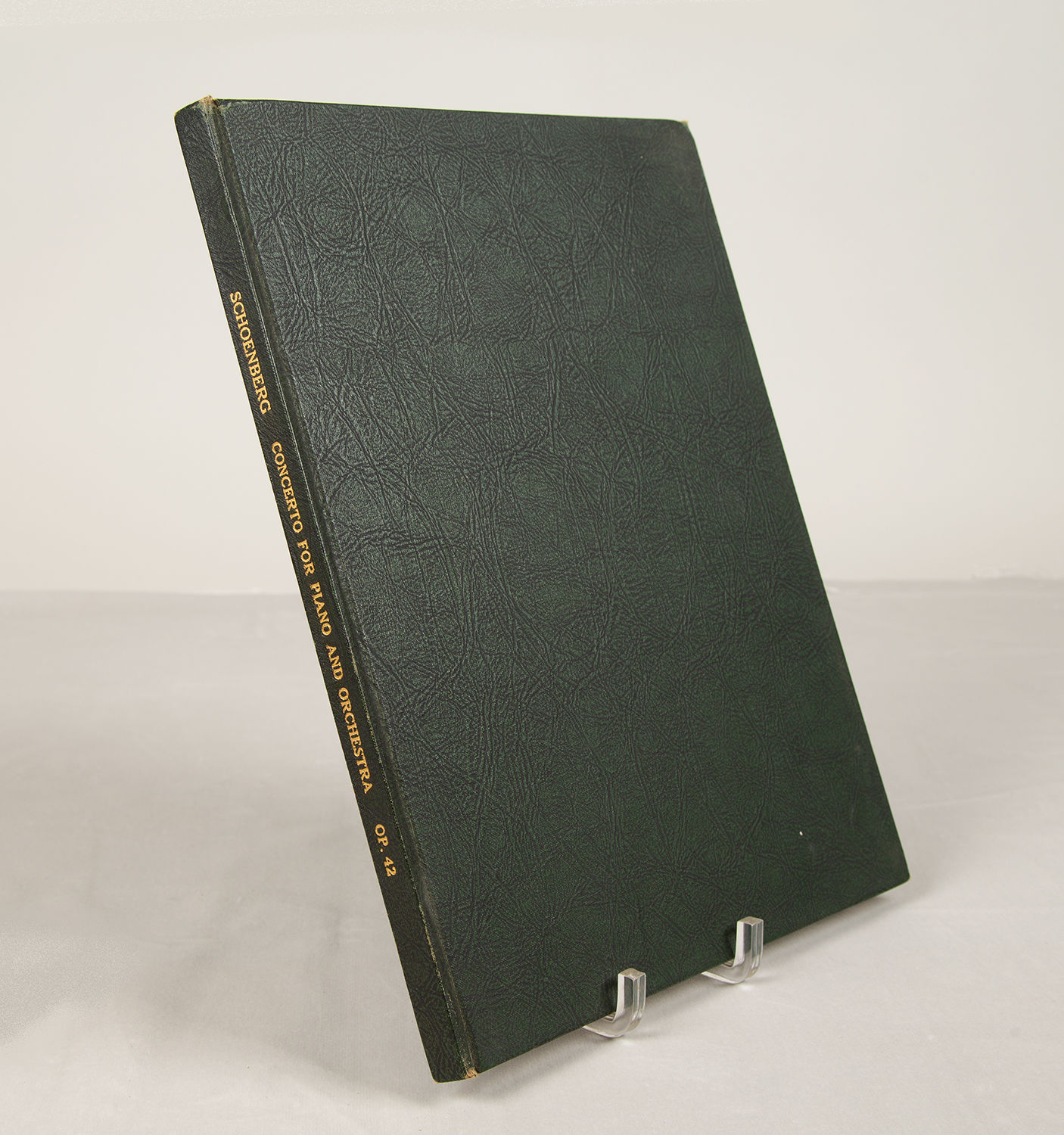
- New York: G. Schirmer [PN 40728], 1944
New York: G. Schirmer [PN 40728], 1944. STEUERMANN, Eduard 1892-1964 (arr.). Small folio. Full dark green cloth; titling gilt to spine. 2ff., 99 pp. Printed dedication to head of title: "To Henry Clay Shriver." Explanatory note by Schoenberg in English.
Binding slightly rubbed and bumped; minor dampstaining to pastedowns. Light uniform browning. First Edition. Rufer (E), p. 70. GA B/15, pp. 94-95.
The full score was not published until 1946.
"Schönberg's Piano Concerto, op. 42, which was originally commissioned by his former student Oscar Levant, is conceived as a single-movement form displaying the characteristics of a multimovement sonata cycle. Like the program of the concerto it divides into four parts. The opening melody of the Concerto, lasting thirty-nine bars, presents the four modes of the tone row in the following order: basic set, inversion of retrograde, retrograde, and inversion... The manuscript includes the four parts of the programme (which - according to Schönberg scholarship - is clearly autobiographical), each accompanied by a musical example from one of the four sections of the concerto." © Arnold Schönberg Center.
Binding slightly rubbed and bumped; minor dampstaining to pastedowns. Light uniform browning. First Edition. Rufer (E), p. 70. GA B/15, pp. 94-95.
The full score was not published until 1946.
"Schönberg's Piano Concerto, op. 42, which was originally commissioned by his former student Oscar Levant, is conceived as a single-movement form displaying the characteristics of a multimovement sonata cycle. Like the program of the concerto it divides into four parts. The opening melody of the Concerto, lasting thirty-nine bars, presents the four modes of the tone row in the following order: basic set, inversion of retrograde, retrograde, and inversion... The manuscript includes the four parts of the programme (which - according to Schönberg scholarship - is clearly autobiographical), each accompanied by a musical example from one of the four sections of the concerto." © Arnold Schönberg Center.