

Peer Gynt: A Dramatic Poem by Henrik Ibsen
- Philadelphia: J.B. Lippincott Co, 1936
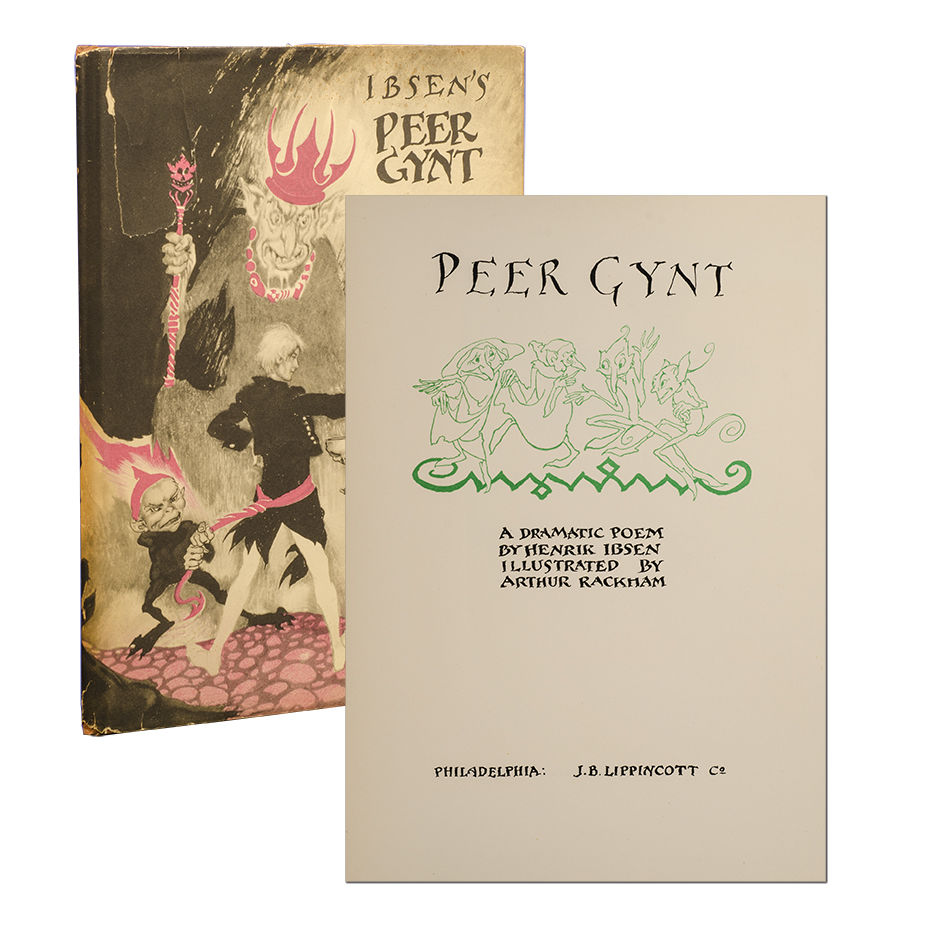
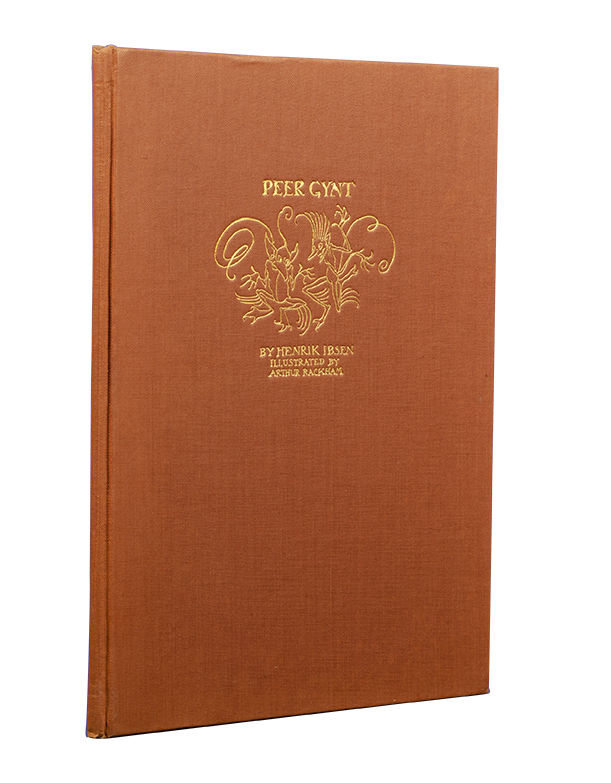
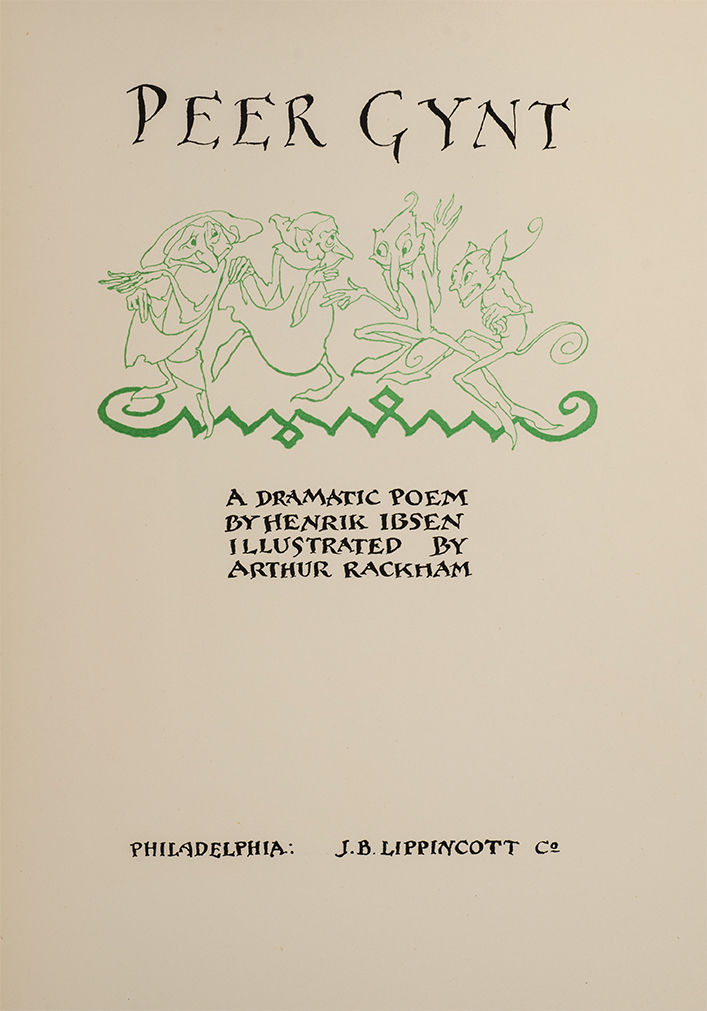
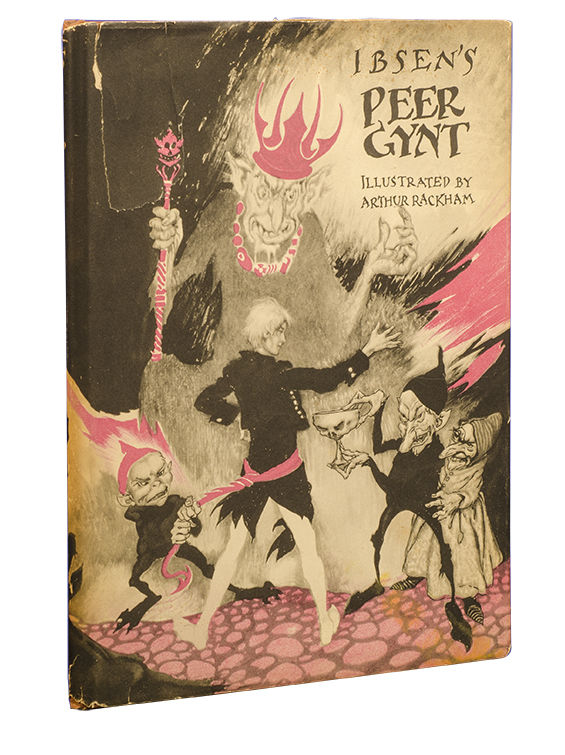
Philadelphia: J.B. Lippincott Co, 1936. Publisher's salesperson's sample copy (preceding the first edition). Large octavo (9 13/16 x 7 7/16 inches; 249 x 189 mm.). Complete. Original printed color pictorial dust jacket (with "Harrap" on the spine) with a neatly repaired tear on front near spine. Original gilt decorated brown cloth. Original pictorial endpapers. Title-page printed in green and black. Two full-page color plates with descriptive tissue guards and two half-page black and white illustrations. A Fine copy in a Near Fine dust jacket.
A great rarity. These were obviously produced in minimal quantity for the publisher's salespeople to solicit advance orders from bookshops. The 'list' of illustrations leaf states "[There will be Twelve Plates in Colour]" The vignettes on the half-title and title-page in the published edition are printed in a much lighter and brighter green. The list of books Illustrated by Arthur Rackham on the verso of the half-title is very different from the published edition. The two color plates are: "Peer and the Woman in Green" [in the published edition this plate faces p. 66 and is titled "Peer follows the Woman in Green"] and "Anitra's Dance" [in the published edition this plate faces page 148]. Although this sample has the Lippincott imprint, the verso of the title-page says "Printed in Great Britain."
Although inspired by the folk legend and by Peter Christen Asbjornsen's fairy tales, the playwright Henrik Ibsen believed some of the story to be based on true events. He also based some of the characters on his own family members, including his parents, thus imbuing them with a sense of an authenticity. Ibsen, who was interested in promoting Norwegian culture, first wrote Peer Gynt in verse while traveling in Italy. Although he did not originally intend it to be a theatrical production, it has gone on to be an essential part of his oeuvre (Encyclopedia). First published in 1867, this deluxe edition of Ibsen's five-act play is a perfect merging of Rackham’s illustrate style with Ibsen’s folk-adventure narrative. "In the troll scenes, or in Peer's moorland encounter with the threadballs, Rackhamerie abounds...". (Gettings).
Arthur Rackham (1867-1939) is perhaps the most acclaimed and influential illustrators of the Golden Age of Illustration. A prolific artist even from his youth, Rackham got his start as an illustrator working for the Westminster Budget Newspaper (1892). Over the next few years, he took on more and more commissions for children’s books, hitting his career high in the first three decades of the twentieth century. Rackham turned his imaginative pen to every classic—from Shakespeare to Dickens to Poe.
Not mentioned by Riall.
A great rarity. These were obviously produced in minimal quantity for the publisher's salespeople to solicit advance orders from bookshops. The 'list' of illustrations leaf states "[There will be Twelve Plates in Colour]" The vignettes on the half-title and title-page in the published edition are printed in a much lighter and brighter green. The list of books Illustrated by Arthur Rackham on the verso of the half-title is very different from the published edition. The two color plates are: "Peer and the Woman in Green" [in the published edition this plate faces p. 66 and is titled "Peer follows the Woman in Green"] and "Anitra's Dance" [in the published edition this plate faces page 148]. Although this sample has the Lippincott imprint, the verso of the title-page says "Printed in Great Britain."
Although inspired by the folk legend and by Peter Christen Asbjornsen's fairy tales, the playwright Henrik Ibsen believed some of the story to be based on true events. He also based some of the characters on his own family members, including his parents, thus imbuing them with a sense of an authenticity. Ibsen, who was interested in promoting Norwegian culture, first wrote Peer Gynt in verse while traveling in Italy. Although he did not originally intend it to be a theatrical production, it has gone on to be an essential part of his oeuvre (Encyclopedia). First published in 1867, this deluxe edition of Ibsen's five-act play is a perfect merging of Rackham’s illustrate style with Ibsen’s folk-adventure narrative. "In the troll scenes, or in Peer's moorland encounter with the threadballs, Rackhamerie abounds...". (Gettings).
Arthur Rackham (1867-1939) is perhaps the most acclaimed and influential illustrators of the Golden Age of Illustration. A prolific artist even from his youth, Rackham got his start as an illustrator working for the Westminster Budget Newspaper (1892). Over the next few years, he took on more and more commissions for children’s books, hitting his career high in the first three decades of the twentieth century. Rackham turned his imaginative pen to every classic—from Shakespeare to Dickens to Poe.
Not mentioned by Riall.