

Princess Mary's Gift Book
- London: Hodder and Stoughton, 1914
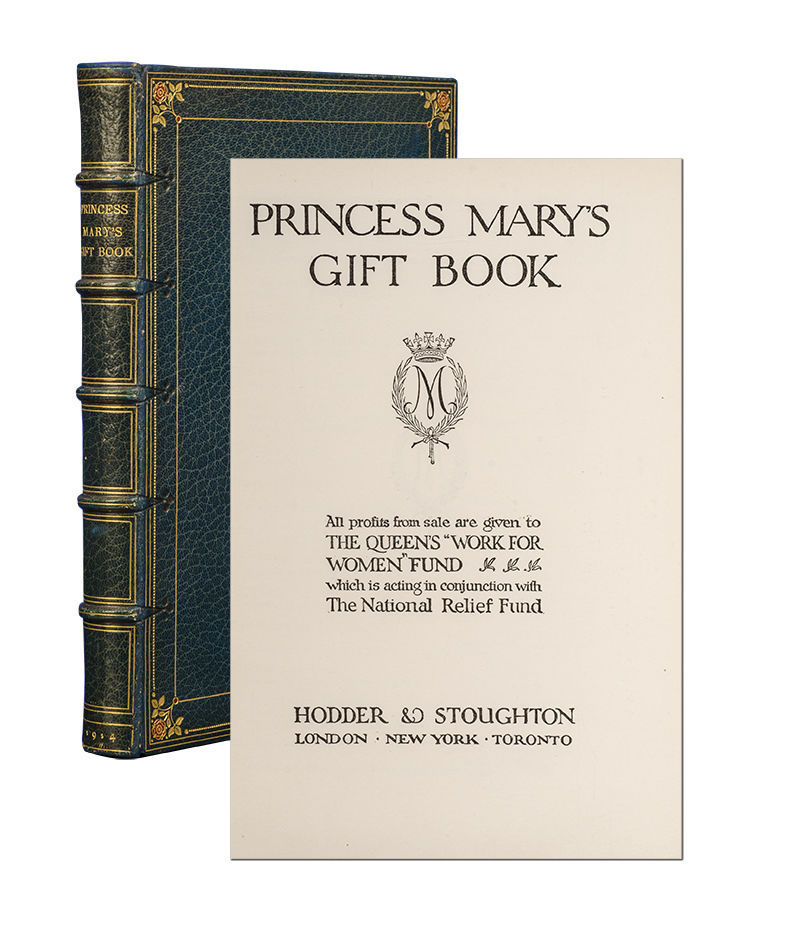
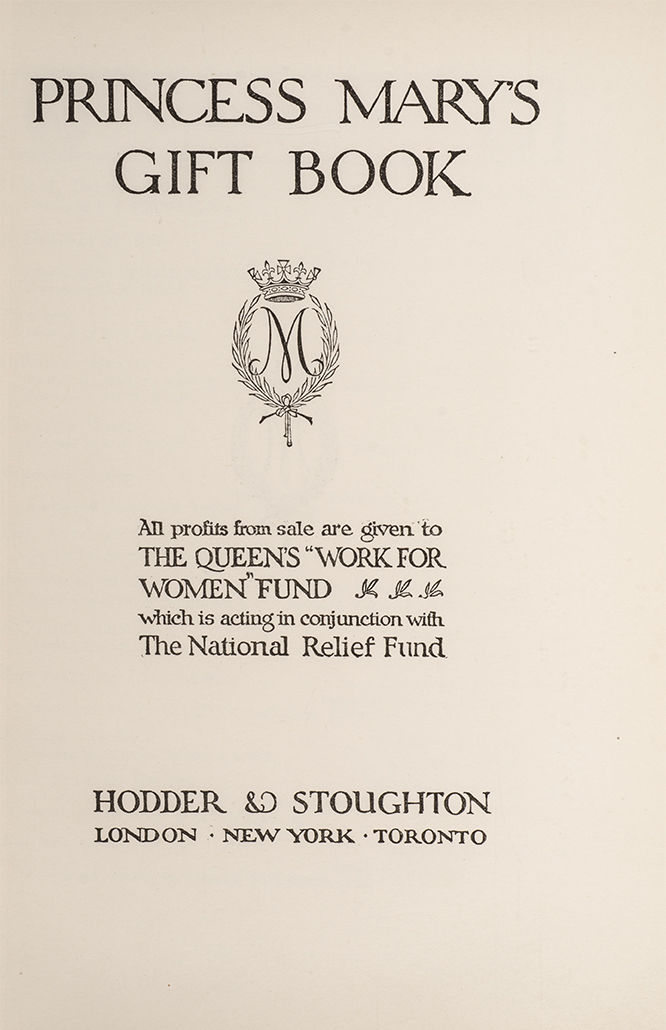
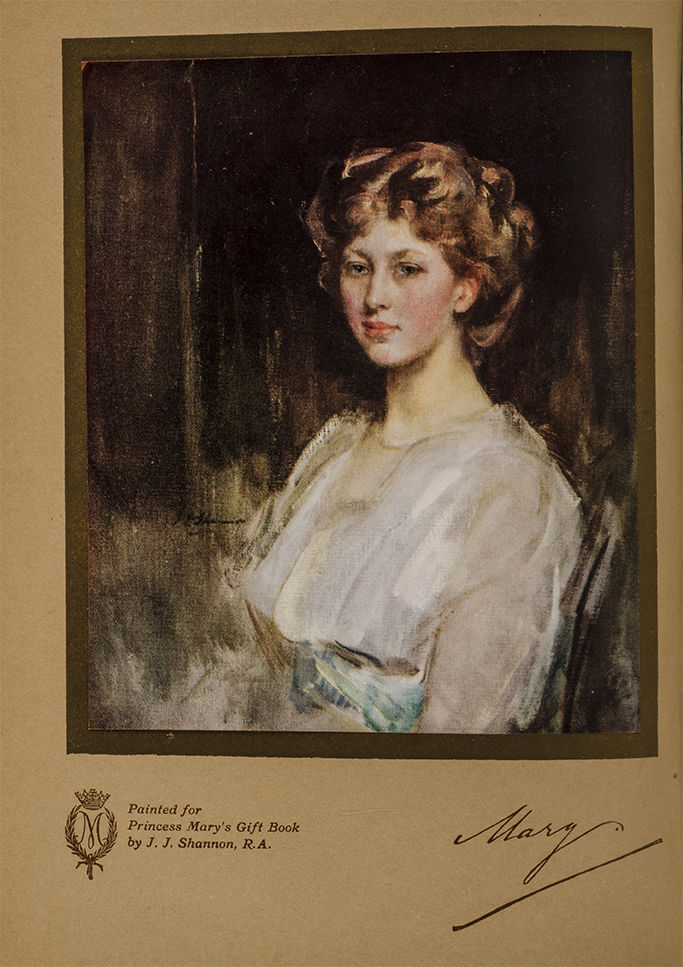
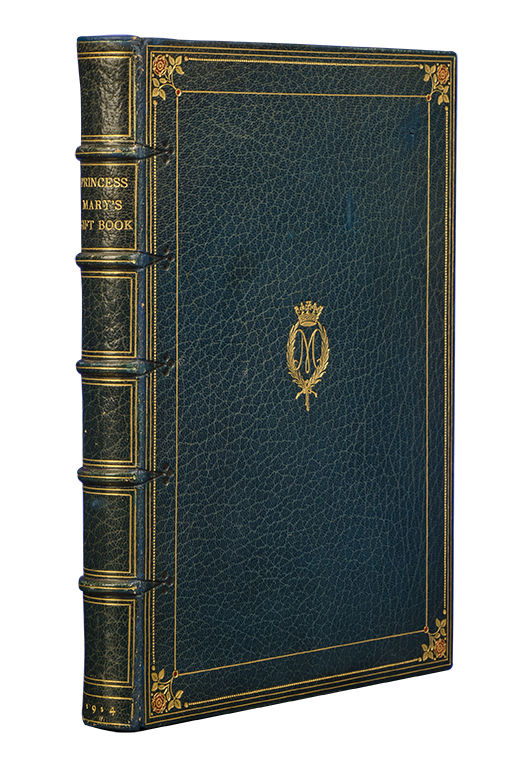
London: Hodder and Stoughton, 1914. First edition. Finely bound ca. 1914 by Sangorski & Sutcliffe (stamp-signed on rear turn-in) in full dark blue morocco, covers decoratively paneled in gilt with inlaid red morocco floral corner-pieces and in the center in gilt, the Royal stamp of Princess Mary. Spine with five raised bands, paneled and lettered in gilt in compartments, all edges gilt, cream watered silk liners and endleaves.Quarto (9 7/8 x 7 5/16 inches; 251 x 186 mm). vi, 140 pp. Fourteen color plates tipped-in to captioned tan stock with brown line frame, many black and white text drawings. Four figure ink number (upside down) on verso of rear blank leaf. An exceptional copy.
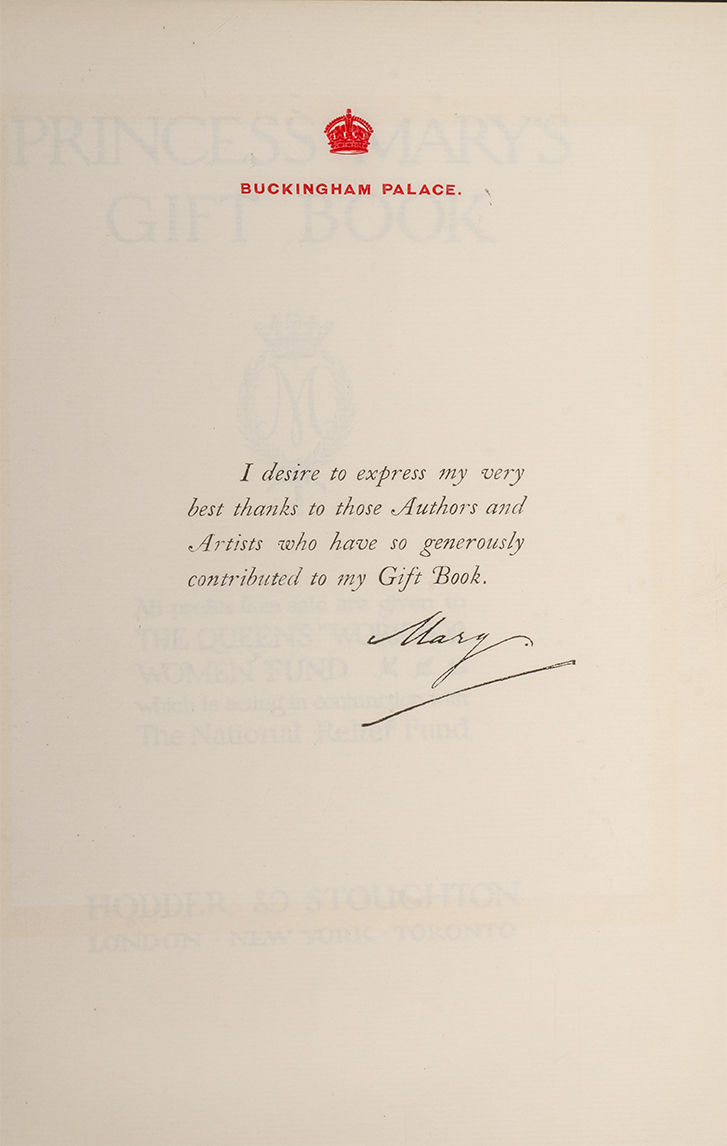
A relatively common book, but scarce in fine condition. This may well be a special presentation binding that was done at the time of publication. "This was the first of a group of wartime books sponsored by prominent people and sold to raise money for worthy causes. The most popular, it sold 604,884 copies during the two years, 1914-1916, that is was in print. The Times in an article November 21, 1914 sought to promote the cause, "The Queen's Fund," by directing the public to the display of the original drawings at the Leicester Galleries" (Hughey).
The fourteen tipped-in color plates include:
"So nobody can quite explain Exactly where the rainbows end" (Arthur Rackham) "True Spartan Hearts" (Edmund Dulac)
"The Ant Lion" (E.J. Detmold)
"A Holiday in Bed" (W. Russell Flint)
There are also many black & white drawings by C.E. Brock; E.J. Detmold; Arthur Rackham; Byam Shaw; H. M. Brock; Lewis Baumer and Edmund J. Sullivan.
Arthur Rackham (1867-1939) is perhaps the most acclaimed and influential illustrators of the Golden Age of Illustration. A prolific artist even from his youth, Rackham got his start as an illustrator working for the Westminster Budget Newspaper (1892). Over the next few years, he took on more and more commissions for children’s books, hitting his career high in the first three decades of the twentieth century. Rackham turned his imaginative pen to every classic—from Shakespeare to Dickens to Poe.
Latimore and Haskell 93. Riall 120. Hughey 34.
A relatively common book, but scarce in fine condition. This may well be a special presentation binding that was done at the time of publication. "This was the first of a group of wartime books sponsored by prominent people and sold to raise money for worthy causes. The most popular, it sold 604,884 copies during the two years, 1914-1916, that is was in print. The Times in an article November 21, 1914 sought to promote the cause, "The Queen's Fund," by directing the public to the display of the original drawings at the Leicester Galleries" (Hughey).
The fourteen tipped-in color plates include:
"So nobody can quite explain Exactly where the rainbows end" (Arthur Rackham) "True Spartan Hearts" (Edmund Dulac)
"The Ant Lion" (E.J. Detmold)
"A Holiday in Bed" (W. Russell Flint)
There are also many black & white drawings by C.E. Brock; E.J. Detmold; Arthur Rackham; Byam Shaw; H. M. Brock; Lewis Baumer and Edmund J. Sullivan.
Arthur Rackham (1867-1939) is perhaps the most acclaimed and influential illustrators of the Golden Age of Illustration. A prolific artist even from his youth, Rackham got his start as an illustrator working for the Westminster Budget Newspaper (1892). Over the next few years, he took on more and more commissions for children’s books, hitting his career high in the first three decades of the twentieth century. Rackham turned his imaginative pen to every classic—from Shakespeare to Dickens to Poe.
Latimore and Haskell 93. Riall 120. Hughey 34.