

The Vicar of Wakefield

- Philadelphia: David McKay Company, 1929
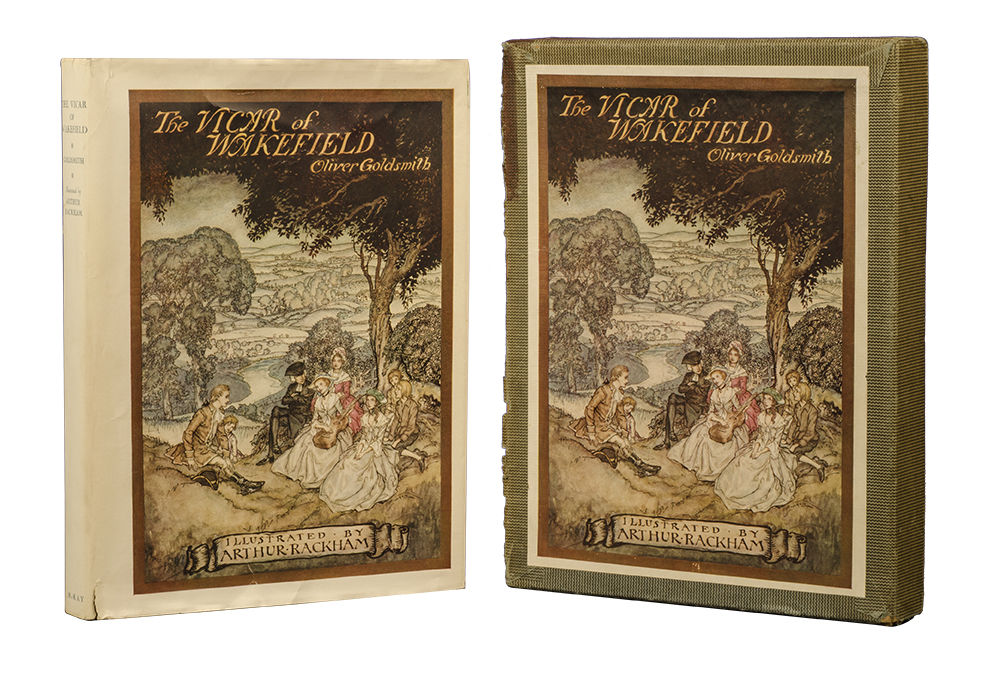
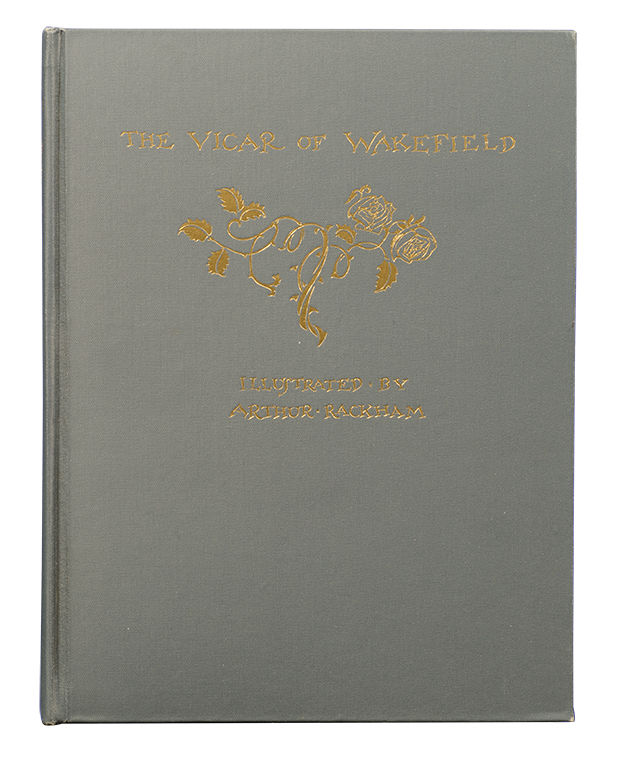
Philadelphia: David McKay Company, 1929. First American trade edition. Quarto (9 1/2 x 7 1/8 inches; 242 x 182 mm.). Collating 231, [1]. Publishers dark blue ribbed cloth over boards, front cover and spine decoratively stamped in gilt. Pictorial endpapers, top edge gilt. Small stain on lower blank margin of color frontispiece with very slight mark on facing (title) page. Twelve full page color plates, twenty-two black and white line drawings. Otherwise a very Fine copy with the original color pictorial dust jacket with a 'titled' version of the color plate "A Favourite Song of Dryden's" (facing page 36) on the front panel. Clean tear on upper panel neatly repaired, small closed tear on lower rear panel.
Original blue cardboard box with the same color illustration as on the dust jacket pasted on the top panel and a white label "The Vicar of Wakefield / Oliver Goldsmith / Illustrated by Arthur Rackham on the lower edge. The box has had some repairs to the corners and the left-hand side edge is missing.
Reportedly published as a means for thwarting debt, The Vicar of Wakefield became one of the most popular novels of the late 18th century. Mixing irony with sentimentalism, it paints a portrait of village life "narrated by Dr. Primrose, the title character, whose family endured multiple trials -- including the loss of their fortune, the seduction of a daughter, the destruction of their home by fire, and the vicar's incarceration -- before all is put right at the end" (Britannica). Goldsmith was a noted Irish wit and a member of Samuel Johnson’s famed literary club, who Johnson praised as: “In genius, vivid, versatile, sublime. In style, clear, elevated, elegant." The legend of the book’s publication is that Goldsmith was about to be arrested by his landlady for debt, when Johnson was able to sell the manuscript of the novel to a publisher for sixty pounds, saving his friend in the nick of time. For this illustrated edition, Rackham embraced historical costume and his traditional whimsy, despite the more fashionable Jazz-Age and Art Deco style predominant at the time (Husdon).
Arthur Rackham (1867-1939) is perhaps the most acclaimed and influential illustrators of the Golden Age of Illustration. A prolific artist even from his youth, Rackham got his start as an illustrator working for the Westminster Budget Newspaper (1892). Over the next few years, he took on more and more commissions for children’s books, hitting his career high in the first three decades of the twentieth century. Rackham turned his imaginative pen to every classic—from Shakespeare to Dickens to Poe.
Hudson 171. Latimore and Haskell 65. Riall 170.
Original blue cardboard box with the same color illustration as on the dust jacket pasted on the top panel and a white label "The Vicar of Wakefield / Oliver Goldsmith / Illustrated by Arthur Rackham on the lower edge. The box has had some repairs to the corners and the left-hand side edge is missing.
Reportedly published as a means for thwarting debt, The Vicar of Wakefield became one of the most popular novels of the late 18th century. Mixing irony with sentimentalism, it paints a portrait of village life "narrated by Dr. Primrose, the title character, whose family endured multiple trials -- including the loss of their fortune, the seduction of a daughter, the destruction of their home by fire, and the vicar's incarceration -- before all is put right at the end" (Britannica). Goldsmith was a noted Irish wit and a member of Samuel Johnson’s famed literary club, who Johnson praised as: “In genius, vivid, versatile, sublime. In style, clear, elevated, elegant." The legend of the book’s publication is that Goldsmith was about to be arrested by his landlady for debt, when Johnson was able to sell the manuscript of the novel to a publisher for sixty pounds, saving his friend in the nick of time. For this illustrated edition, Rackham embraced historical costume and his traditional whimsy, despite the more fashionable Jazz-Age and Art Deco style predominant at the time (Husdon).
Arthur Rackham (1867-1939) is perhaps the most acclaimed and influential illustrators of the Golden Age of Illustration. A prolific artist even from his youth, Rackham got his start as an illustrator working for the Westminster Budget Newspaper (1892). Over the next few years, he took on more and more commissions for children’s books, hitting his career high in the first three decades of the twentieth century. Rackham turned his imaginative pen to every classic—from Shakespeare to Dickens to Poe.
Hudson 171. Latimore and Haskell 65. Riall 170.