

There Were Giants: A Story of Blood and Steel
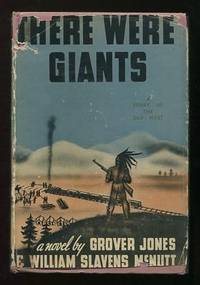
- Hardcover
- New York: M.S. Mill Co., Inc., (c.1939)
New York: M.S. Mill Co., Inc.. Good in Fair dj. (c.1939). First Edition. Hardcover. [ex-rental library book ("Boulevard Book Shop" stamped on front pastedown, handwritten circulation slip on rear endpaper), the book itself only moderately worn; the jacket, however, is firmly affixed to the book at both flaps, has been unevenly trimmed by about 1/8"-1/4" along the bottom edge, and has suffered some paper loss to the upper spine extremities and the top right corner of the front panel]. The only published novel by this noted screenwriting team, a legendary (though now largely forgotten) duo who were the epitome of the fast-thinking, seat-of-the-pants story-pitchers of Hollywood lore. (They're acknowledged to have been the models for the leading characters in Samuel and Bella Spewack's 1936 play "Boy Meets Girl," which was filmed by Warner Bros. in 1938.) Jones, the more colorful and voluble of the pair, came to Hollywood from his native Terre Haute, Indiana, in 1915, with the modest amibition of becoming a sign painter for the movies; he worked his way up through the ranks as a gag man, writer and director of short comedies, and eventually became one of the most prolific (and highly-salaried) screenwriters at the Paramount studio. (It was there that he teamed up with the wonderfully-named McNutt.) Jones was also a prolific writer of magazine fiction, and for a couple of years in the late 1930s published his own magazine (called Jones'), which he printed himself on a linotype machine installed at his home in Pacific Palisades. Jones and McNutt did their last work for Paramount in 1935, and I half suspect that this book, an anomaly in their otherwise exclusively-screenwritten joint oeuvre, might well have been an unrealized movie treatment that Jones decided to rework as a novel following McNutt's death in January 1938. It's kind of an epic "of the days when the West was golden and an empire was to be had for the taking," with the central conflict involving two competing larger-than-life figures: the cattle baron "Roarin' Bill" Holliday and the railroad-building mogul Carter Harrington, who wants "to thrust the railroad's metal straight into the heart of Holliday's domain." It's interesting to note a couple of Hollywood happenings concurrent with the publication of this novel: one was the production (at Paramount, ironically) of Cecil B. DeMille's railroad-building epic UNION PACIFIC (which, if my surmise about the origins of this book is correct, may well be the reason that it never got off the ground as a movie, i.e. Hollywood wasn't big enough for more than one railroad-themed film at a time); the other was the fact that about this time, Jones was engaged in crafting the early treatments and drafts of a very different kind of Western yarn, the W.C. Fields-Mae West co-starring venture at Universal, MY LITTLE CHICKADEE. So one way or another, Jones would have had the Old West on his brain for much of 1939. (And sadly, by the end of the following year he too would be dead, at the age of 46.) .