

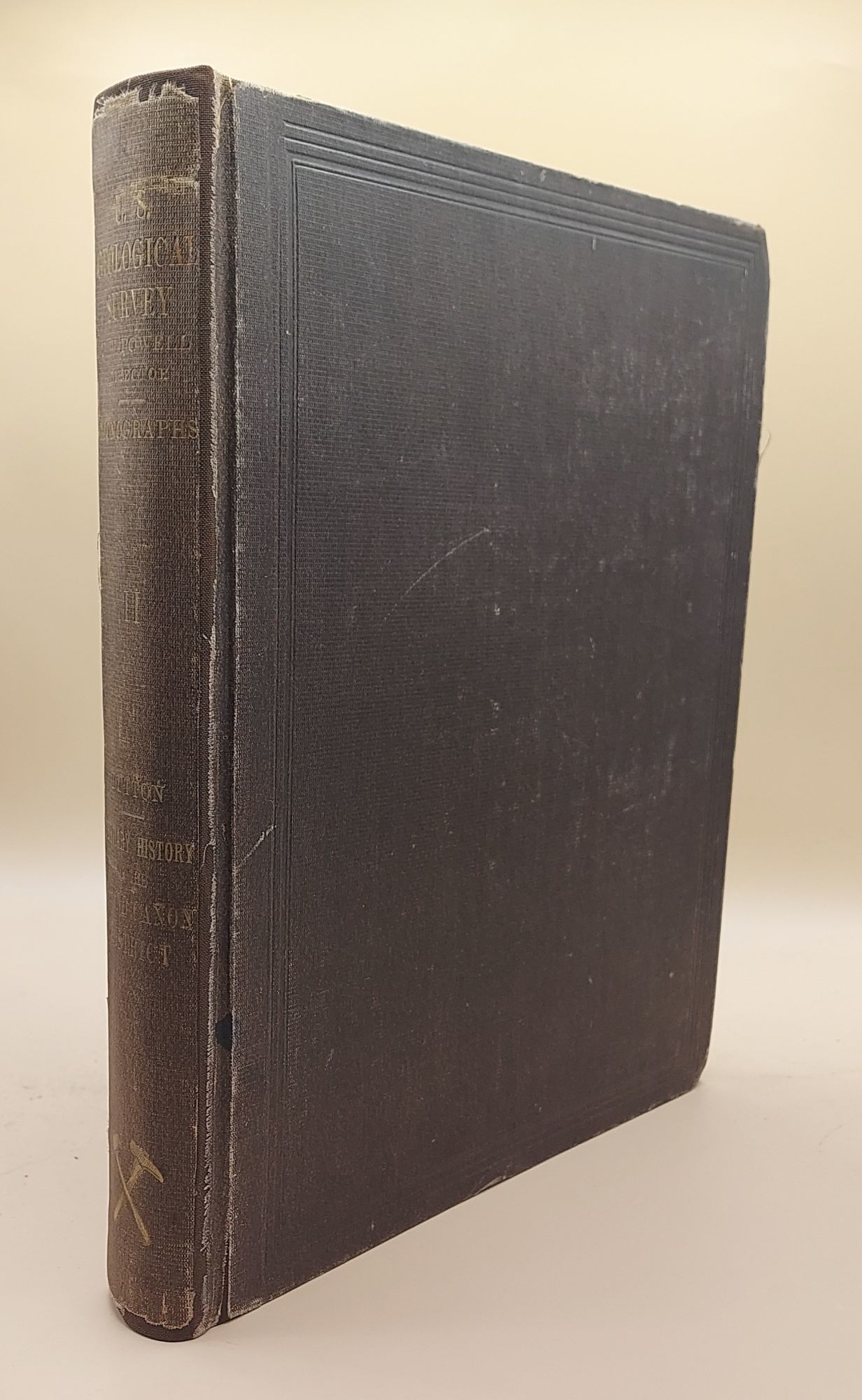
Tertiary History of the Grand Canon with Atlas to Accompany the Monograph on the Tertiary History of the Grand Canon District (two volume set)
- Hardcover
- Washington: [United States Government Printing Office] Julius Bien & Co. Lith. New York, 1882
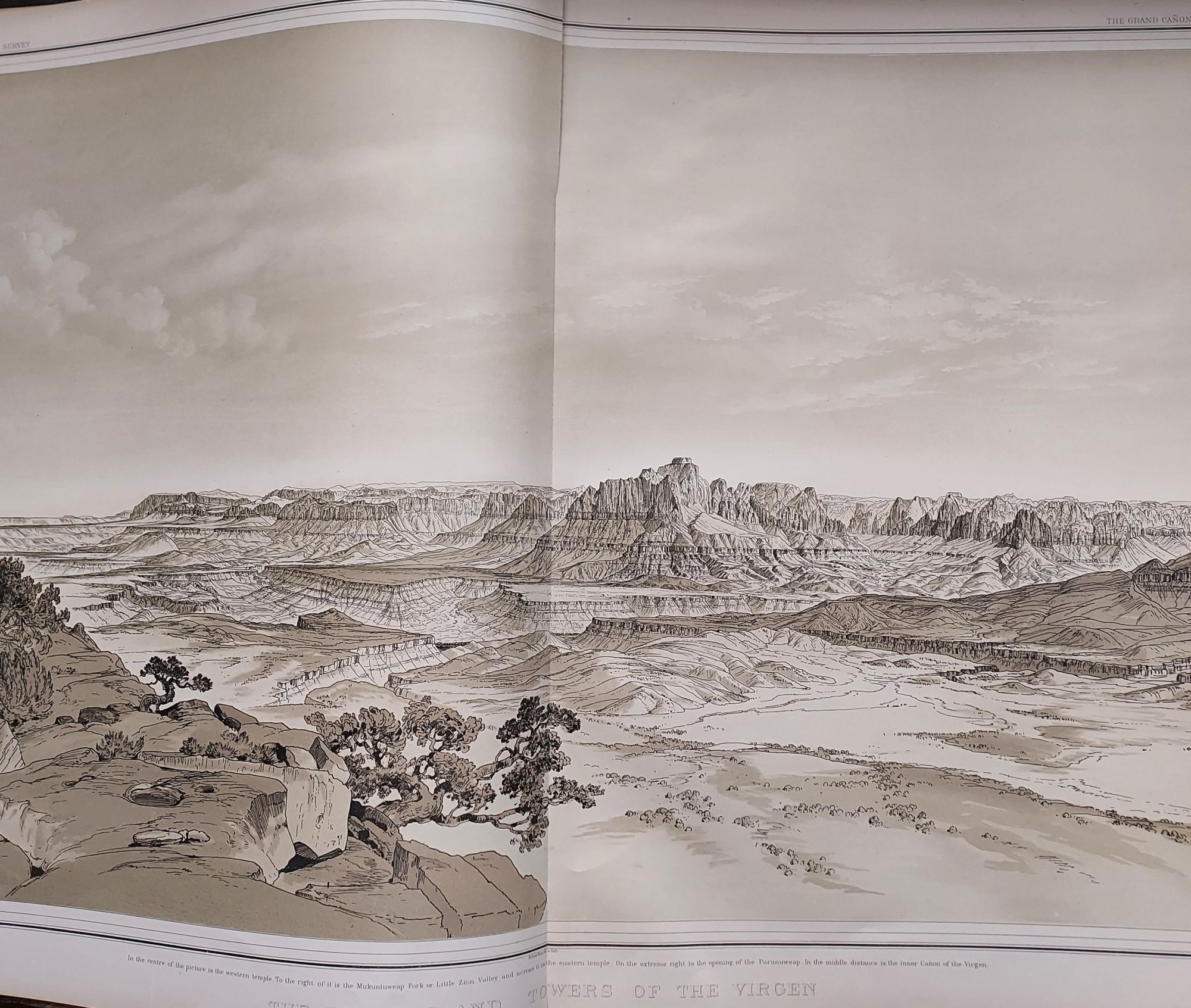
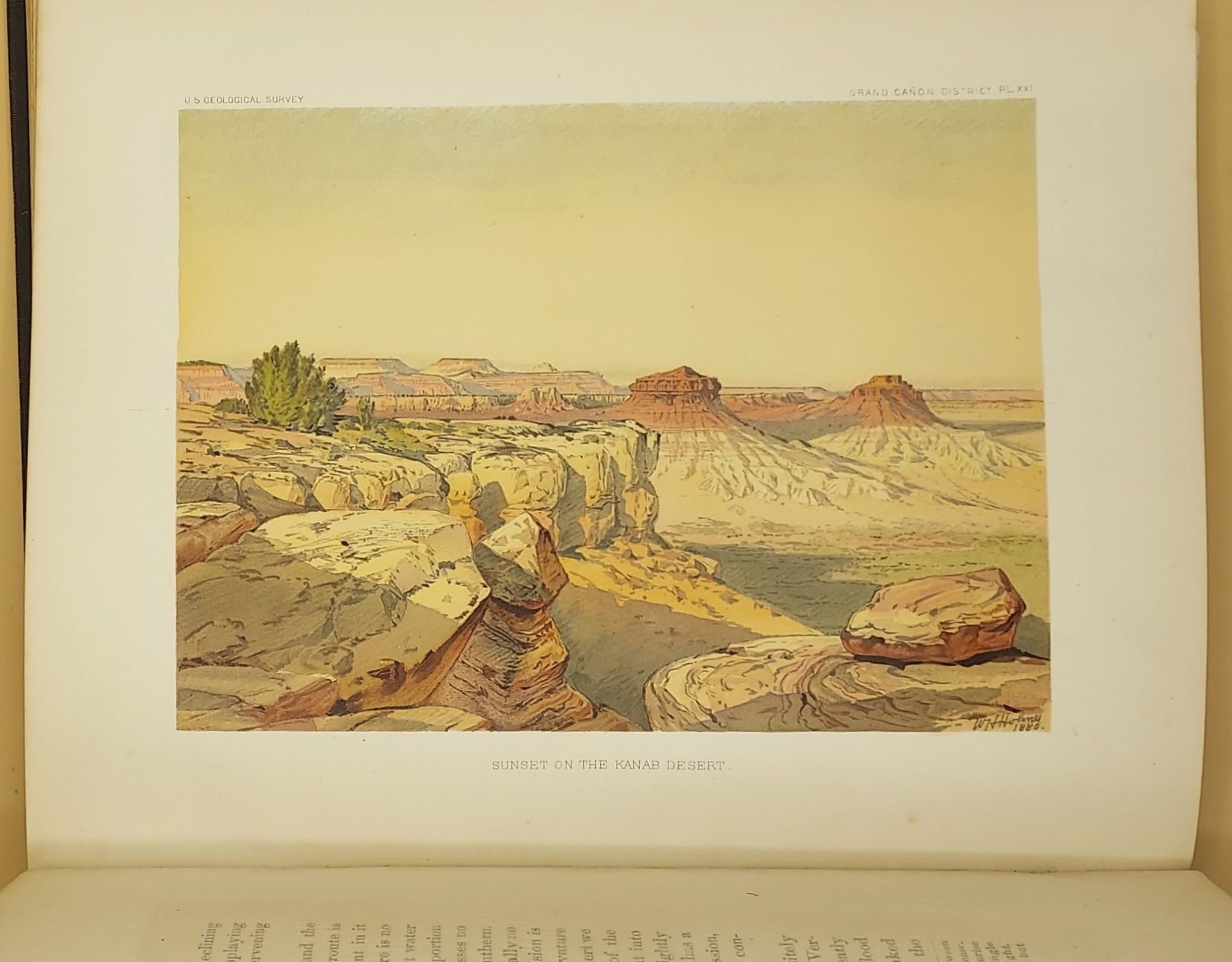
Washington: [United States Government Printing Office] Julius Bien & Co. Lith. New York, 1882. First edition. Hardcover. Very good. Monograph. 264pp. Quarto [30.5 cm] Brown cloth boards. Atlas. Twenty-three sheets including title-page and table of contents (sheet 1), 12 color maps, 10 color views. Folio [51.5 cm] In original brown cloth with gilt stamped title on front board. Both volumes rebacked, with original spines overlaid. Extremities rubbed. Hinges reinforced. Plate XV of the atlas volume is detached and laid in. In the monograph volume: plate XV is labeled as X and is facing p. 57 (before plate XIV facing p. 58); plate XXIII is labeled XXI. Plate XXXVII faces p. 214 not p. 212. Plate XXXVI has been taped on the reverse, along the inside margin. The tissue guard for plate XVIII is absent. This atlas contains the three stunning panoramas, 'From Point Sublime in the Kaibab', by William H. Holmes. These three panoramas offer a 270 degree view of the Grand Canyon. This atlas also contains Thomas Moran's exquisite work, 'The Transept, Kaibab Division, Grand Cañon An Amphitheater of the Second Order.' These four plates have made this work one of the most sought after Western Americana titles, and are usually missing from this monumental work.
In 1875, Clarence Edward Dutton (1841-1912) joined the United States Geological Survey and is known for his extensive explorations of the Rocky Mountain region. His greatest accomplishment is his Tertiary History of the Grand Canon District of 1882. It is still considered the preeminent work on the Grand Canyon to date. The atlas is beautifully illustrated with maps and views engraved by Julius Bien. Sheet XVIII of the atlas, titled "The Transept, Kaibab Division, Grand Canyon" is based on the monumental painting of the same title by artist Thomas Moran (1837-1926). Moran, more than any other artist, is most closely associated with images of the Grand Canyon. The field artist for the Dutton geological exploration was William Henry Holmes (1846-1933). Holmes was most noted for his sense of realism and accurate draftsmanship. Holmes contributed many finely executed panoramic views of the Grand Canyon to the Atlas that are quite stunning. He exhibited at the National Academy of Design, The Art Institute of Chicago and The Brooklyn Art Club among others. Holmes later held positions as Curator at the University of Chicago (1898-1906) and was a former Director of the National Academy of Design (1920-1932). Farquhar states: "One of the greatest, if not the very greatest of all Grand Canyon books...The atlas, containing the superb panoramic views by William H. Holmes and a drawing by Thomas Moran, is a rich portfolio of art as well as a collection of maps and an exposition of geology." Farquhar 73. Spamer, p. 53.
In 1875, Clarence Edward Dutton (1841-1912) joined the United States Geological Survey and is known for his extensive explorations of the Rocky Mountain region. His greatest accomplishment is his Tertiary History of the Grand Canon District of 1882. It is still considered the preeminent work on the Grand Canyon to date. The atlas is beautifully illustrated with maps and views engraved by Julius Bien. Sheet XVIII of the atlas, titled "The Transept, Kaibab Division, Grand Canyon" is based on the monumental painting of the same title by artist Thomas Moran (1837-1926). Moran, more than any other artist, is most closely associated with images of the Grand Canyon. The field artist for the Dutton geological exploration was William Henry Holmes (1846-1933). Holmes was most noted for his sense of realism and accurate draftsmanship. Holmes contributed many finely executed panoramic views of the Grand Canyon to the Atlas that are quite stunning. He exhibited at the National Academy of Design, The Art Institute of Chicago and The Brooklyn Art Club among others. Holmes later held positions as Curator at the University of Chicago (1898-1906) and was a former Director of the National Academy of Design (1920-1932). Farquhar states: "One of the greatest, if not the very greatest of all Grand Canyon books...The atlas, containing the superb panoramic views by William H. Holmes and a drawing by Thomas Moran, is a rich portfolio of art as well as a collection of maps and an exposition of geology." Farquhar 73. Spamer, p. 53.