

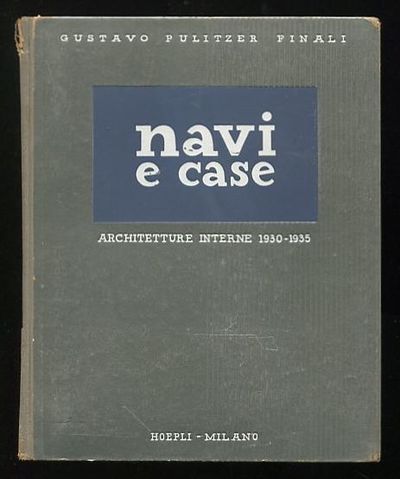
Navi e case: architetture interne 1930-1935
- Hardcover
- Milano: Ulrico Hoepli Editore, 1935
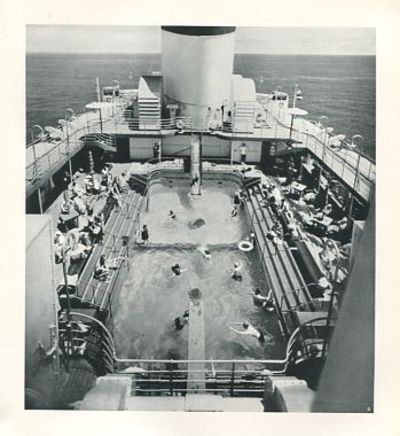
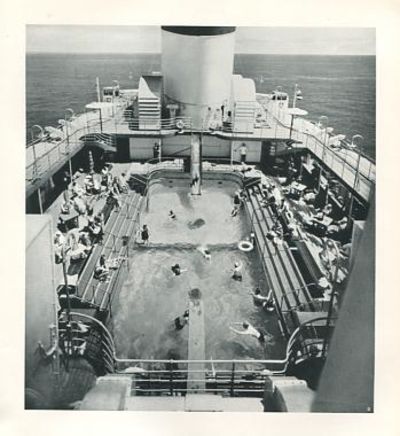
Milano: Ulrico Hoepli Editore. Good. 1935. First Edition. Hardcover. (textured silver paper-covered boards; no dust jacket) [a moderately worn volume, boards slightly bowed, some damage at the top of the spine (the cloth is ripped at both hinges, and about a 3/4" strip of the cloth spine covering has come "untucked"; probably repairable by a competent binder), bumped corners, general external wear, a couple of scrapes in the cloth spine covering, light foxing on the top edge and to the rear endpapers; vintage bookseller's label at bottom corner of front pastedown (Jean French, Los Angeles)]. (B&W photographs, sketches) Like the (translated) title says: ships and houses, mostly the former. This volume depicts the interior fittings and furnishings of four Italian ocean liners (taking up 145 of the book's 213 pages), plus an assortment of sundry residential and public buildings -- several of the latter in London, albeit with Italian connections. The ships whose elegant internals are pictured are: MN. Victoria (launched 1931); TN. Conte di Savoia (1932); MN. Neptunia (1932); MN. Oceania (1933); and MN. Calitea (1933). The most notable of these was undoubtedly the Conte di Savoia, photos of which fill about 40% of this volume. (The ship, which had a fabulous modernist interior designed by architect Melchiorre Bega, was put into wartime service by the Italian Navy in 1940 and was sunk in 1943.) The remaining sections (mostly 6-7 pages each) are devoted to: the interior of the Trieste stock exchange; a couple of exhibitions from 1933; various apartments in Genova and Trieste; the Hotel Duchi d'Aosta, Sestrières (apparently not the same establishment as today's 4-star Grand Hotel Duchi d'Aosta in Trieste, although I'm not 100% sure of that); the public rooms at Grosvenor House, London; the London offices of several Italian shipping lines; the London office of the Italian Tourist Company. The book's text is in Italian; the introduction is by Antonio Maraini (1886-1963), a noted sculptor and art critic. I can't resist noting that he concludes his essay with a statement about "compiutamente anche in questo campo la grandezza del tempo fascista" ("the greatness of the Fascist era in this field also"). Il Duce was no doubt very pleased. NOTE that additional postage charges will be assessed for international shipping of this moderately heavy book. .