

John Checkley; or the Evolution of Religious Tolerance in Massachusetts Bay. Including Mr. Checkley's Controversial Writings; His Letters and Other Papers; His Presentment on the Charge of a Libel for Publishing a Book; His Speech at His Trial; the Hon. John Read's Plea in Arrest of Judgment; and a Bibliography of the Great Controversy on Episcopacy by the Ministers of The Standing Order and the Clergy of the Church of England. 1719-1774., with Historical Illustrations and a Memoir by the Rev. Edmund F. Slafter, in Two Volumes [Publications of the Prince Society]
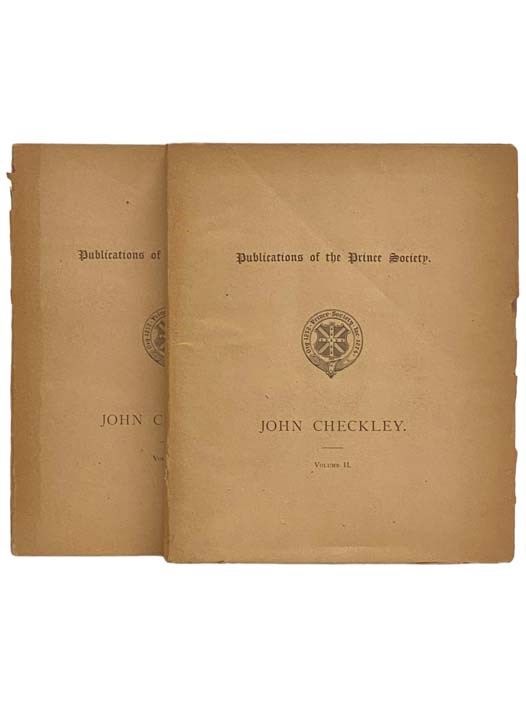
- Soft Cover
- Boston: The Prince Society, 1897
Boston: The Prince Society, 1897. Limited Edition. Soft Cover. Good. One of 250 copies. Spines creased, some loss from corners, wrappers toned. 1897 Soft Cover. 287; 320 pp. Two volume set. CHECKLEY, John, clergyman, born in Boston, Massachusetts, in 1680; died in Providence, Rhode Island, in 1753. He published in London, in 1723, a reprint of Leslie's "Short and Easy Method with the Deists," to which he added a " Discourse Concerning Episcopacy, in Defence of Christianity and the Church of England," consisting of a rude attack on the clergy and people of New England. For this he was tried before the Supreme Court in Boston in 1724, and fined £50 for libel. He went to England to take orders in 1727, intending to settle at Marblehead, but the bishop of London refused to ordain a man who had rendered himself so obnoxious to the New Englanders, and was a foe to Christians of other persuasions in the community. Afterward he was ordained by the bishop of Exeter, and sent to Narragansett. He settled in Providence in 1739. He was a man of eccentric and irascible conduct, but witty, learned in the classics, and familiar with the Narragansett language. He published, in 1715, "Choice Dialogues about Predestination," which were answered by Thomas Watter, who defended the Calvinistic doctrine, and were republished with an "Answer by a Stripling" in 1720. In 1727 appeared " The Modest Proof of the Order of the Churches," the authorship of which was accredited to him, introducing the Episcopal controversy into New England, and eliciting replies from Martin Mar-Prelate and Wigglesworth. He published also his speech upon his trial, and reissued it in London in 1738.--Famous Americans