

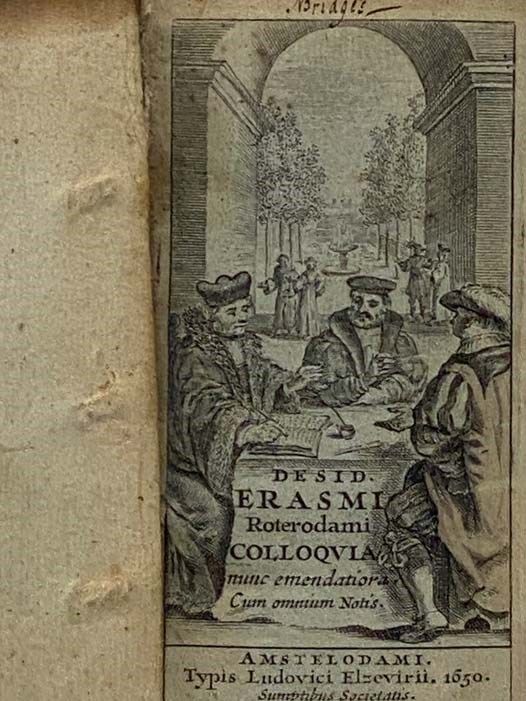
Colloquia. nunc emendatiora. Cum omnium Notis. [All the Familiar Colloquies of Desiderius Erasmus, of Rotterdam, Concerning Men, Manners, and Things]


- Full-Leather
- Amstelodami [Amsterdam]: Typis Ludovici Elsevirii [Lodowijk Elzevir], 1650
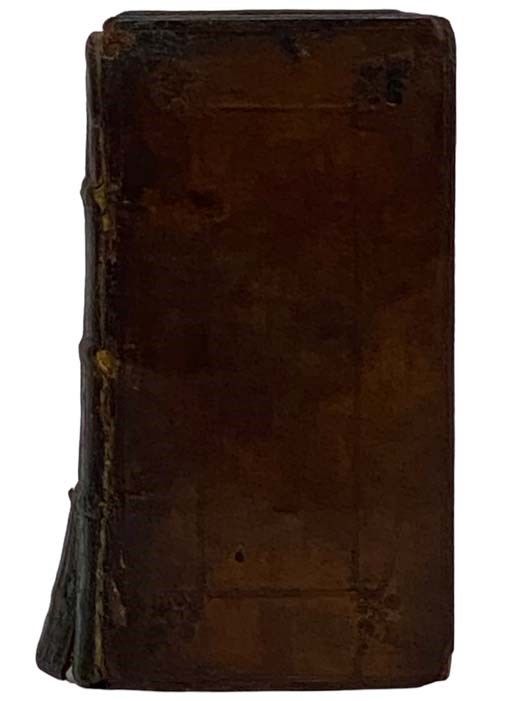
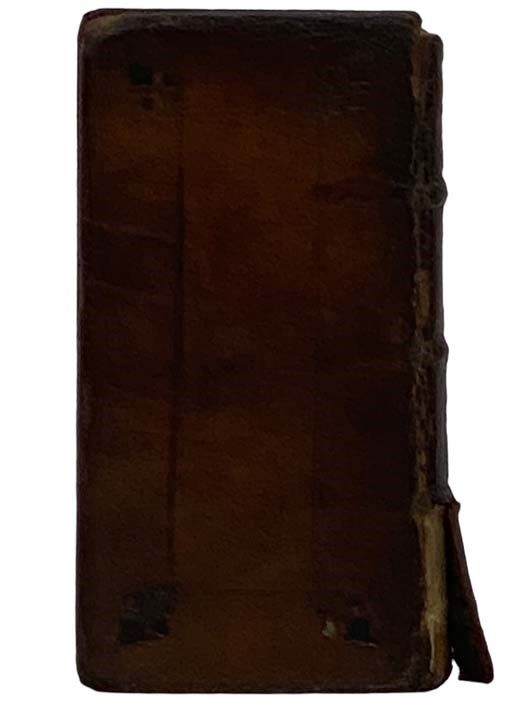
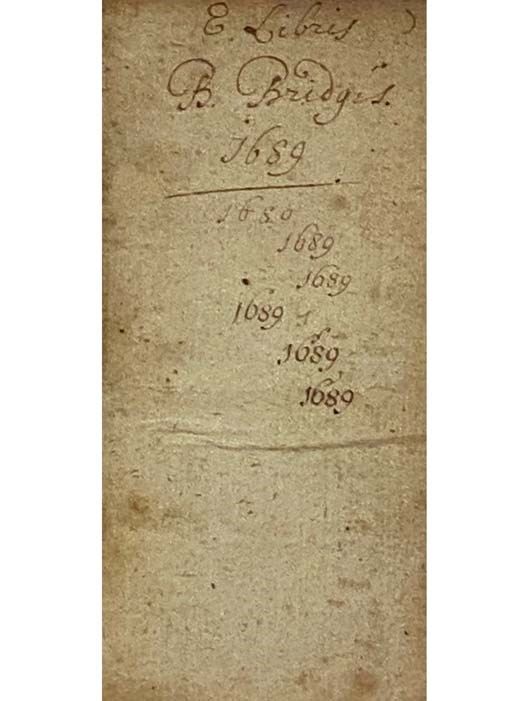
Amstelodami [Amsterdam]: Typis Ludovici Elsevirii [Lodowijk Elzevir], 1650. Full-Leather. Good/No Jacket. Spine toned with drying leather and some loss from head, joints beginning to split with 2 inch chip from spine base, but all sewings holding firmly, ink name and date (B. Bridges, 1689) on front free endpaper, which is loose but included, ink name on title page, minimal ink marginalia, pencil notes on rear free endpaper. 1650 Full-Leather. 589, [3] pp. A-Mm8, Nn4, Oo8, Pp4. 4 7/8 x 2 5/8. Full leather, blind-stamped borders and decorations, gilt rules on spine. Engraved title page showing a scribe seated with two other men, with an archway in the background. 63 colloquies in the original Latin with a brief biographical sketch of the life of Erasmus preceding text, footnotes throughout text. House of Elzevir edition, printed by Lodowijk Elzevir, who met Galileo in 1636. His grandfather founded the publishing company in the 1580s. One of the many works of the philosopher and Catholic theologian known as the 'Prince of Christian Humanists.' Published in 1518, the pages 'held up contemporary religious practices for examination in a more serious but still pervasively ironic tone' (Coffin/Stacey, Western Civilizations). Christian Humanists viewed Erasmus as their leader in the early 16th century. Erasmus' works had greater meaning to those learned few who had a larger knowledge of Latin and Greek. Colloquies in Latin means a formal written dialogue, thus in his book Erasmus explores man's reaction to others in conversations. The Colloquies is a collection of dialogues on a wide variety of subjects. They began in the late 1490s as informal Latin exercises for Erasmus' own pupils. In about 1522 he began to perceive the possibilities this form might hold for continuing his campaign for the gradual enlightenment and reform of all Christendom. Between that date and 1533 twelve new editions appeared, each larger and more serious than the last, until eventually some fifty individual colloquies were included ranging over such varied subjects as war, travel, religion, sleep, beggars, funerals, and literature. All of these works were in the same graceful, easy style and gentle humor that made them continually sought as schoolboy exercises and light reading for generations. "Originally written in his early days at Paris as dialogues illustrating the art of polite conversation, they were afterwards expanded into conversation pieces in which all the topics of the day were discussed with a freedom which ensured their popularity. Later in the century and up to the eighteenth century they were a set book in schools, and there are lines in Shakespeare which directly recall Erasmus's words." - Printing and the Mind of Man 53 (referencing the 1524 original)