

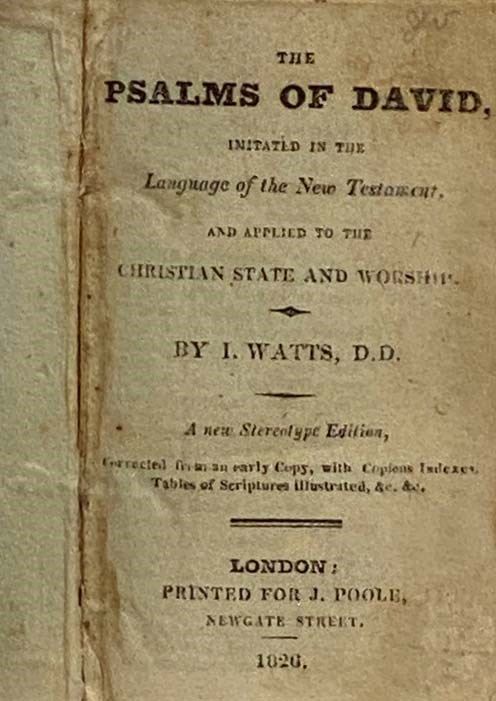
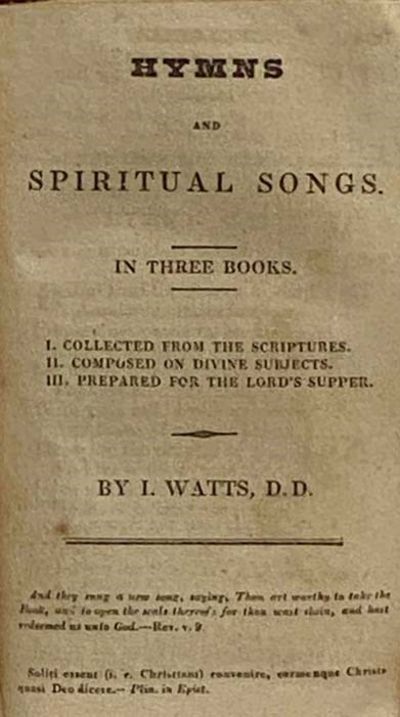
The Psalms of David, Imitated in the Language of the New Testament, and Applied to the Christian State and Worship. New Stereotype Edition, Corrected from an early Copy, with Copious Indexes, Tables of Scriptures illustrated, &c. &c. [with] Hymns and Spiritual Songs. in Three Books: I. Collected from the Scriptures.; II. Composed on Divine Subjects.; Prepared for the Lord's Supper
- Full-Leather
- London: Printed for J. Poole, Newgate Street, 1826
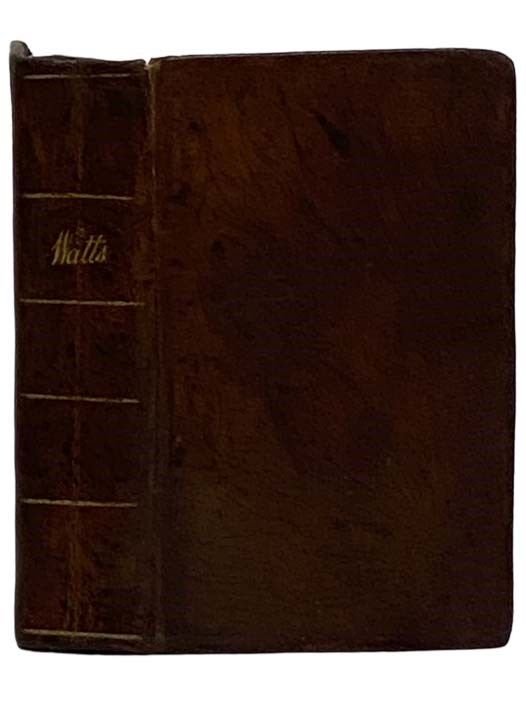
London: Printed for J. Poole, Newgate Street, 1826. Reissue. Full-Leather. Very Good/No Jacket. Front free endpaper missing, edges lightly spotted. 1826 Full-Leather. xxiv, 611, [5] pp. 4 1/2 x 2 3/4. Two of Watts's early works together in one volume. Isaac Watts (17 July 1674 - 25 November 1748), was an English hymn-writer, theologian and logician. He was recognized as the 'Father of English Hymnody,' as he was the first prolific and popular English hymn-writer, credited with some 750 hymns. Many of his hymns remain in active use today and have been translated into many languages. "In the first half of his literary career Watts published four verse collections: Horae lyricae (in two books, 1706; much enlarged and reorganized in three books, 1709); Hymns and Spiritual Songs (1707, enlarged 1709); Divine Songs Attempted in Easy Language, for the Use of Children (1715); and The Psalms of David Imitated in the Language of the New Testament (1719). He also included some hymns in his Sermons on Various Subjects (1721) and some early poems in Reliquiae juveniles: Miscellaneous Thoughts in Prose and Verse (1734); a handful of poems appeared at the beginning of the posthumously published Remnants of Time (1753). As part of these collections he published some very important manifestos: the enlarged preface to Horae (1709); 'A short essay toward the improvement of psalmody', which followed the text of Hymns (1707), but which was not republished in his lifetime; and the prefaces to Hymns and Psalms (the last incorporating some material from the 'Essay'). Watts essentially regarded poetry as a divine gift which should be dedicated to God but which had been profaned. In the revised preface to Horae he invoked the example of the Old Testament poets and associated himself with the principles and practice of John Dennis, Abraham Cowley, Richard Blackmore, John Norris, and John Milton, arguing that the Christian preacher could find abundant aid from the poet. His hymns and psalms clearly illustrated this principle. According to Gibbons (the story originated with Watts's co-pastor Price), Watts complained about the quality of the hymns sung at the meeting at Southampton (perhaps by William Barton), and his father told him to mend the matter, which he did with great success (Gibbons, 254). His brother Enoch in a letter of March 1700 criticizing existing hymns and versions of the psalms urged him to publish his own (Milner, 176 - 9); the success of Horae evidently encouraged him to do so. Watts divided his Hymns into three books, the first paraphrases of biblical texts, the second on general divine subjects, and the third designed for the Lord's supper. In the preface he said that he had sunk the metaphors 'to the level of vulgar capacities', though he hoped 'not to give disgust to persons of richer sense, and nicer education' (Works, 7.122). His work on the hymns and psalms was closely related: the 1706 edition of Horae and the early editions of the Hymns contained several psalms, which he moved to the collected Psalms in 1719. Psalm 114 appeared in The Spectator (no. 461, 19 August 1712). In a note to 'Sickness and recovery' (Watts, Works, 7.364) he explained that he had written only half by 1712 - 13 and after his recovery applied himself to finishing them. His version of the Psalms was not intended as a translation: as the title made clear, they were 'Imitated in the Language of the New Testament and applied to the Christian State and Worship'. This meant bringing David up to date, and substituting Jesus for Jehovah and Britain for Israel. One of Watts's best-known hymns, 'Jesus shall reign where'er the sun', is an imitation of Psalm 72, part 2; another, 'Our God our help in ages past', is based on Psalm 90: 1 - 5 (it was later altered by John Wesley to 'O God our help'). From Hymns the best-known are 'Come let us join our cheerful songs' (1.62, based on Revelation 5: 11 - 13) and 'When I survey the wondrous cross' (3.7). Watts was unequivocal about the value of his religious poetry and the revolution he had brought about in congregational worship: in a note dated 3 March 1720 in the seventh edition of Hymns he said of his two books of hymns and psalms: 'if an Author's own Opinion may be taken, he esteems it the greatest Work that ever he has publish'd, or ever hopes to do for the Use of the Churches' (Escott, 136)." - Oxford Dictionary of National Biography