

Vera, the Medium; 'Miss Civilization
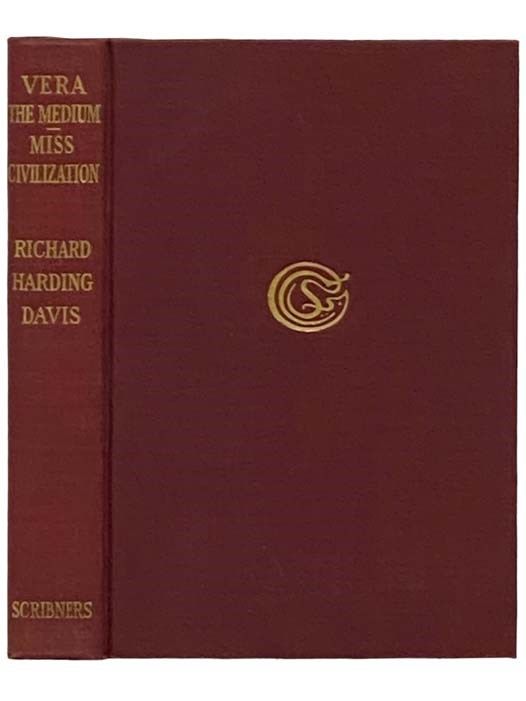
- Hard Cover
- New York: Charles Scribner’s Sons, 1911
New York: Charles Scribner’s Sons, 1911. Reprint. Hard Cover. Near Fine/No Jacket. 0x0x0. Reprint. An excellent copy. Binding tight and square, pages clean, bright, and unmarked. 1911 Hard Cover. 215 pp. Illustrated. ABOUT VERA, THE MEDIUM: INTRODUCTION The early Chinese believed that jade had an immortality of its own and was impervious to decay. For them there was no substance nobler, purer, more durable, more pre-eminently suitable for the fashioning of religious emblems and the embodiment of dogma. Round jade, as round a kernel, the whole body of early Chinese civilisation crystallised. And yet they were not the first discoverers or users of jade, for the Babylonians made seal cylinders of jade, and Professor Elliott Smith believes that the Turkestan jade mountains and rivers were first worked by miners from Mesopotamia who, passing on legends about the magical qualities of jade, infected the Chinese with their beliefs. ABOUT MISS CIVILIZATION: Miss Civilization, a one act comedy, tells the story of a young woman who matches wits with three burglars attempting to rob her house. ABOUT THE AUTHOR: Richard Harding Davis, (born April 18, 1864, Philadelphia, Pa., U.S. - died April 11, 1916, Mount Kisco, N.Y., U.S.), U.S. author of romantic novels and short stories and the best known reporter of his generation. Davis studied at Lehigh and Johns Hopkins universities and in 1886 became a reporter on the Philadelphia Record. He then worked on various newspapers in Philadelphia and New York, wrote short stories, and in 1890 became managing editor of Harper's Weekly. On Harper's assignments he toured various parts of the globe, recording his impressions of the American West, Europe, and South America in a series of books (1892 - 96). He was a war correspondent, reporting every war from the Greco-Turkish to World War I. He plunged into what he reported, defying rules in order to join in the battle of San Juan Hill in the Spanish - American War; he was nearly shot by the Germans as a spy in World War I. His early fiction achieved immediate success, particularly Gallegher and Other Stories (1891), a collection of newspaper stories, Van Bibber and Others (1892), and Ranson's Folly (1902). Many of his published works were illustrated by Charles Dana Gibson. He wrote seven popular novels published between 1897 and 1909. Several of his 25 plays were also very successful, notably Ranson's Folly (1904), The Dictator (1904), and Miss Civilization (1906).