

The Social Significance of the Modern Drama
- SIGNED
- Boston: Richard G. Badger, 1914
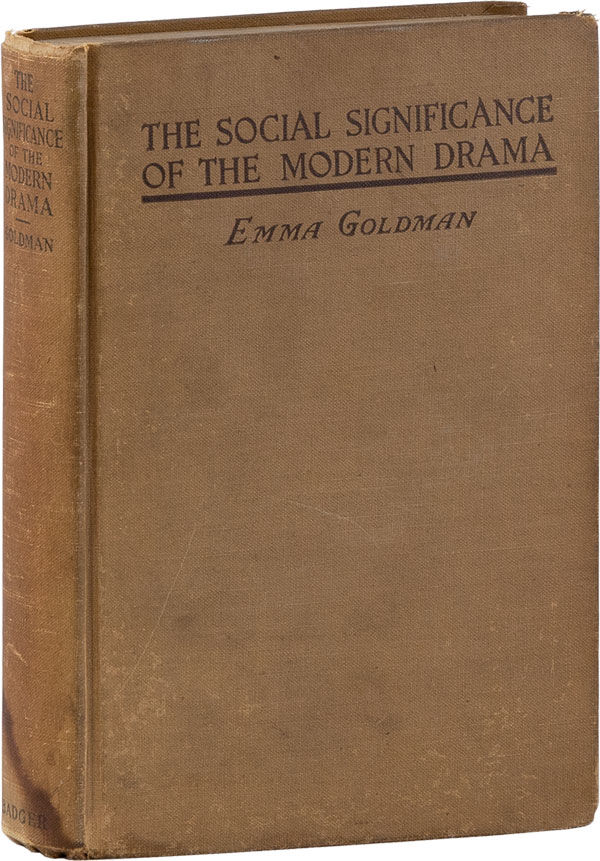
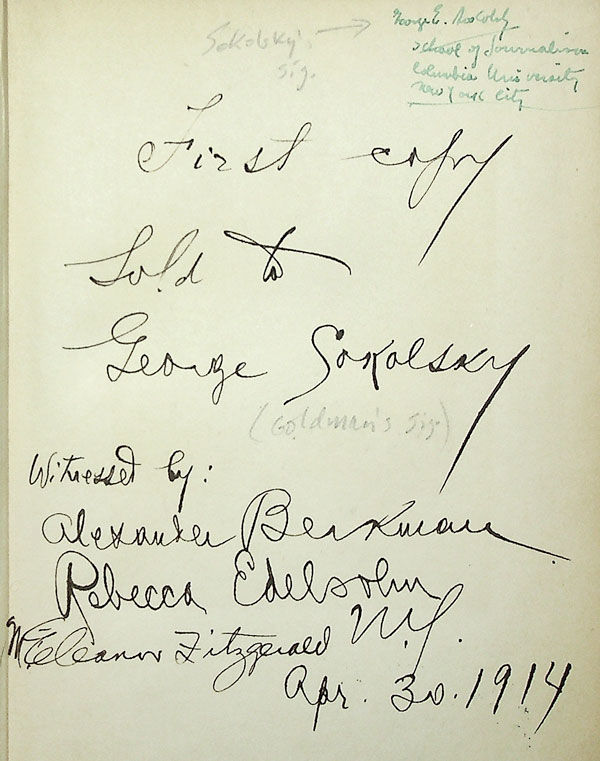
Boston: Richard G. Badger, 1914. First Edition. Octavo (19cm); light brown cloth, with titles stamped in black on spine and front cover; portrait frontispiece; 315,[1],[4]pp ads. This copy originally owned by American radio broadcaster and newspaper columnist George Ephraim Sokolsky (1893-1962), with his pictorial bookplate mounted to front pastedown, and his holograph signature ("George E. Sokolsky / School of Journalism / Columbia University / New York City") at upper right corner of front endpaper. Beneath his signature is a holograph note in Emma Goldman's hand: "First copy sold to George Sokolsky." "Witnessed by:" (also in her hand), followed by the holograph signatures of Alexander Berkman, Rebecca Edelsohn, and M. Eleanor Fitzgerald, and dated N.Y. April 30, 1914. Circular rubber stamp of the Otis Free Public Library (Otis, MA) on lower front pastedown, with an unused library "Date Due" card tipped onto rear endpaper, and beige trapezoidal paper remnant mounted to lower rear pastedown. Moderate wear, sunning to spine, with old, faint dampstaining to 3/4 of rear cover and base of spine; contents clean, but for some neat underlining in Sokolsky's hand on pp.175-176, and a brief note written horizontally in the left margin of p.3, that this was gifted (presumably to the library) in 1950; just Very Good, lacking the rare dustjacket. Goldman's treatise on the political implications of significant playwrights in the late 19th and early 20th centuries. The book featured Goldman's analyses on the political - even radical - work of Scandinavian, German, French, English, Irish, and Russian playwrights, touching on works by Ibsen, Strindberg, Sudermann, Hauptmann, Rostand, Shaw, Galsworthy, Yeats, Tolstoy, Chekov, and Andreyev, among others.
A distinguished and most curious copy – apparently the first copy off the press, sold to Sokolsky while he was still a student at Columbia University's School of Journalism, where he was a leader among student radicals. Sokolsky was part of the welcoming committee for Leon Trotsky when he arrived in New York in January, 1917. Shortly thereafter, he went to Russia and began writing for the English-language Russian Daily News, though after the Kerensky government was overthrown by the Bolsheviks, he became disillusioned with the revolution. The Bolsheviks kicked him out of Russia in March, 1918, and with Trotsky's assistance he was able to flee to China, where he spent the next 14 years working variously as a special correspondent for English-language newspapers, an informant, propagandist, and political adviser to Sun Yat-sen. After his return to the U.S. in 1935, he became stridently anti-communist, ultimately becoming both a vocal supporter of and mentor to Senator Joseph McCarthy. This copy is a relic of Sokolsky's most radical period, bearing a quartet of signatures from some of the 20th century's most prominent anarchist voices: Goldman and Berkman, but also Rebecca Edelsohn (1892-1973, Berkman's lover, and the first political hunger striker in America), and Mary Elizabeth Fitzgerald (1877-1955, an intimate of the Goldman/Berkman circle, member of the Provincetown Players, and co-editor of The Blast with Berkman after they relocated to San Francisco). [60851].
A distinguished and most curious copy – apparently the first copy off the press, sold to Sokolsky while he was still a student at Columbia University's School of Journalism, where he was a leader among student radicals. Sokolsky was part of the welcoming committee for Leon Trotsky when he arrived in New York in January, 1917. Shortly thereafter, he went to Russia and began writing for the English-language Russian Daily News, though after the Kerensky government was overthrown by the Bolsheviks, he became disillusioned with the revolution. The Bolsheviks kicked him out of Russia in March, 1918, and with Trotsky's assistance he was able to flee to China, where he spent the next 14 years working variously as a special correspondent for English-language newspapers, an informant, propagandist, and political adviser to Sun Yat-sen. After his return to the U.S. in 1935, he became stridently anti-communist, ultimately becoming both a vocal supporter of and mentor to Senator Joseph McCarthy. This copy is a relic of Sokolsky's most radical period, bearing a quartet of signatures from some of the 20th century's most prominent anarchist voices: Goldman and Berkman, but also Rebecca Edelsohn (1892-1973, Berkman's lover, and the first political hunger striker in America), and Mary Elizabeth Fitzgerald (1877-1955, an intimate of the Goldman/Berkman circle, member of the Provincetown Players, and co-editor of The Blast with Berkman after they relocated to San Francisco). [60851].