

Autograph manuscript, written aboard the USS De Soto at St. Thomas, Virgin Islands, giving a first-hand account of the 1867 earthquake and tsunami that hit the island
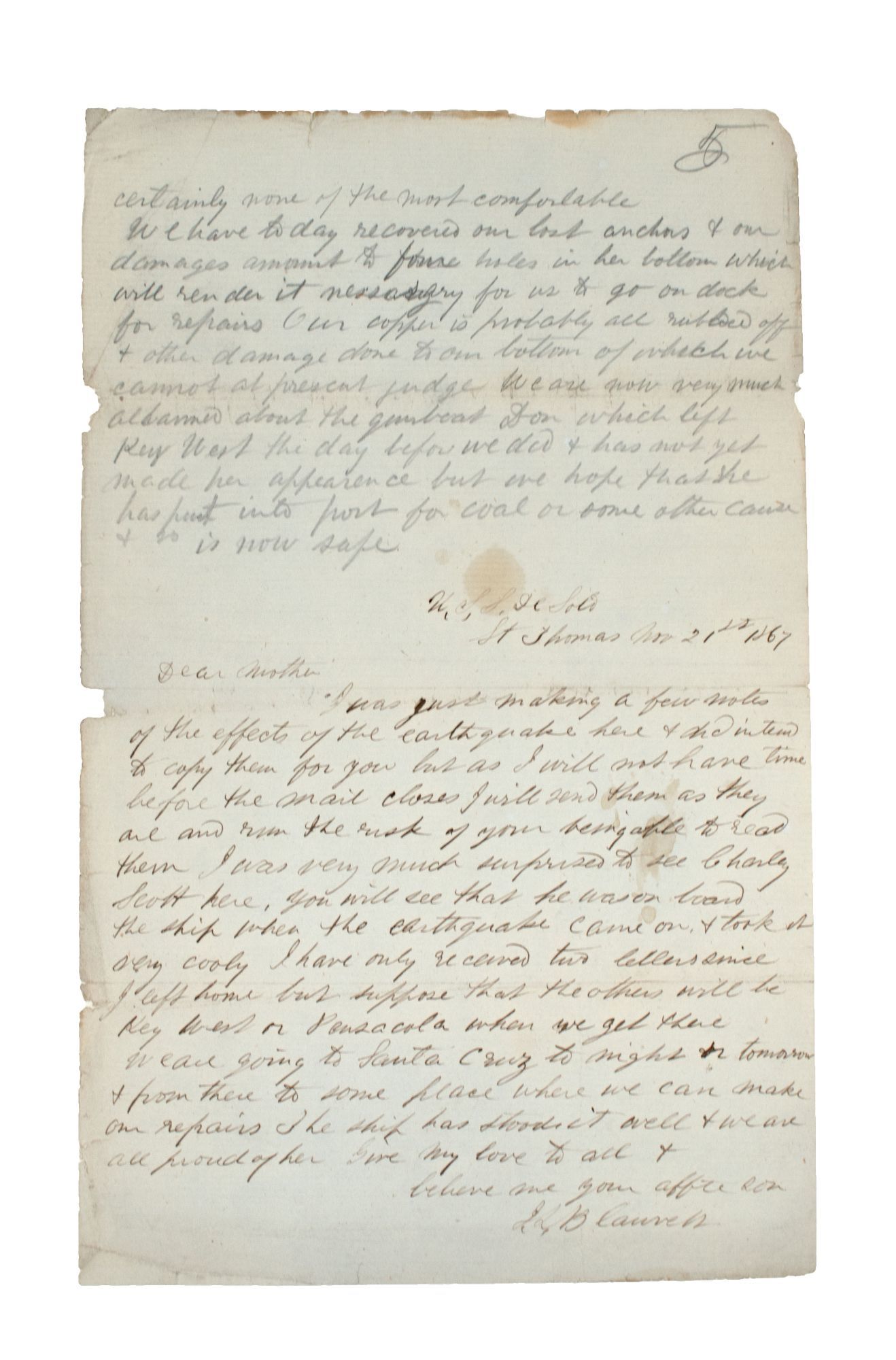
- SIGNED 5pp. (written on rectos only) on folio sheets, with an autograph letter signed addressed to his mother on the fifth page sending
- St. Thomas, Virgin Islands , 1867
St. Thomas, Virgin Islands, 1867. 5pp. (written on rectos only) on folio sheets, with an autograph letter signed addressed to his mother on the fifth page sending the manuscript, following the description of events. A total of sum 1250 words. Folio. Sheets with wear around the edges. Each sheet neatly backed with paper, repairing small tears or separations. Overall, in good condition, and very readable. 5pp. (written on rectos only) on folio sheets, with an autograph letter signed addressed to his mother on the fifth page sending the manuscript, following the description of events. A total of sum 1250 words. Folio. An exciting firsthand account by an American sailor, describing the effects of the terrible earthquakes and tsunamis that hit the Virgin Islands on November 18, 1867. J.L.B. Cauvelt was a sailor aboard the U.S.S. De Soto, which was anchored in the harbor of St. Thomas when the earthquake hit. The ship was badly damaged in the resultant tsunamis caused by the earthquakes, which had an estimated 7.5 magnitude on the Richter scale. These are Cauvelt's original notes of his experiences, written shortly afterward and appended to a letter he wrote his mother on November 21.
On the afternoon of November 18, 1867, a magnitude 7.5 earthquake occurred in the Anegada trough, located between the Virgin Islands of St. Croix and St. Thomas. The earthquake actually consisted of two shocks, separated by ten minutes. These shocks generated two tsunami waves that were recorded at several island locations across the eastern Caribbean region, most notably on the islands of St. Thomas and St. Croix. The U.S.S. De Soto was docked at St. Thomas when the earthquake hit. Initially a private commercial ship, the De Soto was purchased by the United States Navy at the outbreak of the Civil War. The ship assisted in the blockade of Confederate ports, and participated in the capture or destruction of numerous blockade runners. The De Soto and two other American naval vessels arrived at St. Thomas on November 17, 1867, a day before the earthquakes and tsunamis hit. The De Soto was initially thrown onto a wharf, but was carried back to deep water by the next wave that hit St. Thomas. Badly damaged, the ship was repaired by its crew over the following days.
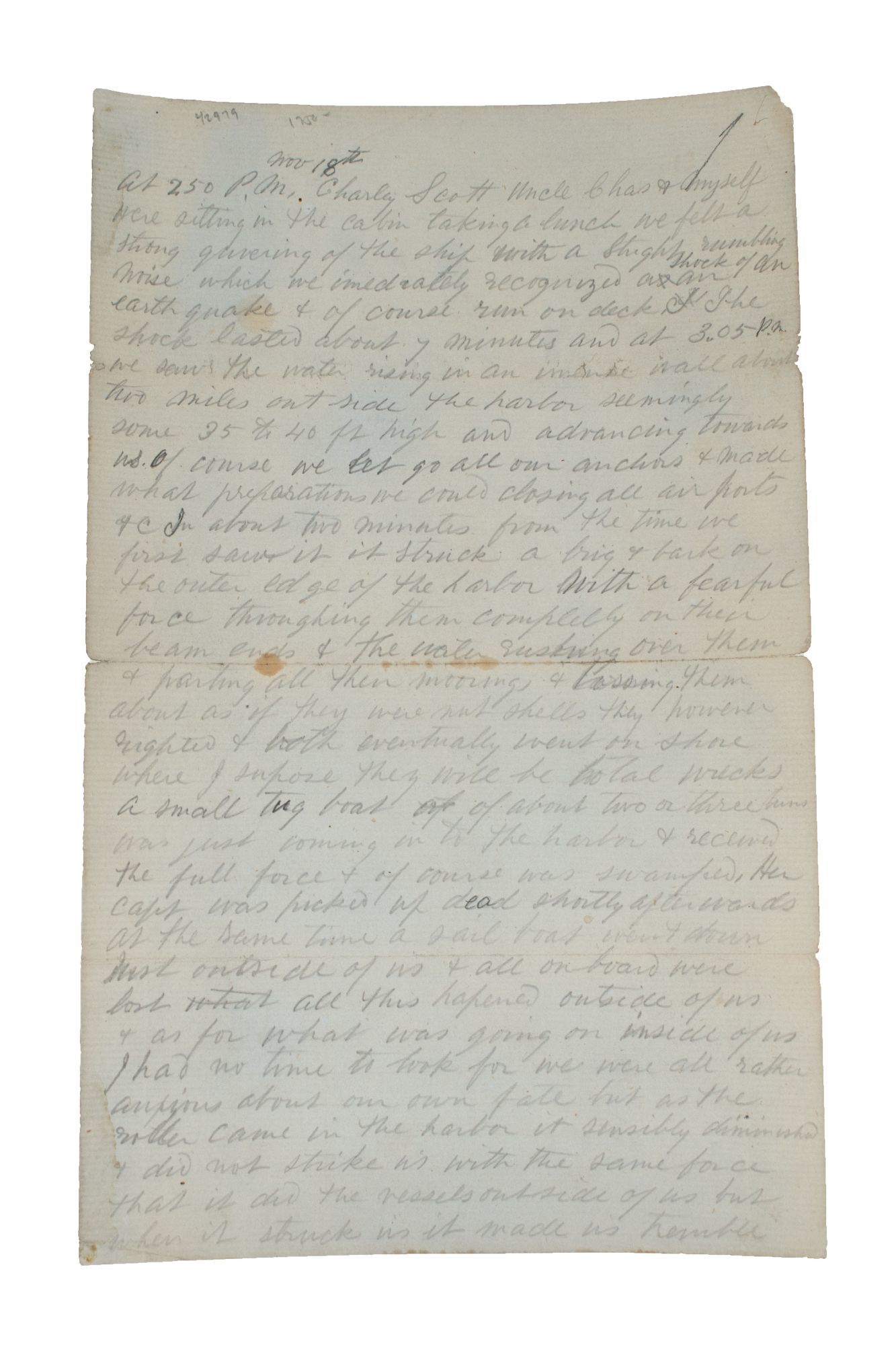
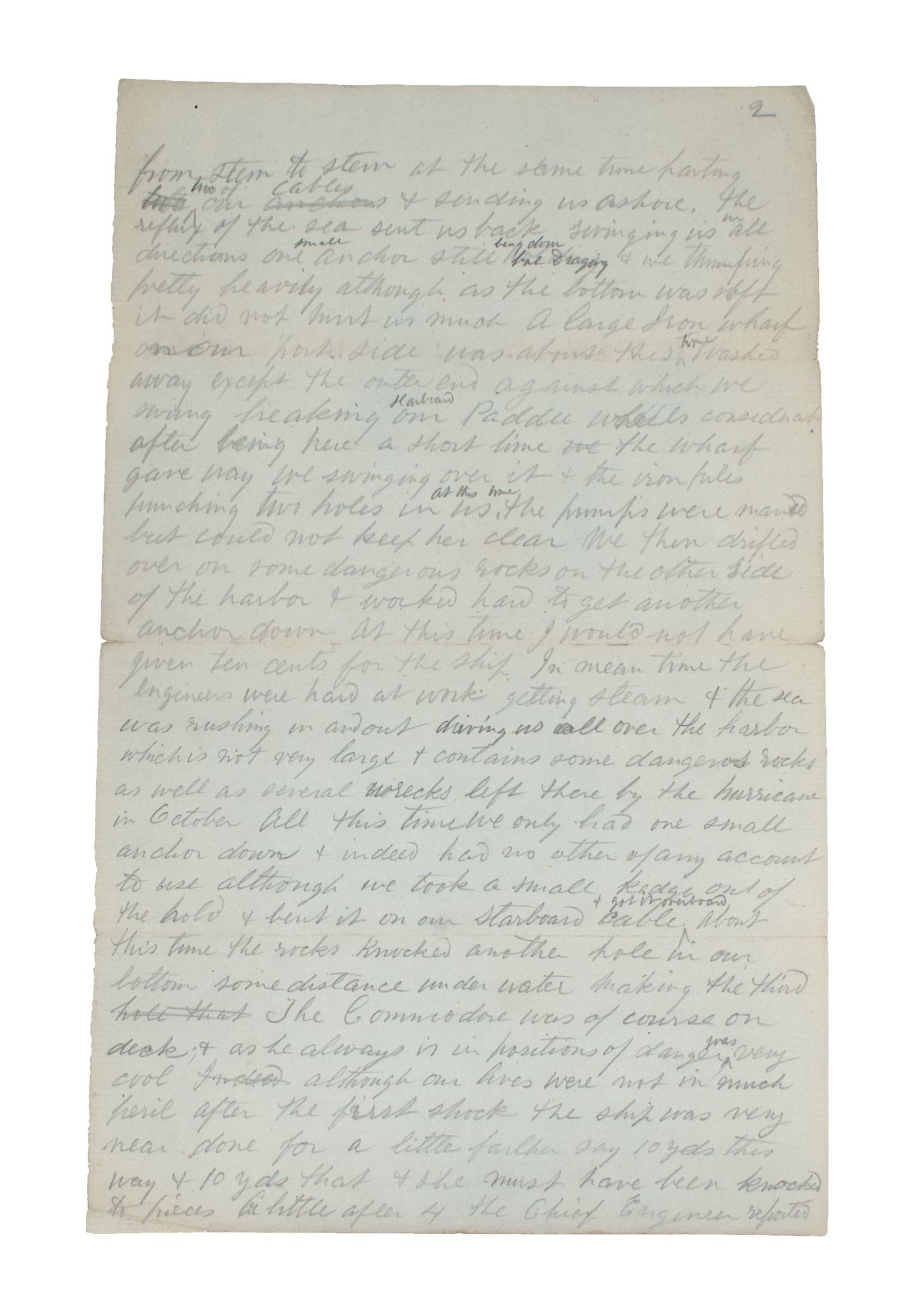
Cauvelt begins by describing the earthquake and resultant tsunami: "At 2.50 p.m. Nov. 18th...we felt a strong quivering of the ship with a slight rumbling noise which we immediately recognized as a shock of an earthquake & of course run on deck. The shock lasted about 7 minutes and at 3.05 p.m. we saw the water rising in an immense wall about two miles out side the harbor, seemingly some 35 to 40 ft. high and advancing towards us. Of course we let go all our anchors & made what preparations we could closing all air ports &c. In about two minutes from the time we first saw it it struck a brig & bark on the outer edge of the harbor with a fearful force throwing them completely on their beam ends & the water rushing over them & parting all their moorings & tossing them about as if they were but shells. They however righted & both eventually went on shore where I suppose they will be total wrecks. A small tug boat of about two or three beams was just coming in to the harbor & received the full force & of course was swamped. Her capt. was picked up dead shortly afterwards. At the same time a sail boat went down just outside of us & all on board were lost. All this happened outside of us & as for what was going on inside of us I had no time to look for we were all rather anxious about our own fate but as the water came in the harbor it sensibly diminished & did not strike us with the same force that it did the vessels outside of us but when it struck us it made us tremble from stem to stern, at the same time parting two of our cables & sending us ashore. The reflux of the sea sent us back swinging us in all directions. One small anchor still being down but dragging & we thumping pretty heavily although as the bottom was soft it did not hurt us much. A large iron wharf on our port side was about this time washed away except the outer end against which we swung breaking our starboard paddle wheels. After being here a short time the wharf gave way, we swinging over it & the iron poles punching two holes in us. At this time the pumps were manned but could not keep her clear. We then drifted over on some dangerous rocks on the other side of the harbor & worked hard to get another anchor down. At this time I would not have given ten cents for the ship."
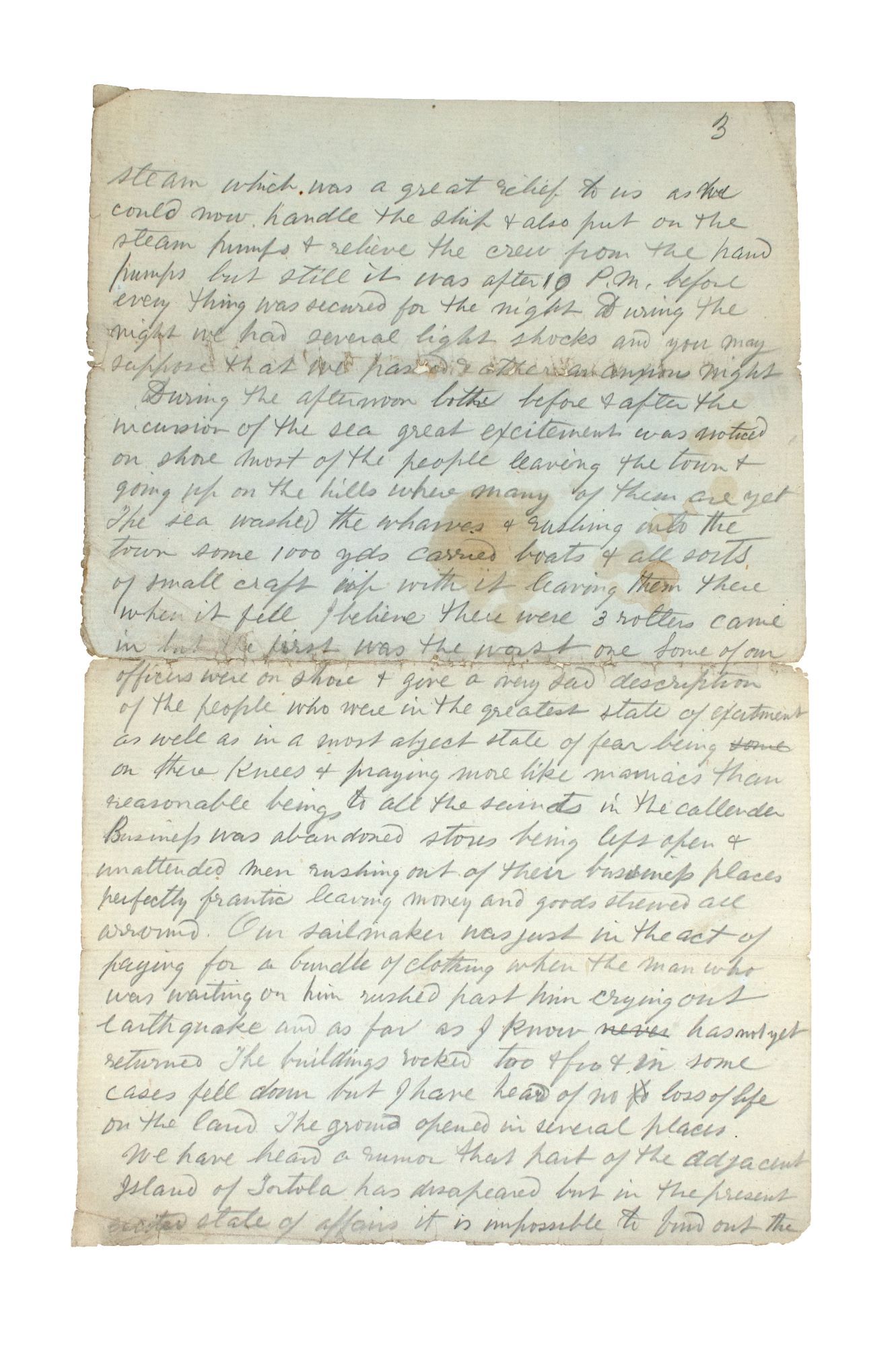
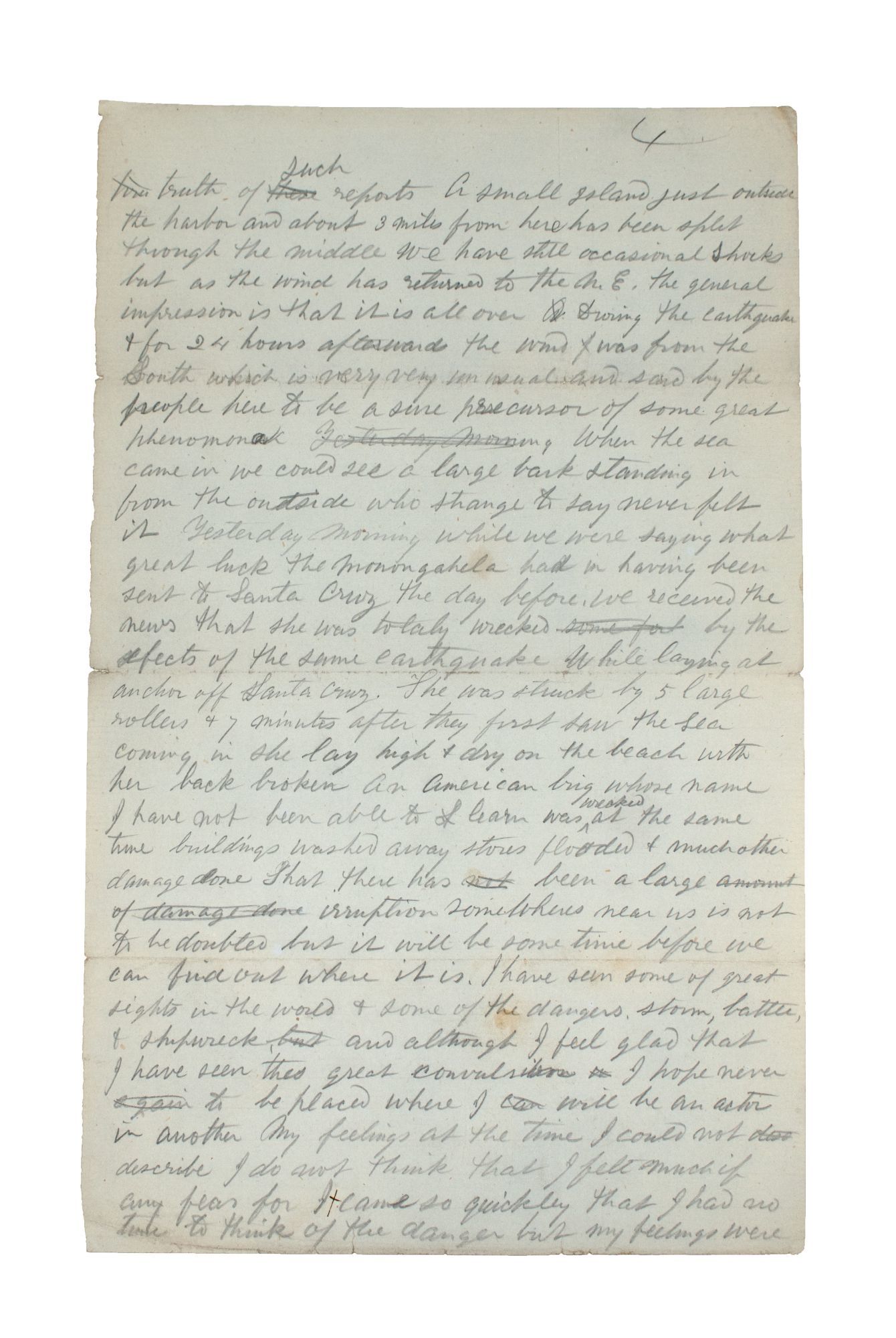
Cauvelt goes on to describe the cool-headed response of the De Soto's commodore, and the repairs that were effected over the next few days. He mentions that another American naval vessel, the Monongahela, which had been sent to Santa Cruz from St. Thomas the day before "was totally wrecked by the effects of the same earthquake...She was struck by 5 large rollers & 7 minutes after they first saw the sea coming in she lay high & dry on the beach with her back broken." Cauvelt also comments on the destruction caused by the tsuanmis on St. Thomas itself, and the plight of the people of the island: "[they] were in the greatest state of excitement as well as in a most abject state of fear being on there [sic] knees & praying more like maniacs than reasonable beings to all the saints in the callender [sic]. Business was abandoned stores being left open & unattended, men rushing out of their business places perfectly frantic leaving money and goods strewed all around."
A remarkable letter, giving a detailed account of a terrible series of earthquakes and tsumanis in the Caribbean in 1867.
On the afternoon of November 18, 1867, a magnitude 7.5 earthquake occurred in the Anegada trough, located between the Virgin Islands of St. Croix and St. Thomas. The earthquake actually consisted of two shocks, separated by ten minutes. These shocks generated two tsunami waves that were recorded at several island locations across the eastern Caribbean region, most notably on the islands of St. Thomas and St. Croix. The U.S.S. De Soto was docked at St. Thomas when the earthquake hit. Initially a private commercial ship, the De Soto was purchased by the United States Navy at the outbreak of the Civil War. The ship assisted in the blockade of Confederate ports, and participated in the capture or destruction of numerous blockade runners. The De Soto and two other American naval vessels arrived at St. Thomas on November 17, 1867, a day before the earthquakes and tsunamis hit. The De Soto was initially thrown onto a wharf, but was carried back to deep water by the next wave that hit St. Thomas. Badly damaged, the ship was repaired by its crew over the following days.
Cauvelt begins by describing the earthquake and resultant tsunami: "At 2.50 p.m. Nov. 18th...we felt a strong quivering of the ship with a slight rumbling noise which we immediately recognized as a shock of an earthquake & of course run on deck. The shock lasted about 7 minutes and at 3.05 p.m. we saw the water rising in an immense wall about two miles out side the harbor, seemingly some 35 to 40 ft. high and advancing towards us. Of course we let go all our anchors & made what preparations we could closing all air ports &c. In about two minutes from the time we first saw it it struck a brig & bark on the outer edge of the harbor with a fearful force throwing them completely on their beam ends & the water rushing over them & parting all their moorings & tossing them about as if they were but shells. They however righted & both eventually went on shore where I suppose they will be total wrecks. A small tug boat of about two or three beams was just coming in to the harbor & received the full force & of course was swamped. Her capt. was picked up dead shortly afterwards. At the same time a sail boat went down just outside of us & all on board were lost. All this happened outside of us & as for what was going on inside of us I had no time to look for we were all rather anxious about our own fate but as the water came in the harbor it sensibly diminished & did not strike us with the same force that it did the vessels outside of us but when it struck us it made us tremble from stem to stern, at the same time parting two of our cables & sending us ashore. The reflux of the sea sent us back swinging us in all directions. One small anchor still being down but dragging & we thumping pretty heavily although as the bottom was soft it did not hurt us much. A large iron wharf on our port side was about this time washed away except the outer end against which we swung breaking our starboard paddle wheels. After being here a short time the wharf gave way, we swinging over it & the iron poles punching two holes in us. At this time the pumps were manned but could not keep her clear. We then drifted over on some dangerous rocks on the other side of the harbor & worked hard to get another anchor down. At this time I would not have given ten cents for the ship."
Cauvelt goes on to describe the cool-headed response of the De Soto's commodore, and the repairs that were effected over the next few days. He mentions that another American naval vessel, the Monongahela, which had been sent to Santa Cruz from St. Thomas the day before "was totally wrecked by the effects of the same earthquake...She was struck by 5 large rollers & 7 minutes after they first saw the sea coming in she lay high & dry on the beach with her back broken." Cauvelt also comments on the destruction caused by the tsuanmis on St. Thomas itself, and the plight of the people of the island: "[they] were in the greatest state of excitement as well as in a most abject state of fear being on there [sic] knees & praying more like maniacs than reasonable beings to all the saints in the callender [sic]. Business was abandoned stores being left open & unattended, men rushing out of their business places perfectly frantic leaving money and goods strewed all around."
A remarkable letter, giving a detailed account of a terrible series of earthquakes and tsumanis in the Caribbean in 1867.