

W.S. Van Dyke's Journal: White Shadows in the South Seas (1927-1928), and Other Van Dyke on Van Dyke
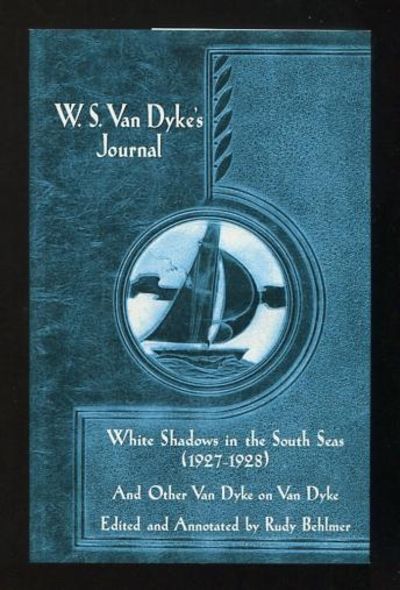
- Hardcover
- Lanham MD/London: The Scarecrow Press, Inc., (c.1996)
Lanham MD/London: The Scarecrow Press, Inc.. Fine in Fine dj. (c.1996). First Edition. Hardcover. [as-new, with no discernible wear to either book or jacket]. (B&W photographs) A fascinating little volume, the centerpiece of which -- the so-called "journal" -- is actually an edited version of a four lengthy letters, sent over the course of several months from the Tahiti location of WHITE SHADOWS IN THE SOUTH SEAS by its eventual director, W.S. "Woody" Van Dyke II, to his then girlfriend (and sometime script supervisor) Josephine Chippo, back in Los Angeles. The letters -- about equally divided between on-location reportage and pining-for-you expressions of his devotion -- were discovered in the early 1990s inside an old trunk at the home of a recently-deceased couple in the San Fernando Valley, and subsequently acquired by the Academy of Motion Picture Arts and Sciences' Margaret Herrick Library, where they are held today as the Josephine Chippo papers. I refer to Van Dyke as the "eventual" director of WHITE SHADOWS because that's not how things started out: the crew was originally dispatched to its distant location under the direction of the great documentary filmmaker Robert Flaherty, the idea being that he would apply his documentarian's visual and ethnographic sensibilities to a dramatic romance of the South Seas, with Monte Blue and Raquel Torres as its stars. However, the producing studio (Metro-Goldwyn-Mayer), understandably dubious about Flaherty's ability to direct a fictional film, assigned Van Dyke to the company to assume responsibility for directing the picture's dramatic sequences. It was a big deal for Van Dyke, who had been directing primarily serials and westerns since 1917 but had only been under contract to M-G-M for about a year or so, and had yet to helm a major production. Long story short, when Flaherty proved unequal to the task, Van Dyke was asked to take over as the primary director, and ended up as the sole credited director. (Without divulging any spoilers, I will only note that anyone who might revere Flaherty as one of the gods of early cinema will have their eyes opened by Van Dyke's account of his behavior on this distant and difficult location, and by learning of the reasons for the studio's dismissal of Flaherty halfway through the shoot.) Editor Behlmer has framed and supplemented this unique document with a variety of documentation and commentary regarding Van Dyke, including: excerpts from the transcript of a story conference for TARZAN, THE APE MAN, which Van Dyke directed a few years later; a couple of 1930s fan magazine articles (one by Van Dyke himself); comments by several of his professional associates, including Myrna Loy and Ingrid Bergman; and a bibliography and filmography. (xx) .