

The Air War in Indochina
- Boston: Beacon Press, 1972
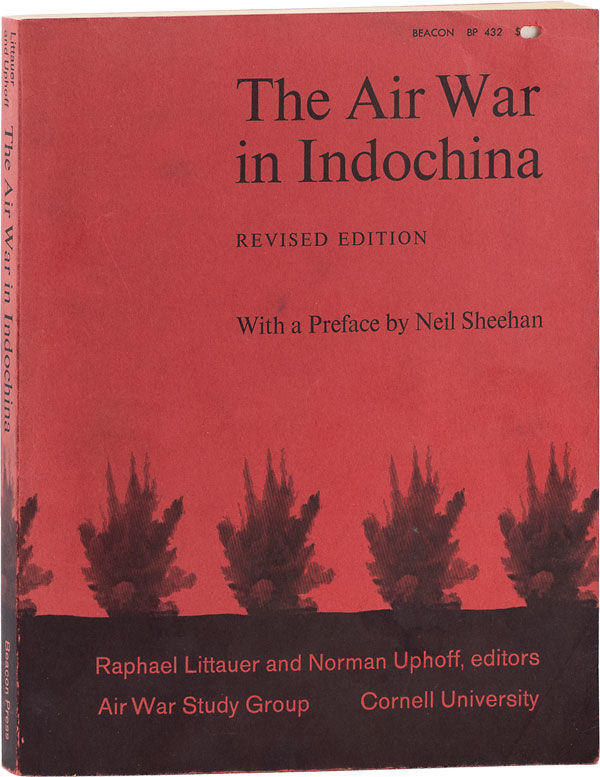
Boston: Beacon Press, 1972. First Revised Edition. 4to. 28cm x 22cm. Publisher's red pictorial card covers. Minor creasing and soiling, most visibly to the lower corner of the front cover, price discreetly excised with a hole punch to the upper front corner. Clean and sharp, a very good copy. 289pp. Internally clean. A very highly detailed and in-depth assessment of the resources, manpower, and costs in play during the air war component of the war in Vietnam with a particular focus upon the intangible nature of that conflict to the average American. An air war is distant and notionally inaccessible to the general public, is the general argument of the work, which was compiled initially in a smaller report in November 1971, then expanded upon by the Anti-War Study group at Cornell University and a wider body of contributors including Rapahel Littauer, Saha Amarasingham, Chandler Morse, Norman Uphoff, and Carl Sagan, amongst a number of others assessing the impact upon economies, ecologies, diverse human populations, neighbouring nations, and the potential continuing and more widespread effects that would be expected to spiral outwards should the aerial campaign continue at contemporary levels. One of the primary thrusts of the research is that Nixon's government used the execution of a massive and sustained aerial campaign to push forward initiatives they would not otherwise have been permitted to pursue for various physical, economic, and humanitarian reasons. One of many sobering points put across throughout the course of the study is that by the time of publication the US had dropped more bombs on Vietname than were dropped on Europe during the entirety of WW2.