

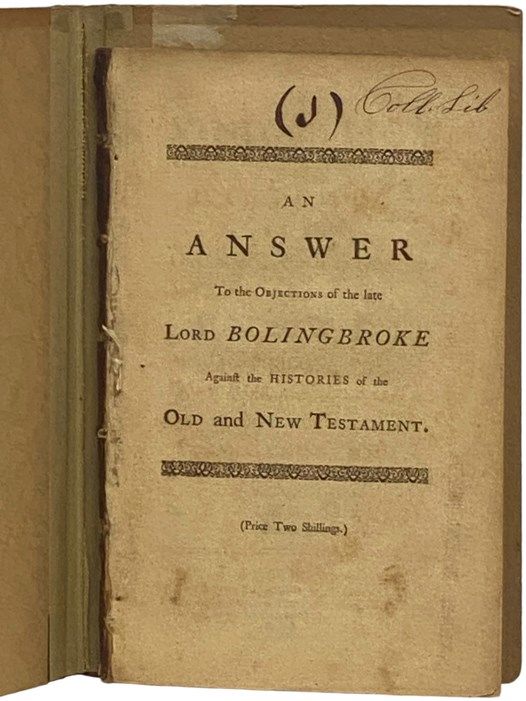
A Vindication of the Histories of the Old and New Testament. In Answer to the Objections of the Late Lord Bolingbroke. In Two Letters to a Young Nobleman
- Hard Cover
- London/Dublin: Bowyer, 1753
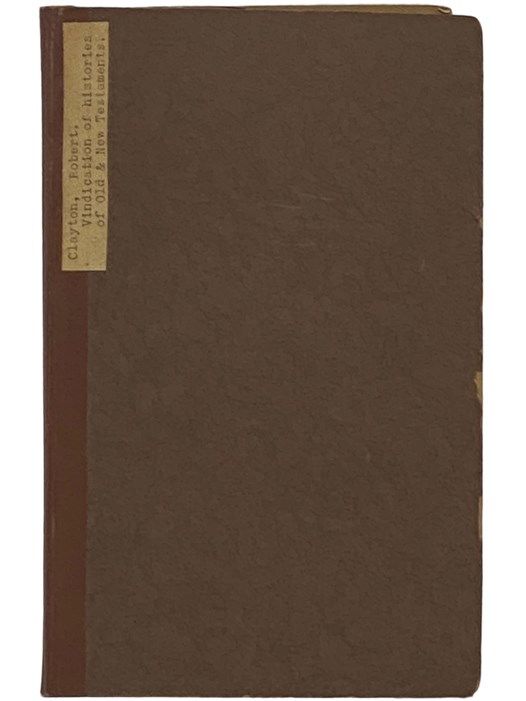
London/Dublin: Bowyer, 1753. Hard Cover. Fair/No Jacket. Boards missing, set in paper binding. Label on front board. Pencil note on flyleaf, ink note on half-title page and title page, ink stamp on title page verso. 1753 Hard Cover. 140 pp. First of what would be three parts, printed 1742-1758. Robert Clayton (1695–1758) was an Irish Protestant bishop, now known for his Essay on Spirit. In his own lifetime, he was notorious for his unorthodox beliefs, which led his critics to question whether he could properly be called a Christian at all, and at the time of his death, he was facing charges of heresy. Clayton proposed, 2 February 1756, in the Irish House of Lords, that the Athanasian creed and Nicene creed should be removed from the liturgy of the Church of Ireland. Despite the controversy this aroused, no proceedings were taken against him until the publication of the third part of the 'Vindication of ... the Old and New Testament,' Dublin, 1757, when he renewed his attack on the Trinity and advanced doctrines contrary to the Thirty-nine Articles. Horace Walpole said caustically that his Vindication seemed calculated to destroy anyone's faith in the Testaments. The government, by now seriously alarmed by the heterodoxy of Clayton's opinions, ordered that he be prosecuted for heresy: a meeting of Irish prelates was called at the house of the Primate of Ireland, and Clayton was summoned to attend. Before the appointed time he died, on 26 February 1758. His next work was 'A Vindication of the Histories of the Old and New Testament, in answer to the Objections of . . . Bolingbroke,' pt. i., Dublin, 1752. In 1753 he published 'A Journey from Grand Cairo to Mount Sinai, and back again. In Company with some Missionaries de propaganda Fide,' &c., translated from a manuscript which had been mentioned by Edward Pococke in his 'Travels.' It included an account of the supposed inscriptions of the Israelites in the Gebel el Mokatab. The work was addressed to the Society of Antiquaries, and the author offered to assist an exploration in Mount Sinai, but the society took no steps in the matter. Edward Wortley Montagu, however, was induced to visit the spot and give an account of the inscriptions. The same year Clayton published 'A Defence of the Essay on Spirit,' London. His next work was 'Some Thoughts on Self-love, Innate Ideas, Freewill,' &c., occasioned by David Hume's works, London, 1754. The same year he brought out the second part of the 'Vindication of ... the Old and New Testament,' Dublin. This produced Alexander Catcott's attack on his theories of the earth's form and the deluge. In 1756 appeared 'Letters which passed between . . . the Bishop of Clogher and Mr. William Penn concerning Baptism,' London, in which he asserted the cessation of baptism by the Holy Ghost. Clayton's friend William Bowyer obtained a copy of the correspondence and published it.