

The Devonian of Southwestern Ontario, Memoir 34, No. 63, Geological Series
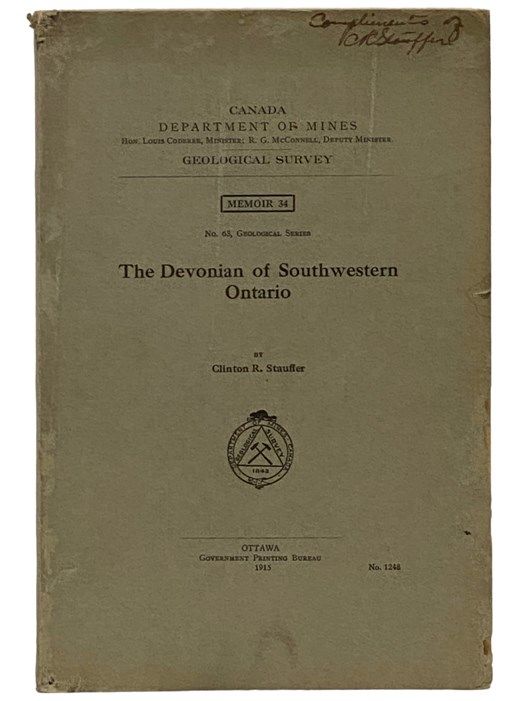
- SIGNED Soft Cover
- Ottawa, Canada: Government Printing Bureau, 1915
Ottawa, Canada: Government Printing Bureau, 1915. Soft Cover. Good. 0x0x0. Signed by author. Presentation copy signed by author on front wrapper. Hinges reinforced with tape, small chips and small tears to wrapper edges. 1915 Soft Cover. v, 341, vii pp. Large color folding map in rear pocket, 20 photographic plates. The Devonian is a geologic period and system of the Paleozoic era during the Phanerozoic eon, spanning 60.3 million years from the end of the preceding Silurian period at 419.2 million years ago (Ma), to the beginning of the succeeding Carboniferous period at 358.9 Ma. It is named after Devon, South West England, where rocks from this period were first studied. The first significant evolutionary radiation of life on land occurred during the Devonian, as free-sporing land plants (pteridophytes) began to spread across dry land, forming extensive coal forests which covered the continents. By the middle of the Devonian, several groups of vascular plants had evolved leaves and true roots, and by the end of the period the first seed-bearing plants (pteridospermatophytes) appeared. The earliest land animals, predominantly arthropods such as myriapods, arachnids and hexapods, also became well-established early in this period, after beginning their colonization of land at least from the Ordovician period. Fishes, especially jawed fish, reached substantial diversity during this time, leading the Devonian to often be dubbed the Age of Fishes. The armored placoderms began dominating almost every known aquatic environment. In the oceans, cartilaginous fishes such as primitive sharks became more numerous than in the Silurian and Late Ordovician. Tetrapodomorphs, which include the ancestors of all four-limbed vertebrates (i.e. tetrapods), began diverging from freshwater lobe-finned fish as their more robust and muscled pectoral and pelvic fins gradually evolved into forelimbs and hindlimbs, though they were not fully established for life on land until the Late Carboniferous. The first ammonites, a subclass of cephalopod molluscs, appeared. Trilobites, brachiopods and the great coral reefs were still common during the Devonian. The Late Devonian extinction, which started about 375 Ma, severely affected marine life, killing off most of the reef systems, most of the jawless fish, half of all placoderms, and nearly all trilobites save for a few species of the order Proetida. The subsequent end-Devonian extinction, which occurred at around 359 Ma, further impacted the ecosystems and completed the extinction of all calcite sponge reefs and placoderms. Devonian palaeogeography was dominated by the supercontinent Gondwana to the south, the small continent of Siberia to the north, and the medium-sized continent of Laurussia to the east. Major tectonic events include the closure of the Rheic Ocean, the separation of South China from Gondwana, and the resulting expansion of the Paleo-Tethys Ocean. The Devonian experienced several major mountain-building events as Laurussia and Gondwana approached; these include the Acadian Orogeny in North America and the beginning of the Variscan Orogeny in Europe. These early collisions preceded the formation of the single supercontinent Pangaea in the Late Paleozoic.