

The Name 'Marylebone' and Cordwainer Ward: Its History and Topography
- Stapled Binding
- UK: The London and Middlesex Archaeological Society, 1918
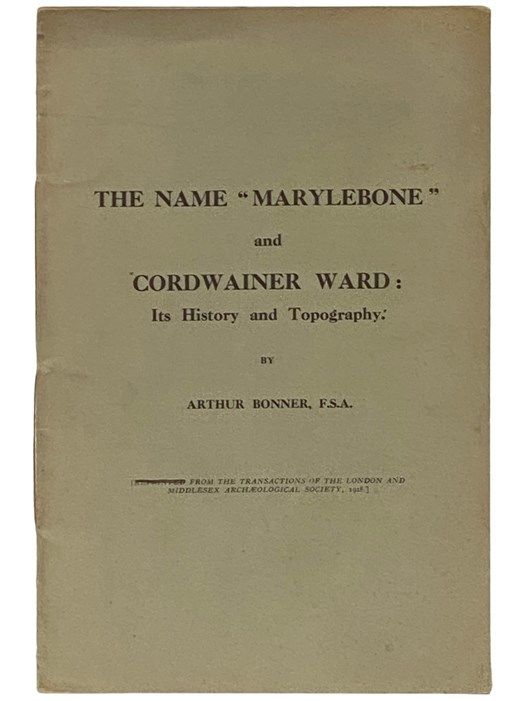
UK: The London and Middlesex Archaeological Society, 1918. Stapled Binding. Very Good. 0x0x0. Ink mark on front wrapper. 1918 Stapled Binding. 75-104 pp. Reprinted from The Transactions of The London and Middlesex Archaeological Society, 1918. Marylebone is a district in the West End of London, in the City of Westminster. Oxford Street forms its southern boundary. An ancient parish and latterly a metropolitan borough, it merged with the boroughs of Westminster and Paddington to form the new City of Westminster in 1965. Marylebone station lies two miles north-west of Charing Cross. There are also two tube stations in Marylebone – Baker Street and Bond Street. Marylebone was an Ancient Parish formed to serve the manors (landholdings) of Lileston (in the west, which gives its name to modern Lisson Grove) and Tyburn in the east. The parish is likely to have been in place since at least the twelfth century and will have used the boundaries of the pre-existing manors. The boundaries of the parish were consistent from the late twelfth century to the creation of the Metropolitan Borough which succeeded it. Cordwainer is a small, almost rectangular-shaped ward in the City of London, England. It is named after the cordwainers, the professional shoemakers who historically lived and worked in this particular area of London; there is a Livery Company for the trade — the Worshipful Company of Cordwainers. The ward is sometimes referred to as the "Cordwainers' ward". It is bounded to the north by Poultry and Cheapside (the boundary with Cheap ward); to the west by the eponymous Bread Street and the ward of the same name; to the south by Cannon Street (and Vintry and Dowgate wards); and to the east by Walbrook ward and a street of the same name. Streets within Cordwainer's boundaries are, amongst others, Bow Lane, Pancras Lane and part of Watling Street. Queen Street runs north–south through the centre of the ward.