

Hymns [from the Yattendon Hymnal, with Notices of the Tunes for which they were written]





- Oxford: Henry Daniel, 1899
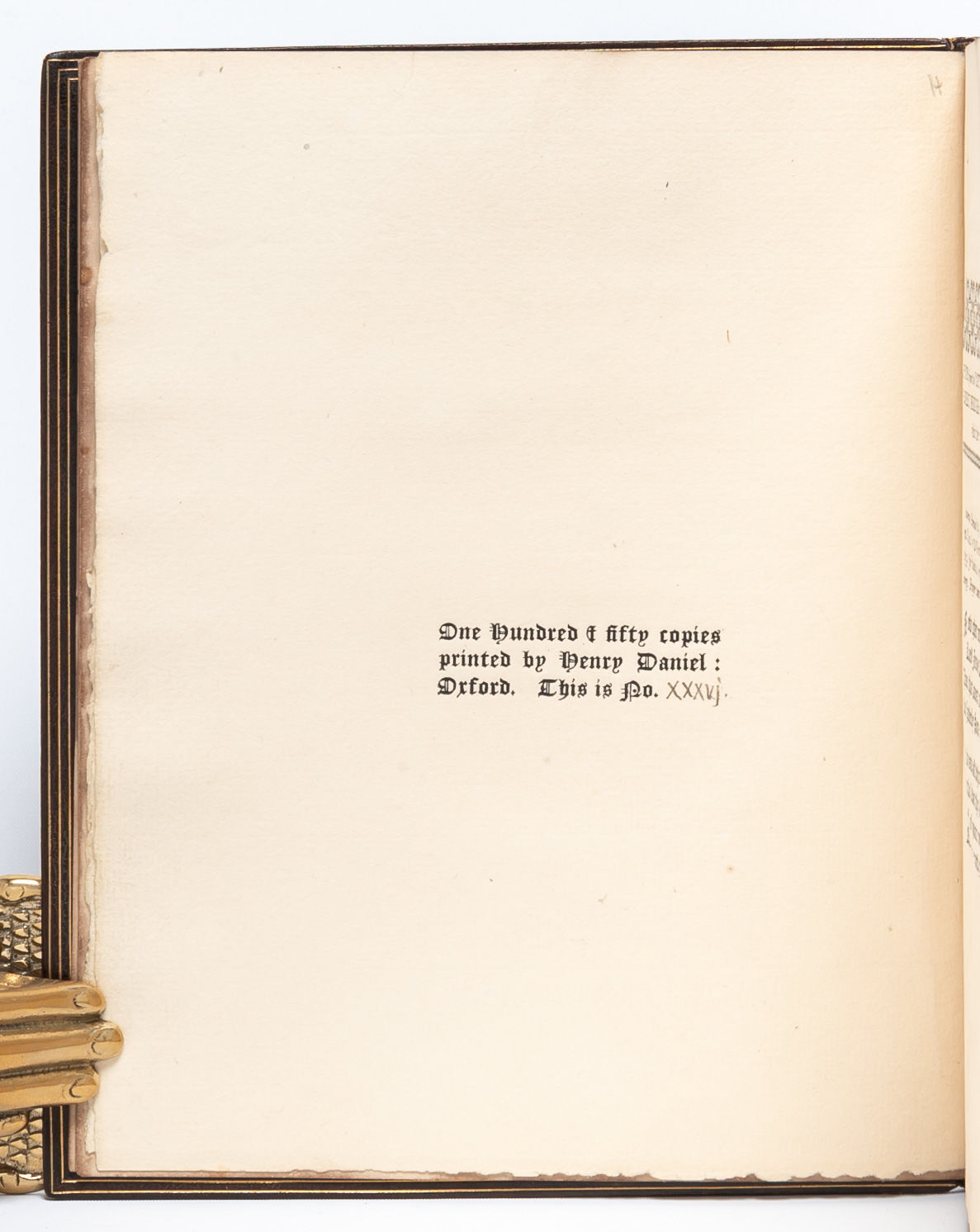
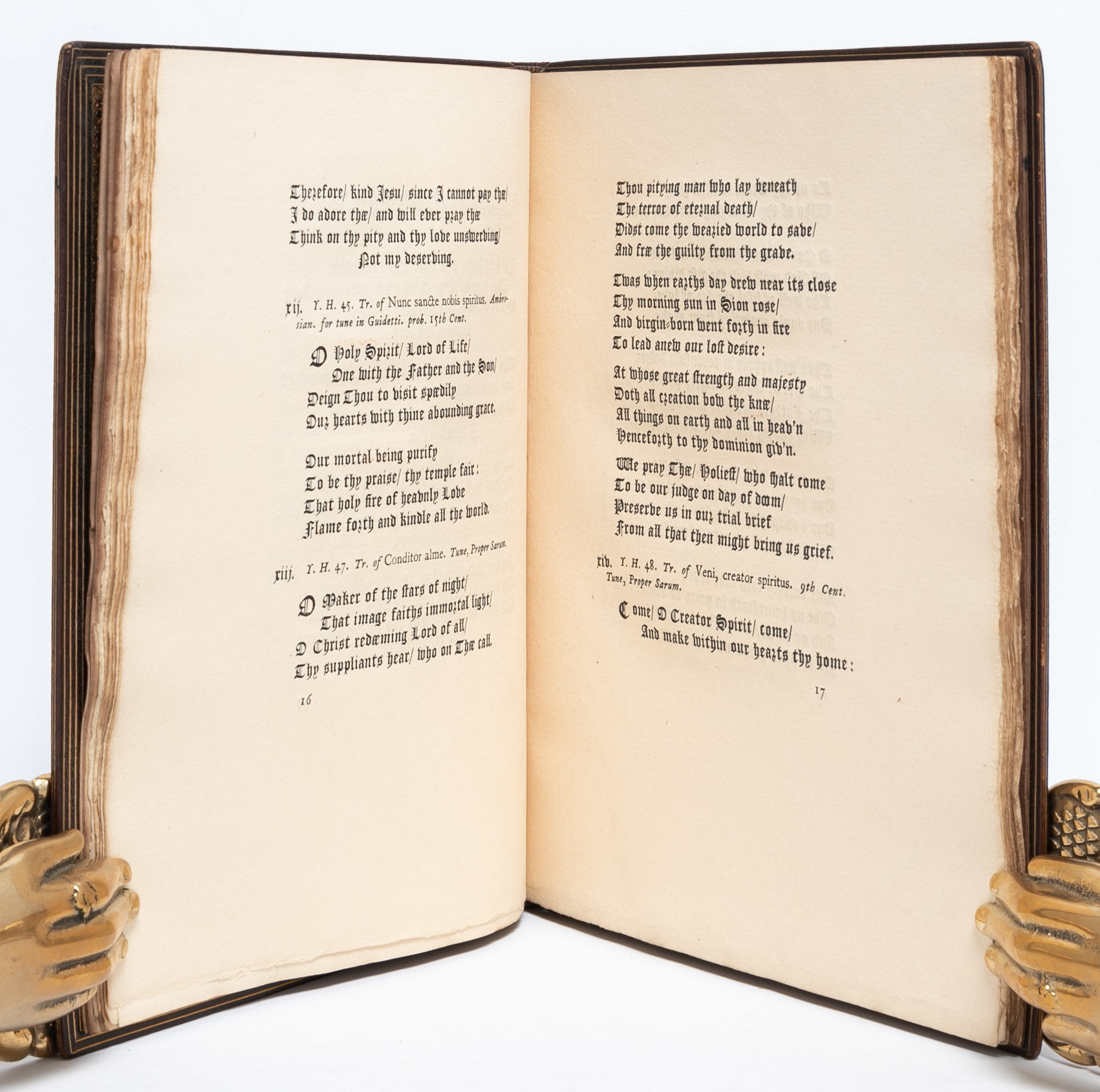
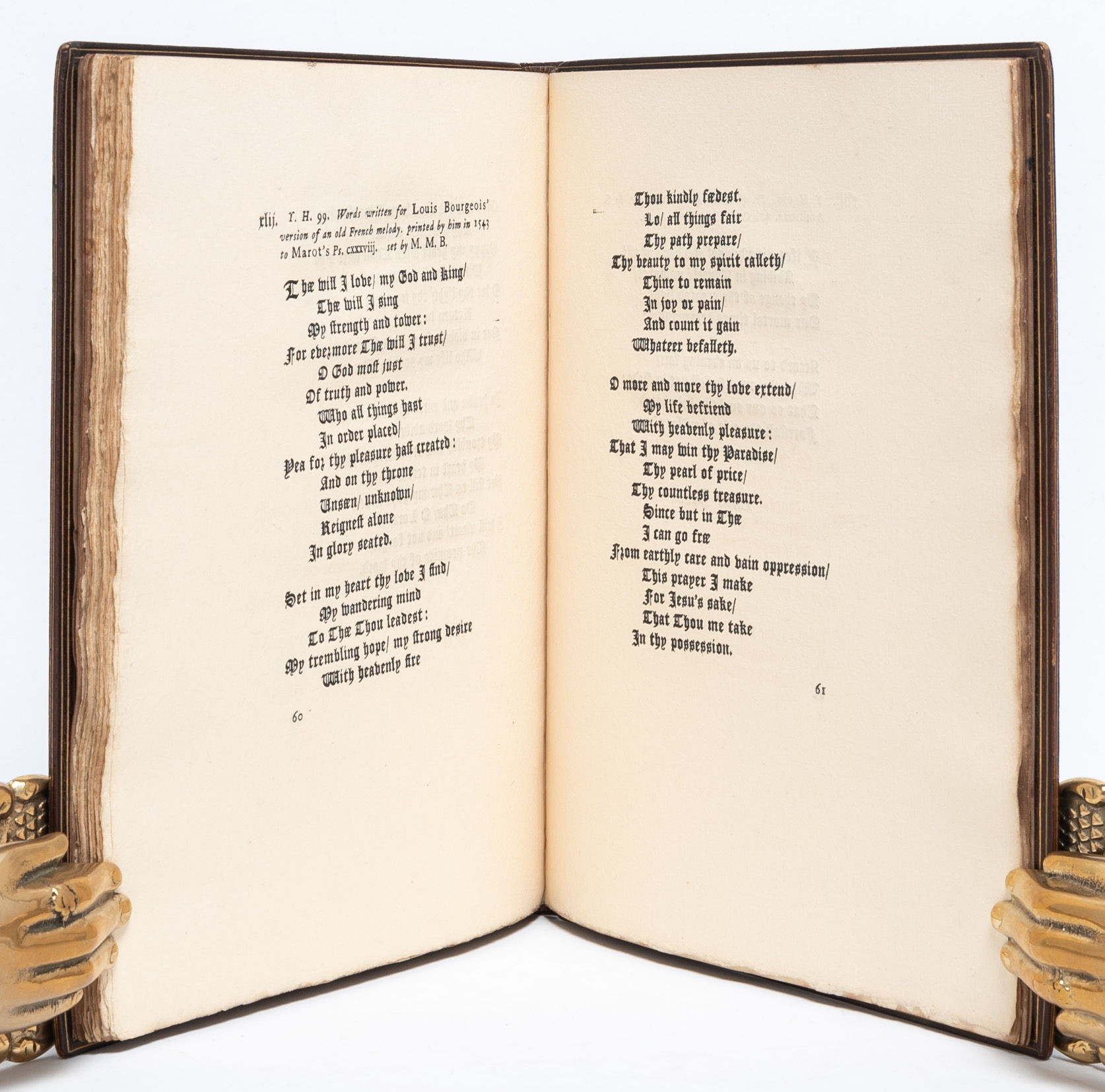
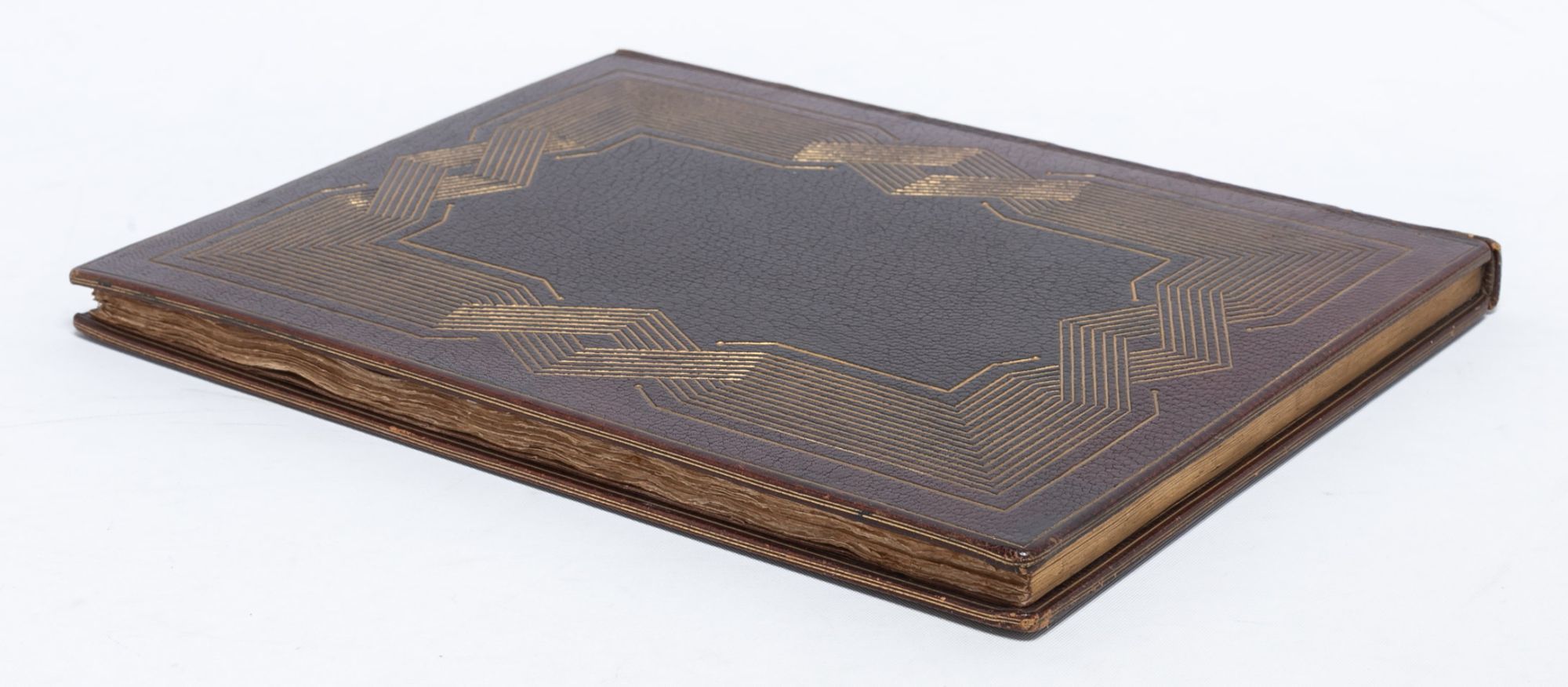
Oxford: Henry Daniel, 1899. First thus. Near Fine. Limited to 150 copies, this number 36. Printed in black letter. Finely bound by Zaehnsdorf in a modernist style, likely for exhibition (with their circlular stamp on the rear silk paste-down). Bound in full dark brown crushed morocco. Interwoven rules create a central panel on the front and rear boards, similar, but smaller patterns in the spine panels. Top edge gilt, others untrimmed, ruled inner dentelles, dark brown silk end papers. Spine a bit toned and few bookseller notations to the verso of the front end paper. Clean and fresh throughout. Quarto (leaves 228 x 172), collating: [iv], 64,[x], complete.
Feeling that current church music has become to worldly, the late-Victorian poet Robert Bridges was driven to create music that reached for something beyond the realm of man. To achieve his revivalist goals, Bridges collaborated on the project with musical scholar H. Ellis Wooldridge and his wife, the pianist Monica Bridges to write news hymns for their parish church in Yattendon. Even the printing of the hymns reflected 16th century book production and typography transporting the reader to another time and place.
The Austro-Hungarian -born, Joseph Zaehnsdorf (1816-1886) trained with binders in Stuttgart and in Vienna, before moving to Germany, Switzerland, France, and eventually settling London. He working for various shops before opening his own bindery in 1842. In the face of industrializing production Zaehnsdorf embraced craft and eventually gained recognition for his talent. He was known for his precise finish and elegant design. The firm would continue in his son John William’s capable hands; it employed binders like Louis Genth, Roger de Coverly, and Sarah Prideaux. Family run until 1947, it was eventually acquired by Asprey of London in 1983 (Gertz). Near Fine.
Feeling that current church music has become to worldly, the late-Victorian poet Robert Bridges was driven to create music that reached for something beyond the realm of man. To achieve his revivalist goals, Bridges collaborated on the project with musical scholar H. Ellis Wooldridge and his wife, the pianist Monica Bridges to write news hymns for their parish church in Yattendon. Even the printing of the hymns reflected 16th century book production and typography transporting the reader to another time and place.
The Austro-Hungarian -born, Joseph Zaehnsdorf (1816-1886) trained with binders in Stuttgart and in Vienna, before moving to Germany, Switzerland, France, and eventually settling London. He working for various shops before opening his own bindery in 1842. In the face of industrializing production Zaehnsdorf embraced craft and eventually gained recognition for his talent. He was known for his precise finish and elegant design. The firm would continue in his son John William’s capable hands; it employed binders like Louis Genth, Roger de Coverly, and Sarah Prideaux. Family run until 1947, it was eventually acquired by Asprey of London in 1983 (Gertz). Near Fine.