

Collection of Reports Addressed to Peter McQuhae From Various Figures in the British Foreign Office, on Subjects Including an Imminent Filibustering Attack on Cuba by a Pro-Slavery Organization from the Unted States; the Movements of a Slave Trading Brig’s Fishing Rights, Relations to Spain And Other Issues of Pressing Importance to British Interests in the Caribbean
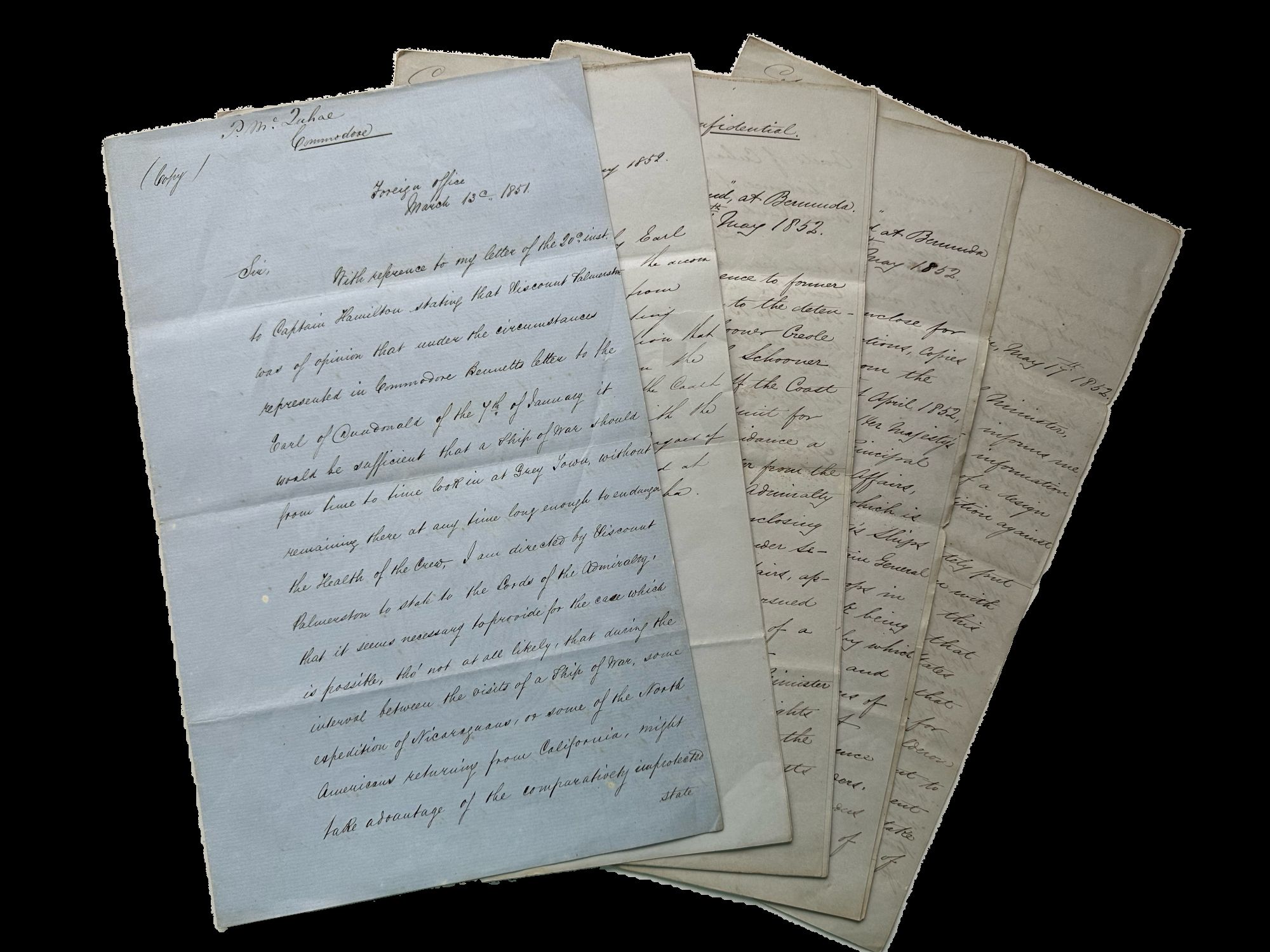
- Five groups of documents measuring 13 x 8 inches, various paginations (see full description below). Fine condition
- London , 1852
London, 1852. Five groups of documents measuring 13 x 8 inches, various paginations (see full description below). Fine condition. A scarce set of primary source documents relating to the protection of British territory in the Caribbean, in particular along the Mosquito Coast, during the period of varied interests in the area, in the period following the Anglo-Spanish agreement on the slave trade. Consisting of a series of secretarial copies of reports delivered to Peter McQuhae, Commodore of H.M.S. Imauam, stationed in Jamaica, these dispatches offer an overview of the issues confronting the British Navy in Jamaica during the period and in the Caribbean more broadly. Most of the documents refer to issues with Cuba, the most interesting perhaps being a letter warning of an impending filibustering expedition against Cuba by a pro-slavery faction in the American South.
The group consists of five groups of bound documents, some bound out of order and likely bound later. Contents are as follows:
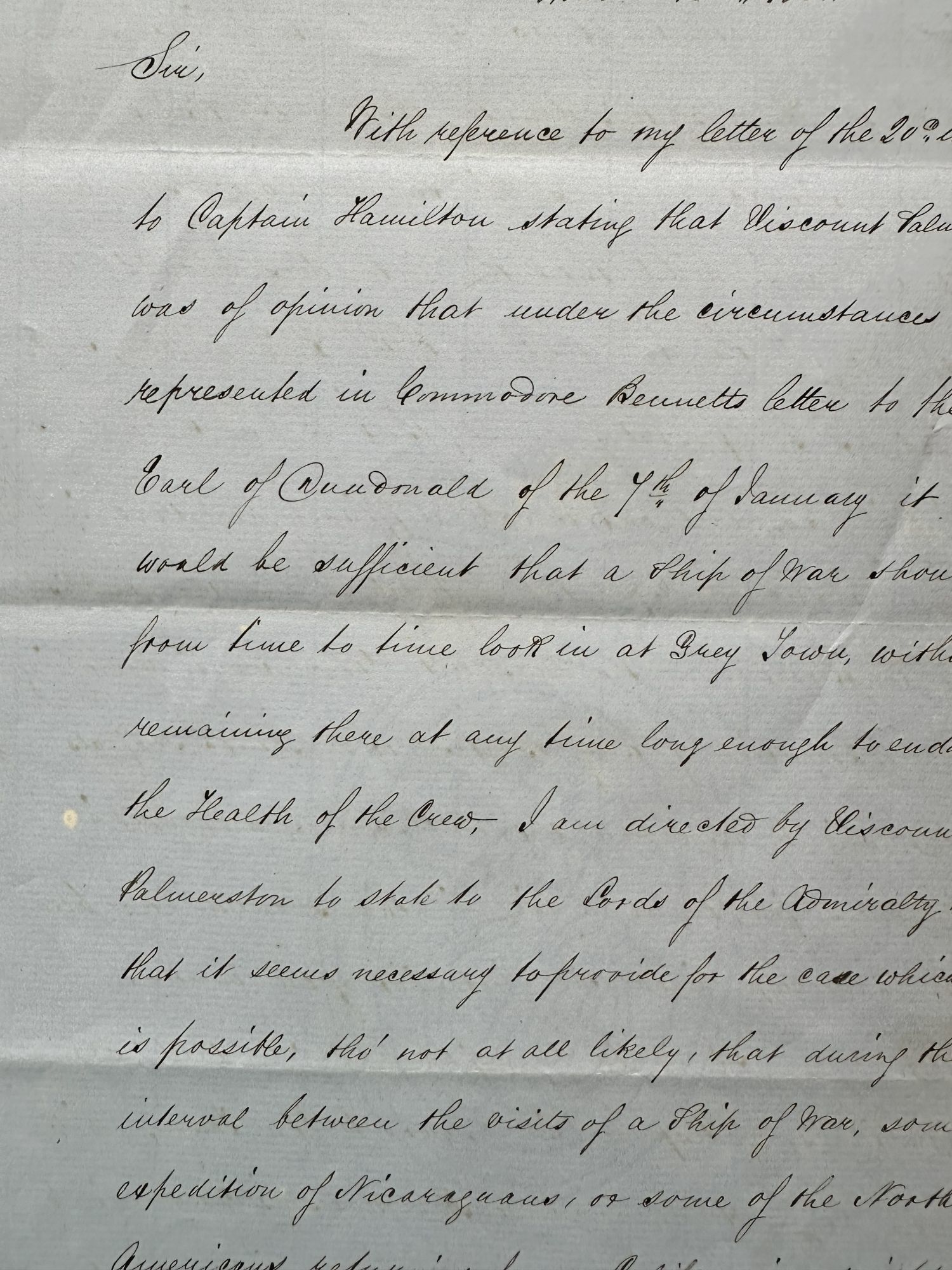
1. Addington, A.M. Four Page Report Concerning Placing a Ship of War at Grey Town to Discourage Invasions on the Mosquito Coast, March 13, 1851.
Henry Addington writes McQuhae to recommend stationing a warship at Grey Town:
“...it would be sufficient that a Ship of War should from time to time look in grey Town, without remaining there at any time long enough to endanger the health of the crew… to provide for the case which is possiblee, tho’ not at all likely, that during the interval between the visits of a Ship of War, some expedition of Nicaraguan, or some of the North Americans returning from California, might take advantage of the comparatively unprotected state of the lace, to take possession of it, and that the cruiser on its return to Grey Town, might find the place so occupied, Lord Palmerston concieves taht in such an event, it would seem to be inconsistent with the Honor of this Country, that a British Ship of War, should acquiesce in such an aggression, and it would be right that the intruder should be expelled, if the Commander of the Ship of War, should find as he probably would, that he had the means of doing so, without much difficulty, and that in case he should repel the intruders and re-establish the authorities of the Mosquito Government, demanding the liberation of any British or Mosquito subjects who might have been made Prisoners, and holding hostages for their relief if they should have been removed up into the interior of the Country.
It It is to be hoped however, that all questions of dispute in regard to Grey Town, will, beoon be settled, because Her Majesty’s government has through Her Majesty’s Minister at Washington proposed to the Government, of the United States, that an arrangement should be made, by which the Sovereignty of Grey Town… should be transferred to the State of Costa Rica… Lord Palmerston desires me to add that there are at present at Washington a plenipotentiaries, both from Nicaragua and Costa Rica for the purpose of conducting this negotiation…”
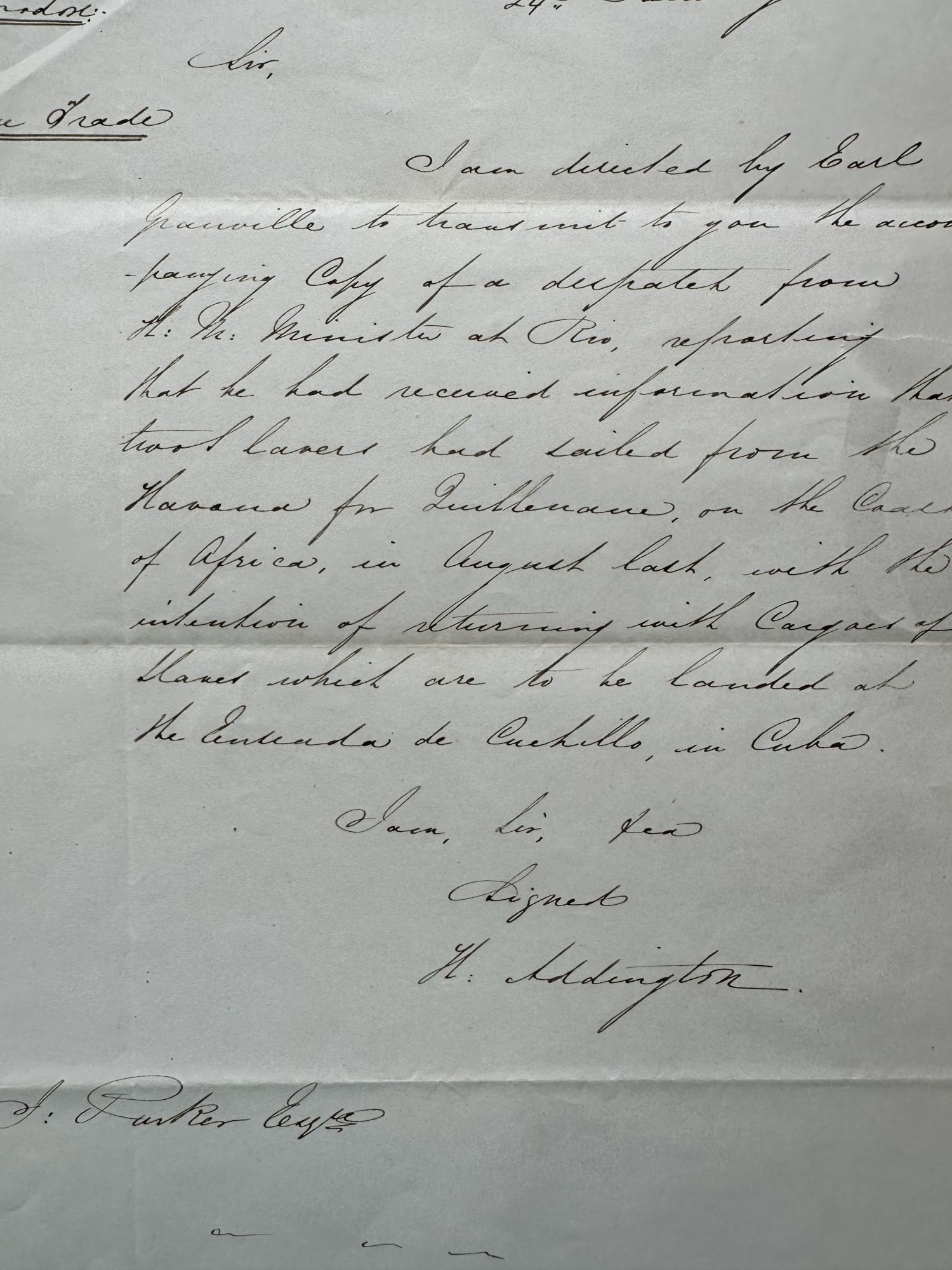
2. Addington, G.M. Single Page Letter in Secretarial Hand Warning of Incoming Ships to Cuba Carrying Enslaved Individuals, January 24, 1852.
Addington writes to McQuhae about two incoming vessels carrying enslaved Africans, passing on information received at Rio De janeiro by another British vessel:
“I am directed by Earl GraH.M. Minister at Rio, reporting that he had recieved information that two Slavers had sailed from Havana to… the coast of Africa… with the intention of returning with Cargoes of slaves which are to be landed at the Entrade de Cuchillo, in Cuba.”
3. Seymour, G.F., et al. Four Reports Bound Together on Varied Subjects, including the Case of the Creole, British Fishing Rights in Spanish Waters off of Cuba and Porto Rico, and the Case of a Detained British Vessel in Cuba, 1852.
A series of four reports addressed to McQuhae on various subject, as follows:
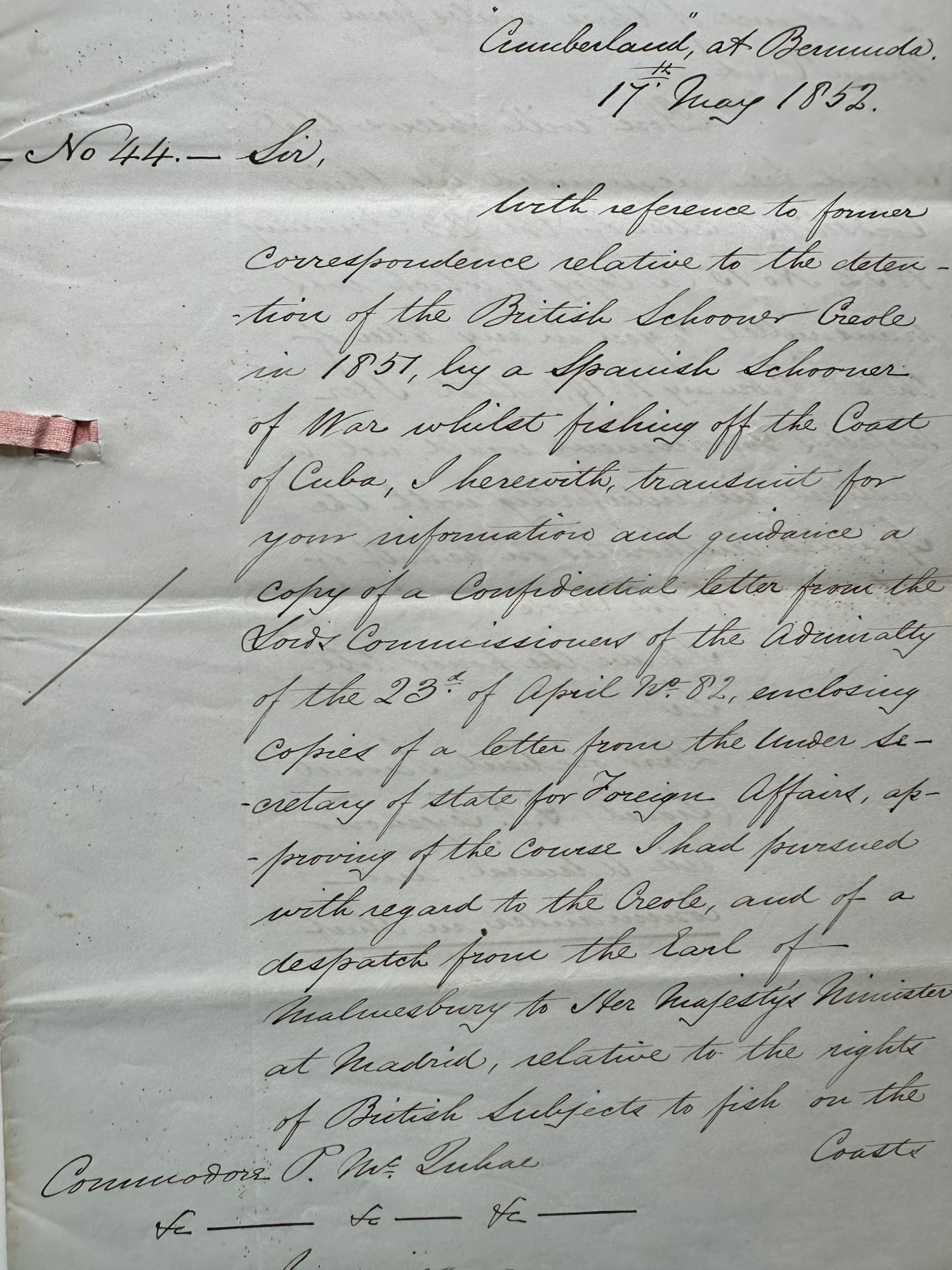
A. Report dated May 17, 1852, from Seymour, discussing the case of the Creole, detained in 1851:
“...enclosing copies of a letter from the Under Secretary of State for Foreign Affairs, approving of the course I had pursued with regard to the Creole, and of a despatch from the Earl of Malmesbury to Her Majesty’s Minister at Madrid, relative to the rights of British Subjects to fish on the coast of Cuba…”
B. Letter from Augustus Stafford, Apriul 23, 1852, discussing the Creole, mostly discussing the enclosure of varied reports on the subjects but with little specific information.
C. Addington, A.M. April 21, 1852, letter discussing the Creole case and the enclosure of documents.
D. Earl of Malmesbury, April 14, 1852, letter discussing the Creole case in more detail:
“ The Right thus claimed rests on this universally admitted precept of international Law, “dominium finitur, ubi finitur armorum vis,” which in modern practice has been construed to mean “about one marine league from the mainland,” and H.M.’s Govt are clearly justified in demanding that the Spanish authorities shall be ordered not to meddle or interfere with British fishermen outside that three mile boundary…”
4. Earl of Malmesbury, et al. Series of Three Secretarial Copies of Reports Concerning Impending Filibuster Raids on Cuba, Giving Instructions for Assisting Spanish Forces.
A very interesting series of reports detailing the planned response to pending “Piratical Attacks,” showing the extent to which British forces were prepared for an American filibuster attack on the island and the degree to which they intended on assisting the Spanish forces. As follows:
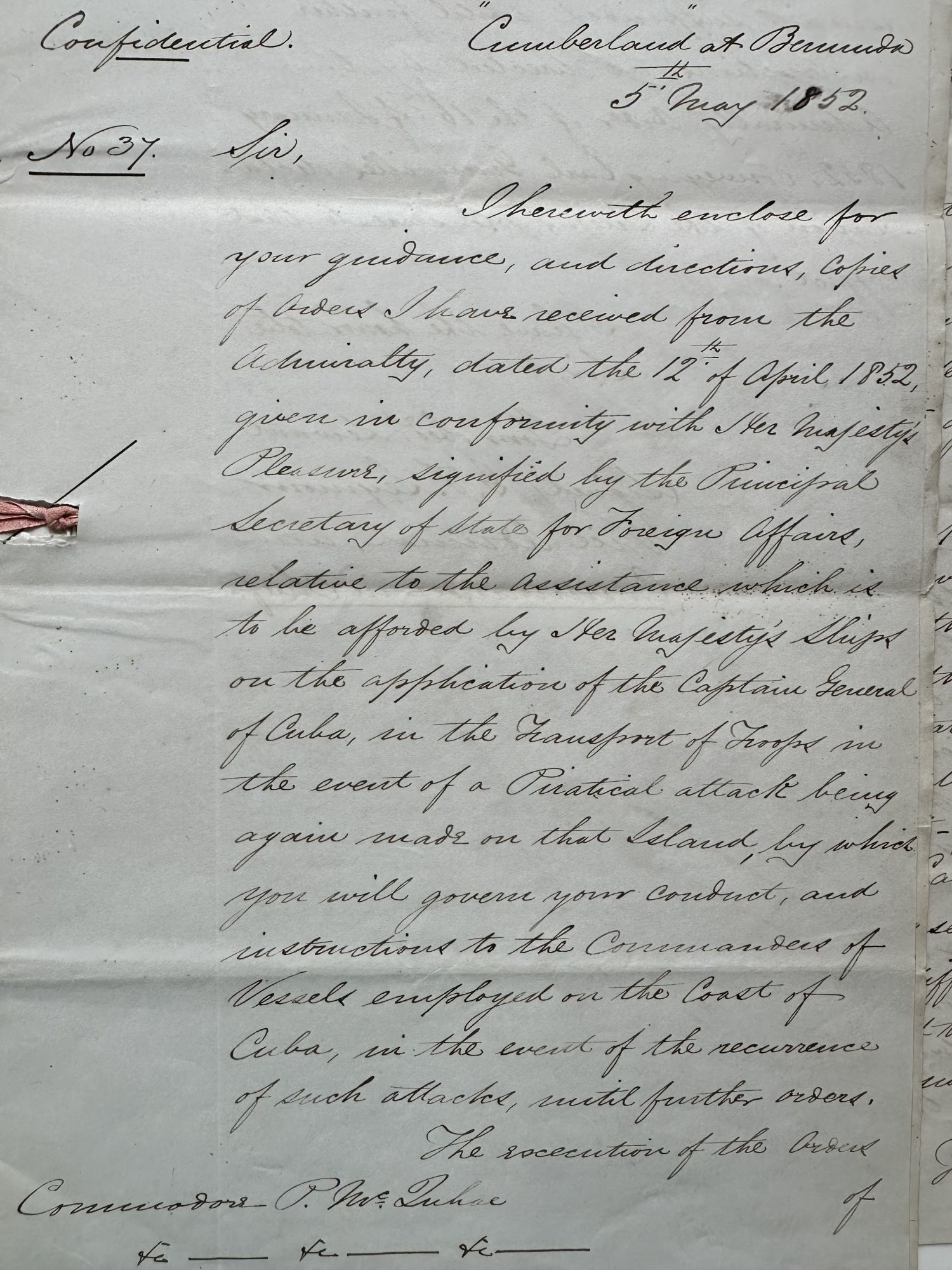
A. Seymour, G.F. Secretarial Copy of Letter Written on May 5, 1852 from Cumberland at Bermuda, relaying the transmission of a full report of instructions to the British forces regarding an impending filibuster raid:
“ I hereby enclose for your guidance… orders… relative to the assistance which is to be afforded by Her Majesty’s Ships on the application of the Captain General of Cuba, in the Transport of Troops in the event of a Piratical attack being again made on that island by which you will govern your conduct…”
B. Earl of Malmesbury. Secretarial Copy of a Letter Dated April 10, 1862, discussing piratical attacks:
“...that in the event of a Piratical Attach being made upon that island… HM’s ships might assist in conveying troops to any poiunt of the Coast of Cuba at which the invading Party might effect a landing…”
C. Honley, P. Secretarial Copy of an Undated Letter, c. 1852, regarding piratical attacks:
“Her Majesty’s ships might assist in coveying Troops to any point off the Coast of Cubat at which the invading Party might effect a landing… you should be instructed until further ORders that if the Captain General of Cuba should require your assistance for the transport of troops in the manner pointed out in your abovementioned dispatch, you should comply with that demand…”
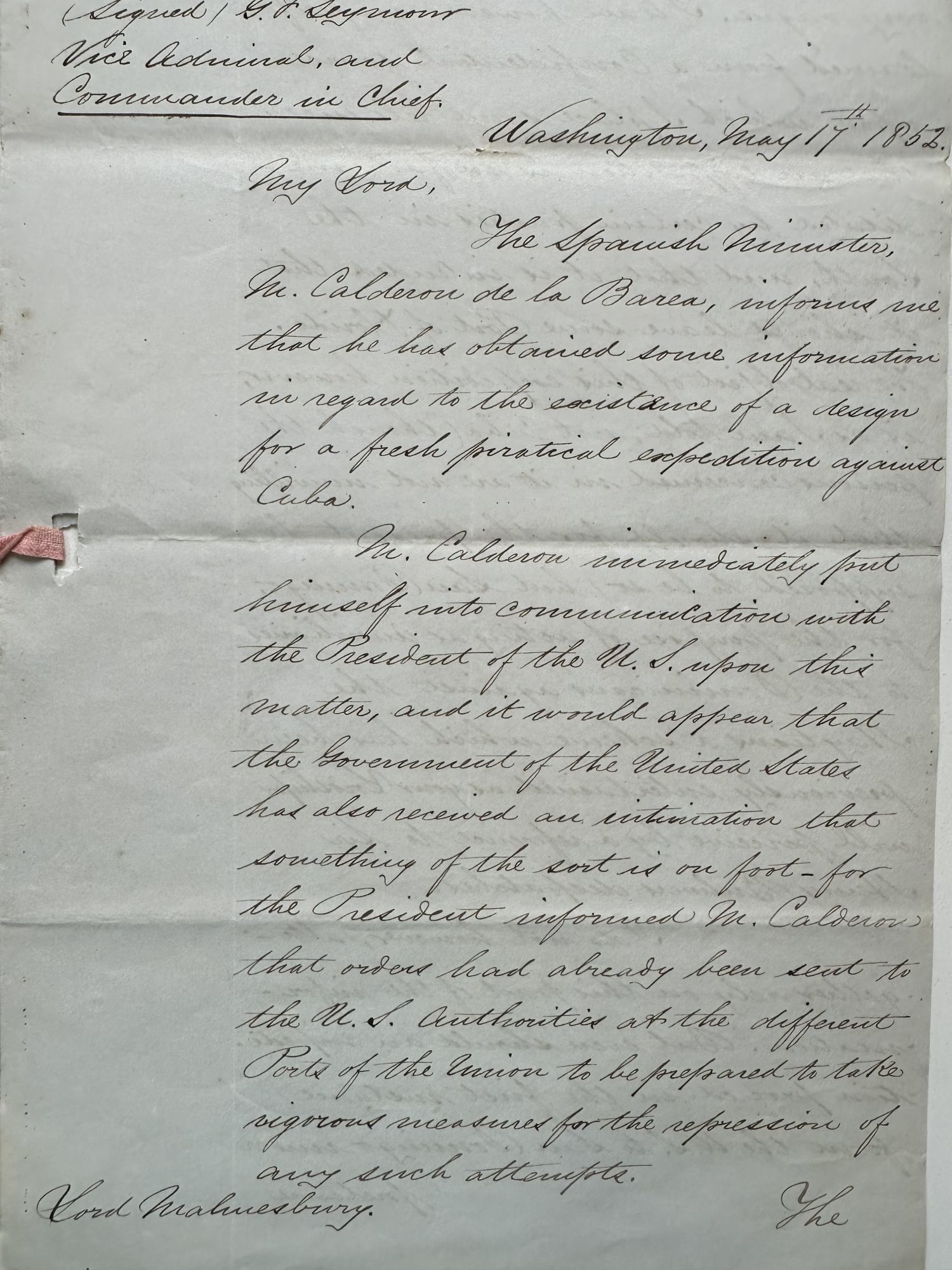
5. Crampton, Sir John. Copy of a Letter in Secretarial Hand Relaying the Impending Danger of a Pro-Slavery Filibuster Mission from Florida, May 17, 1852.
A fascinating letter relaying information received from M. Calderon de la Barca concerning an impending filibuster mission against Cuba led by a Dr. Wren, part of an organization called “The Lone Star Association:”
“...it would appear that the government of the United States has also received an intimation that something of the sort is on foot for the President informed M. Calderon that orders had already been sent to the U.S. Authorities at the different Ports of the Union to be prepared to take vigorous measures for the repression of any such attempts… an expedition is in fact meditated by certain parties in the South, and that it is intended that it should leave some Port of Florida. The real object of this expedition however, as as I am told, not Cuba… but San Domingo, for the purpose of acting as auxiliaries to the Dominicans against the Haytians… it is by no means impossible that its ultimate aim would be Cuba… the persons I am given to understand, engaged in the expedition, are a Dr. Wren, who is president of a society called “The Lone Star State Association…”
The letter is worthy of further study - we find references to a Dr. Wren in newspaper articles from the period but were unable to pinpoint his identity or the history of his organization. An article from a Loudon, Tennessee newspaper describes Dr. Wren as a “representative of New Orleans societies” and described a meeting in Loudon in 1852 trying to recruit for the overthrow of the Spanish colonial government of Cuba through an invasion.
The group consists of five groups of bound documents, some bound out of order and likely bound later. Contents are as follows:
1. Addington, A.M. Four Page Report Concerning Placing a Ship of War at Grey Town to Discourage Invasions on the Mosquito Coast, March 13, 1851.
Henry Addington writes McQuhae to recommend stationing a warship at Grey Town:
“...it would be sufficient that a Ship of War should from time to time look in grey Town, without remaining there at any time long enough to endanger the health of the crew… to provide for the case which is possiblee, tho’ not at all likely, that during the interval between the visits of a Ship of War, some expedition of Nicaraguan, or some of the North Americans returning from California, might take advantage of the comparatively unprotected state of the lace, to take possession of it, and that the cruiser on its return to Grey Town, might find the place so occupied, Lord Palmerston concieves taht in such an event, it would seem to be inconsistent with the Honor of this Country, that a British Ship of War, should acquiesce in such an aggression, and it would be right that the intruder should be expelled, if the Commander of the Ship of War, should find as he probably would, that he had the means of doing so, without much difficulty, and that in case he should repel the intruders and re-establish the authorities of the Mosquito Government, demanding the liberation of any British or Mosquito subjects who might have been made Prisoners, and holding hostages for their relief if they should have been removed up into the interior of the Country.
It It is to be hoped however, that all questions of dispute in regard to Grey Town, will, beoon be settled, because Her Majesty’s government has through Her Majesty’s Minister at Washington proposed to the Government, of the United States, that an arrangement should be made, by which the Sovereignty of Grey Town… should be transferred to the State of Costa Rica… Lord Palmerston desires me to add that there are at present at Washington a plenipotentiaries, both from Nicaragua and Costa Rica for the purpose of conducting this negotiation…”
2. Addington, G.M. Single Page Letter in Secretarial Hand Warning of Incoming Ships to Cuba Carrying Enslaved Individuals, January 24, 1852.
Addington writes to McQuhae about two incoming vessels carrying enslaved Africans, passing on information received at Rio De janeiro by another British vessel:
“I am directed by Earl GraH.M. Minister at Rio, reporting that he had recieved information that two Slavers had sailed from Havana to… the coast of Africa… with the intention of returning with Cargoes of slaves which are to be landed at the Entrade de Cuchillo, in Cuba.”
3. Seymour, G.F., et al. Four Reports Bound Together on Varied Subjects, including the Case of the Creole, British Fishing Rights in Spanish Waters off of Cuba and Porto Rico, and the Case of a Detained British Vessel in Cuba, 1852.
A series of four reports addressed to McQuhae on various subject, as follows:
A. Report dated May 17, 1852, from Seymour, discussing the case of the Creole, detained in 1851:
“...enclosing copies of a letter from the Under Secretary of State for Foreign Affairs, approving of the course I had pursued with regard to the Creole, and of a despatch from the Earl of Malmesbury to Her Majesty’s Minister at Madrid, relative to the rights of British Subjects to fish on the coast of Cuba…”
B. Letter from Augustus Stafford, Apriul 23, 1852, discussing the Creole, mostly discussing the enclosure of varied reports on the subjects but with little specific information.
C. Addington, A.M. April 21, 1852, letter discussing the Creole case and the enclosure of documents.
D. Earl of Malmesbury, April 14, 1852, letter discussing the Creole case in more detail:
“ The Right thus claimed rests on this universally admitted precept of international Law, “dominium finitur, ubi finitur armorum vis,” which in modern practice has been construed to mean “about one marine league from the mainland,” and H.M.’s Govt are clearly justified in demanding that the Spanish authorities shall be ordered not to meddle or interfere with British fishermen outside that three mile boundary…”
4. Earl of Malmesbury, et al. Series of Three Secretarial Copies of Reports Concerning Impending Filibuster Raids on Cuba, Giving Instructions for Assisting Spanish Forces.
A very interesting series of reports detailing the planned response to pending “Piratical Attacks,” showing the extent to which British forces were prepared for an American filibuster attack on the island and the degree to which they intended on assisting the Spanish forces. As follows:
A. Seymour, G.F. Secretarial Copy of Letter Written on May 5, 1852 from Cumberland at Bermuda, relaying the transmission of a full report of instructions to the British forces regarding an impending filibuster raid:
“ I hereby enclose for your guidance… orders… relative to the assistance which is to be afforded by Her Majesty’s Ships on the application of the Captain General of Cuba, in the Transport of Troops in the event of a Piratical attack being again made on that island by which you will govern your conduct…”
B. Earl of Malmesbury. Secretarial Copy of a Letter Dated April 10, 1862, discussing piratical attacks:
“...that in the event of a Piratical Attach being made upon that island… HM’s ships might assist in conveying troops to any poiunt of the Coast of Cuba at which the invading Party might effect a landing…”
C. Honley, P. Secretarial Copy of an Undated Letter, c. 1852, regarding piratical attacks:
“Her Majesty’s ships might assist in coveying Troops to any point off the Coast of Cubat at which the invading Party might effect a landing… you should be instructed until further ORders that if the Captain General of Cuba should require your assistance for the transport of troops in the manner pointed out in your abovementioned dispatch, you should comply with that demand…”
5. Crampton, Sir John. Copy of a Letter in Secretarial Hand Relaying the Impending Danger of a Pro-Slavery Filibuster Mission from Florida, May 17, 1852.
A fascinating letter relaying information received from M. Calderon de la Barca concerning an impending filibuster mission against Cuba led by a Dr. Wren, part of an organization called “The Lone Star Association:”
“...it would appear that the government of the United States has also received an intimation that something of the sort is on foot for the President informed M. Calderon that orders had already been sent to the U.S. Authorities at the different Ports of the Union to be prepared to take vigorous measures for the repression of any such attempts… an expedition is in fact meditated by certain parties in the South, and that it is intended that it should leave some Port of Florida. The real object of this expedition however, as as I am told, not Cuba… but San Domingo, for the purpose of acting as auxiliaries to the Dominicans against the Haytians… it is by no means impossible that its ultimate aim would be Cuba… the persons I am given to understand, engaged in the expedition, are a Dr. Wren, who is president of a society called “The Lone Star State Association…”
The letter is worthy of further study - we find references to a Dr. Wren in newspaper articles from the period but were unable to pinpoint his identity or the history of his organization. An article from a Loudon, Tennessee newspaper describes Dr. Wren as a “representative of New Orleans societies” and described a meeting in Loudon in 1852 trying to recruit for the overthrow of the Spanish colonial government of Cuba through an invasion.