

Fair Copy of a Speech by Baron de Carondelet Regarding the Maintenance of Troop Presence in Lower Louisiana, 1797
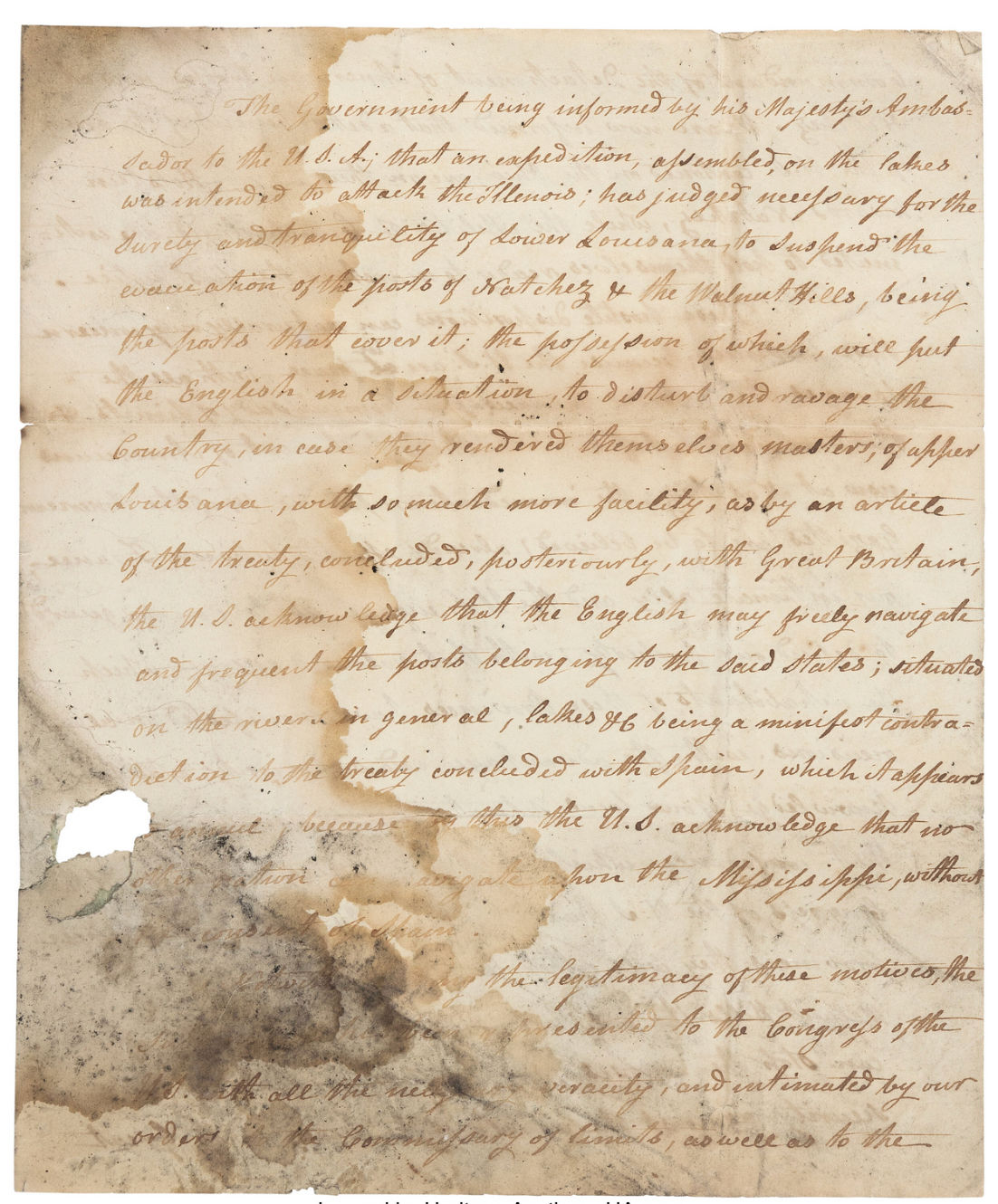
- Three pages of a bifolium, 8 x 9 ½ inches, New Orleans; May 31, 1797. Fair only, with moisture damage and some text illegible
- New Orleans , 1797
New Orleans, 1797. Three pages of a bifolium, 8 x 9 ½ inches, New Orleans; May 31, 1797. Fair only, with moisture damage and some text illegible. Fair. An interesting document from the period following the Treaty of San Lorenzo and before the eventual surrender of Natchez to the Americans in 1798, in which the governor of Louisiana and West Florida, Francisco Luis Hector de Carondelet, issues a statement regarding the delayed withdrawal of Spanish troops from the region. Carondelet is concerned with the British presence in the area, and notes that it is a violation of “the treaty concluded with Spain,” - or Pinckney’s Treaty, which opened up navigation rights of the Mississippi to the United States. The letter describes the possibility of escalating hostilities between the United States, Great Britain and Spain as a result of an impending American mission against the Illinois, the motives of which Carondelet questions as he notes that “These hostile dispositions can naturally only concern these provinces, because the U.S. are in peace with all the savages…” He raises the possibility of British invasion of Louisiana, and potential danger to the city of New Orleans, and states that the Spanish will maintain their presence at Natchez and Walnut Hills unless the American soldiers withdraw. This is a copy of Carondelet’s speech in the hand of Lieutenant Piercy Smith Pope, and we find no other record of it. A full transcription follows:
“The Government being informed by his Majesty’s Ambassador to the U.S., that an expedition assembled on the lakes was intended to attack the Illinois, has judged necessary for the surety and tranquility of Lower Louisiana, to suspend the evacuation of the posts of Natchez & the Walnut Hills, being the posts that cover it; the possession of which, will put the English in a situation to disturb and ravage the country, in case they rendered themselves masters of upper Louisiana, with so much more facility, as by an article of the treaty, concluded, posteriously, with Great Britain, the U.S. acknowledge that the English may freely navigate and frequent the posts belonging to the said States; situated on the river in general, lakes &c being a manifest contradiction to the treaty concluded with Spain, which it appears...... because by this the U.S. acknowledge that no other nation can navigate upon the Mississippi, without the consent of Spain.
...... the legitimacy of these motives, the ....presented to the Congress of the U.S., with all the necessary veracity, and intimated by our orders in the Commissary of Limits, as well as to the Commandant of the Detachment of American troops now at Natchez. We are now informed that a detachment of the army of the U.S., cantoned on the Ohio, are on their way by Holstein towards Natchez, while the Militia of Cumberland, are intimated to hold themselves ready to march at the first notice.
These hostile dispositions can naturally only concern these provinces, because the U.S. are in peace with all the savages, the anterior menaces of the Commissary of Limits, & the Commandant of the detachment of Americans now at Natchez; the immediate rupture (& if the American Gazettes are to be believed) already effected between France, our intimate ally and the U.S. engage us to be on our guard to defend our property with that valor & energy which the inhabitants of these Provinces have manifested on all occasions, with the advantage and superiority which a knowledge of our local situation will procure, and that confidence which right and justice inspires. If the Congress of the U.S. had no hostile intention against these provinces, they will either leave the post of Natchez or Walnut Hills, the only bulwarks of Lower Louisiana that can stop the courses of the English, or that they give us security against the article of the Treaty with Great Britain, which exposes lower Louisiana to be pillaged and destroyed down to the Capitol. We will then deliver up the said posts and lay down our arms which they have forced us to take up by arming their Militia in time of peace and sending a considerable body of troops by round about ways to surprise us.
New Orleans, 31st May, 1797
A copy of the Baron de Carondelet’s Proclamation.
P. Pope”
Overall a document of significance in United States / Spanish relations in the period following Pinckney’s Treaty, worthy of further study for scholars of the diplomatic history of the period.
“The Government being informed by his Majesty’s Ambassador to the U.S., that an expedition assembled on the lakes was intended to attack the Illinois, has judged necessary for the surety and tranquility of Lower Louisiana, to suspend the evacuation of the posts of Natchez & the Walnut Hills, being the posts that cover it; the possession of which, will put the English in a situation to disturb and ravage the country, in case they rendered themselves masters of upper Louisiana, with so much more facility, as by an article of the treaty, concluded, posteriously, with Great Britain, the U.S. acknowledge that the English may freely navigate and frequent the posts belonging to the said States; situated on the river in general, lakes &c being a manifest contradiction to the treaty concluded with Spain, which it appears...... because by this the U.S. acknowledge that no other nation can navigate upon the Mississippi, without the consent of Spain.
...... the legitimacy of these motives, the ....presented to the Congress of the U.S., with all the necessary veracity, and intimated by our orders in the Commissary of Limits, as well as to the Commandant of the Detachment of American troops now at Natchez. We are now informed that a detachment of the army of the U.S., cantoned on the Ohio, are on their way by Holstein towards Natchez, while the Militia of Cumberland, are intimated to hold themselves ready to march at the first notice.
These hostile dispositions can naturally only concern these provinces, because the U.S. are in peace with all the savages, the anterior menaces of the Commissary of Limits, & the Commandant of the detachment of Americans now at Natchez; the immediate rupture (& if the American Gazettes are to be believed) already effected between France, our intimate ally and the U.S. engage us to be on our guard to defend our property with that valor & energy which the inhabitants of these Provinces have manifested on all occasions, with the advantage and superiority which a knowledge of our local situation will procure, and that confidence which right and justice inspires. If the Congress of the U.S. had no hostile intention against these provinces, they will either leave the post of Natchez or Walnut Hills, the only bulwarks of Lower Louisiana that can stop the courses of the English, or that they give us security against the article of the Treaty with Great Britain, which exposes lower Louisiana to be pillaged and destroyed down to the Capitol. We will then deliver up the said posts and lay down our arms which they have forced us to take up by arming their Militia in time of peace and sending a considerable body of troops by round about ways to surprise us.
New Orleans, 31st May, 1797
A copy of the Baron de Carondelet’s Proclamation.
P. Pope”
Overall a document of significance in United States / Spanish relations in the period following Pinckney’s Treaty, worthy of further study for scholars of the diplomatic history of the period.