

A Letter Written by the Publisher Hezekiah Niles Discussing the Missouri Compromise, Slavery and the Possibility of Civil War, 1820
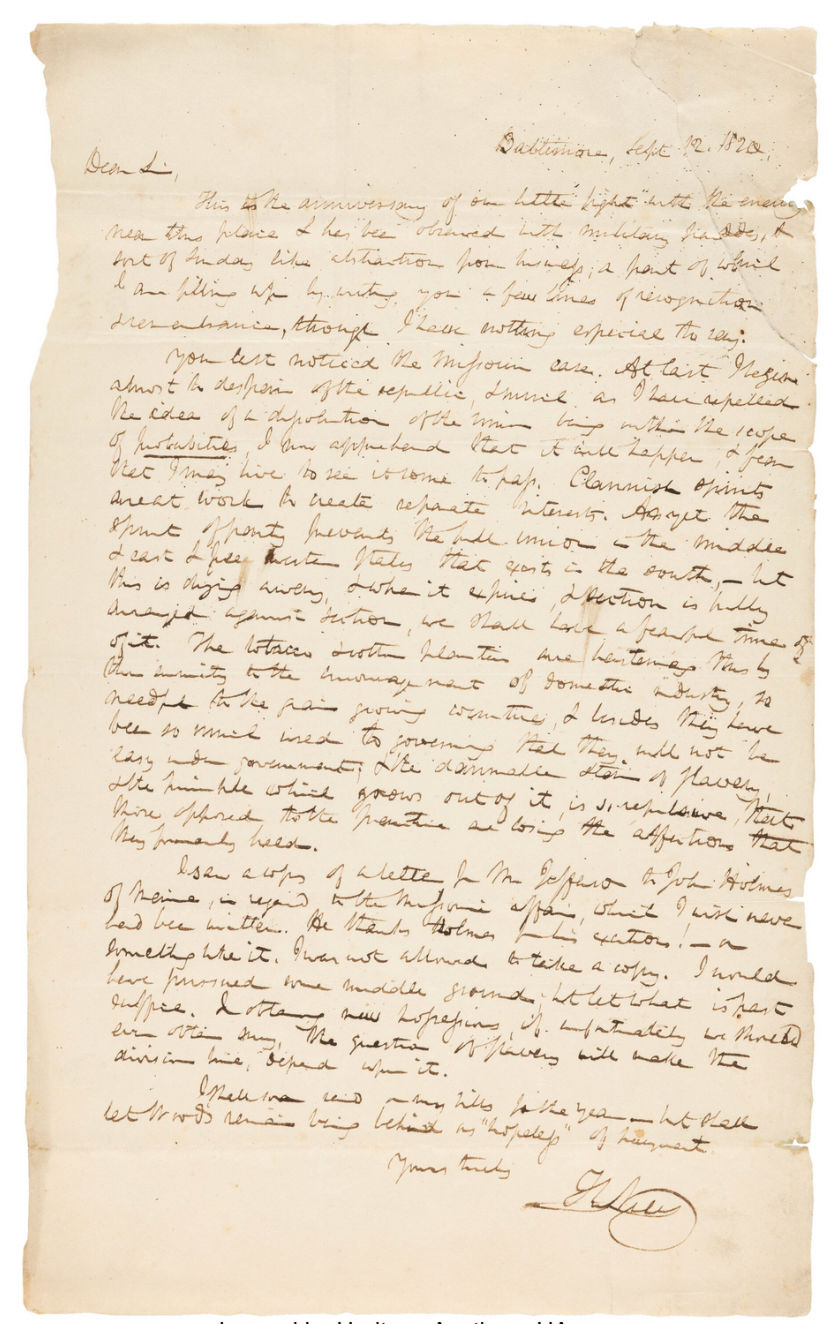
- Single page letter measuring 8 x 13 ½ pages. Very good condition with some small chips at margin
- Baltimore , 1820
Baltimore, 1820. Single page letter measuring 8 x 13 ½ pages. Very good condition with some small chips at margin. Very Good. A candid letter written by Hezekiah Niles discussing the Missouri compromise and a letter and the future of the union, in which he states that “The question of slavery will make the division firm, depend upon it.” Niles - perhaps the most influential American editor at the time - was adamant about providing unbiased coverage in his Weekly Register, making this candid discussion of current affairs more significant.
ANB notes,
“He saw editorial bias as contrary to his mission to be an authoritative historical documentarian for the future. The Register’s prospectus, published 24 June 1811, vowed the publication would be a “Book of Reference, a Fund of Reading,” and its motto, adopted in 1817, was “The Past—the Present—for the Future…” So eager was Niles to fulfill that mission that by 1828 three days of his working week were consumed poring over official reports for material useful to future historians as well as his contemporaries. So determined was he to be objective and thorough in his task that he scorned influence from politicians, endorsed no individual political candidates, rejected all advertisements, and refused all anonymous materials.”
He also discusses a letter written by Thomas Jefferson on the Missouri Compromise,
“I saw a copy of a letter from Mr. Jefferson to John Holmes of Maine, in regard to the Missouri affair, which I wish never had been written. He thanks Holmes for his exertions! - or something like it. I was not allowed to take a copy. I would have proposed some middle ground, if, unfortunately, we should even obtain any. The question of Slavery will make the division firm, depend upon it.”
Niles likely refers to Jefferson’s April 22, 1820 letter, now quite famous, in which he writes that “we have the wolf by the ear, and we can neither hold him, nor safely let him go.” Jefferson was among the subscribors of the Weekly Register, but the exact circumstances surrounding Niles’ viewing of the letter are not clear. Niles published articles in the Register on the necessity of modernizing the economy of the South so it was not dependent on enslavement.
Overall a significant letter which should be of interest to scholars of the Missouri Compromise, Niles and the history of American publishing during the period. Full transcription follows.
Baltimore, Sept. 12, 1820
Dear Sir,
This is the anniversary of our little 'fight' with the enemy near this place & has been observed with military parades, & sort of Sunday like abstention from business, a part of which I am filling up by writing you a few lines of recognition & remembrance, though I have nothing especial to say.
You last noticed the Missouri case. At last I begin almost to despair of the republic, & much as I have repelled the idea of a dissolution of the Union being within the scope of probabilities, I now apprehend that it will happen, & fear that I may live to see it come to pass. Clannish spirits are at work to create separate interests. As yet the spirit of party prevents the [..?..] union in the middle & east & free western states that exists in the south, - but this is dying away, & when it expires, & section is fully arrayed against section, we shall have a fearful time of it. The tobacco & cotton planters are hastening this by their enmity to the encouragement of domestic industry, so needful to the grain growing countries, & besides they have been so much used to governing that they will not be easy under government, & the damnable stain of Slavery & the principle which grows out of it, is so repulsive, that those opposed to the [..?..] are losing the affections that they formerly held.
I saw a copy of a letter from Mr. Jefferson to John Holmes of Maine, in regard to the Missouri affair, which I wish never had been written. He thanks Holmes for his exertions! - or something like it. I was not allowed to take a copy. I would have proposed some middle ground, if, unfortunately, we should even obtain any. The question of Slavery will make the division firm, depend upon it.
I shall now send on my bills for the year - but shall let Woods remain, being behind as 'hopeless' of payment.
Yours truly,
Hezekiah Niles.
ANB notes,
“He saw editorial bias as contrary to his mission to be an authoritative historical documentarian for the future. The Register’s prospectus, published 24 June 1811, vowed the publication would be a “Book of Reference, a Fund of Reading,” and its motto, adopted in 1817, was “The Past—the Present—for the Future…” So eager was Niles to fulfill that mission that by 1828 three days of his working week were consumed poring over official reports for material useful to future historians as well as his contemporaries. So determined was he to be objective and thorough in his task that he scorned influence from politicians, endorsed no individual political candidates, rejected all advertisements, and refused all anonymous materials.”
He also discusses a letter written by Thomas Jefferson on the Missouri Compromise,
“I saw a copy of a letter from Mr. Jefferson to John Holmes of Maine, in regard to the Missouri affair, which I wish never had been written. He thanks Holmes for his exertions! - or something like it. I was not allowed to take a copy. I would have proposed some middle ground, if, unfortunately, we should even obtain any. The question of Slavery will make the division firm, depend upon it.”
Niles likely refers to Jefferson’s April 22, 1820 letter, now quite famous, in which he writes that “we have the wolf by the ear, and we can neither hold him, nor safely let him go.” Jefferson was among the subscribors of the Weekly Register, but the exact circumstances surrounding Niles’ viewing of the letter are not clear. Niles published articles in the Register on the necessity of modernizing the economy of the South so it was not dependent on enslavement.
Overall a significant letter which should be of interest to scholars of the Missouri Compromise, Niles and the history of American publishing during the period. Full transcription follows.
Baltimore, Sept. 12, 1820
Dear Sir,
This is the anniversary of our little 'fight' with the enemy near this place & has been observed with military parades, & sort of Sunday like abstention from business, a part of which I am filling up by writing you a few lines of recognition & remembrance, though I have nothing especial to say.
You last noticed the Missouri case. At last I begin almost to despair of the republic, & much as I have repelled the idea of a dissolution of the Union being within the scope of probabilities, I now apprehend that it will happen, & fear that I may live to see it come to pass. Clannish spirits are at work to create separate interests. As yet the spirit of party prevents the [..?..] union in the middle & east & free western states that exists in the south, - but this is dying away, & when it expires, & section is fully arrayed against section, we shall have a fearful time of it. The tobacco & cotton planters are hastening this by their enmity to the encouragement of domestic industry, so needful to the grain growing countries, & besides they have been so much used to governing that they will not be easy under government, & the damnable stain of Slavery & the principle which grows out of it, is so repulsive, that those opposed to the [..?..] are losing the affections that they formerly held.
I saw a copy of a letter from Mr. Jefferson to John Holmes of Maine, in regard to the Missouri affair, which I wish never had been written. He thanks Holmes for his exertions! - or something like it. I was not allowed to take a copy. I would have proposed some middle ground, if, unfortunately, we should even obtain any. The question of Slavery will make the division firm, depend upon it.
I shall now send on my bills for the year - but shall let Woods remain, being behind as 'hopeless' of payment.
Yours truly,
Hezekiah Niles.