

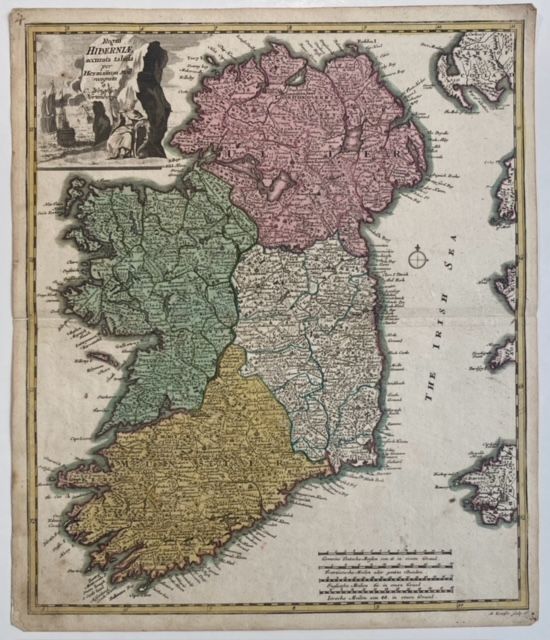
Regni Hiberniae Accurata Tabula per Hermanum Moll; 1718 Map of Ireland based on Herman Moll
- unbound
- Nuremberg: Christoph Weigel, 1718
Nuremberg: Christoph Weigel, 1718. unbound. Kauffer. Map. Copper plate engraving with original hand coloring. Sheet measures 13.25" x 16".
Striking 1718 map of Ireland by Christoph Weigel. The Emerald isle is divided into the four provinces and identifies towns, roads, forests, rivers, and other topographical features in beautiful detail. Features a decorative title cartouche in the top left quadrant illustrating the title on a rock cliff, galleons in the sea, and the Celtic Harp, a symbol of Ireland. Herman Moll, on whose map Weigel has based this map, is credited in the title. The map is in very good condition with vivid hand color and original plate mark visible.
Christoph Weigel the Elder (1654 - 1725) was a German engraver and publisher active in Nuremberg in the early 1700s. He worked closely with the highly successful imperial geographer and cartographer Johann Baptist Homann. His younger brother, Johann Christoph Weigel (1661 - 1726) ran a successful art shop in Nuremberg around the same time. After his death in 1725, the firm passed to his widow, who published a number of Weigel's works posthumously. This is a great example of his work.
Striking 1718 map of Ireland by Christoph Weigel. The Emerald isle is divided into the four provinces and identifies towns, roads, forests, rivers, and other topographical features in beautiful detail. Features a decorative title cartouche in the top left quadrant illustrating the title on a rock cliff, galleons in the sea, and the Celtic Harp, a symbol of Ireland. Herman Moll, on whose map Weigel has based this map, is credited in the title. The map is in very good condition with vivid hand color and original plate mark visible.
Christoph Weigel the Elder (1654 - 1725) was a German engraver and publisher active in Nuremberg in the early 1700s. He worked closely with the highly successful imperial geographer and cartographer Johann Baptist Homann. His younger brother, Johann Christoph Weigel (1661 - 1726) ran a successful art shop in Nuremberg around the same time. After his death in 1725, the firm passed to his widow, who published a number of Weigel's works posthumously. This is a great example of his work.