

In Powder & Crinoline (Signed limited edition)




- SIGNED
- London: Hodder & Stoughton, 1913
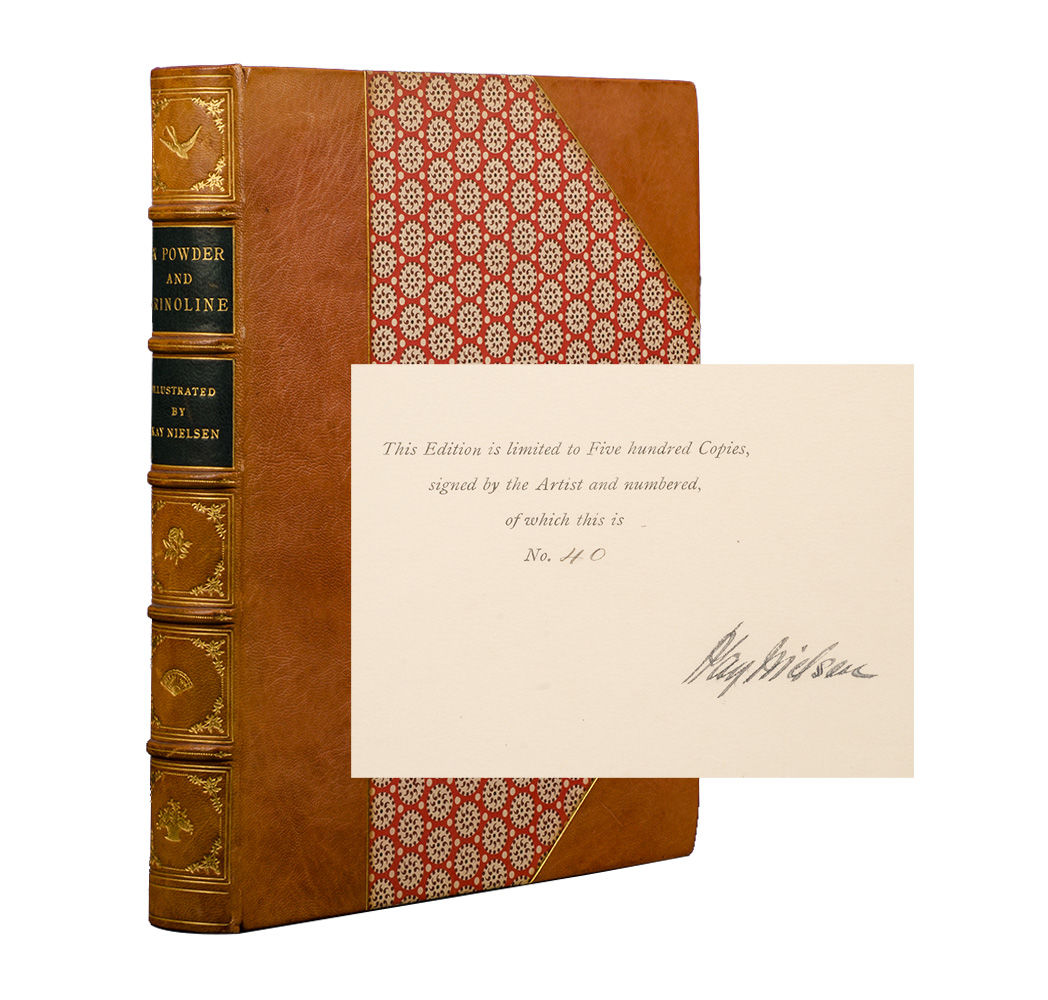
London: Hodder & Stoughton, 1913. First edition. Fine. Edition Deluxe, number 40 of 500 copies, numbered and signed by the artist. A Fine copy. Large quarto (12 x 9 7/8 inches; 305 x 252 mm.). [2, limitation leaf], xii, [13]-163, [1] pp. Inserted title and twenty-six mounted color plates on gray paper with descriptive tissue-guards. Fifteen black & white text illustrations, decorative top margins to text leaves. Bound ca. 1925 by Sangorski & Sutcliffe, stamp signed on verso of front free-endpaper. Three-quarter crushed tan morocco over patterned boards ruled in gilt. Spine with five raised bands decoratively paneled and tooled in gilt in compartments. Two blue morocco labels lettered in gilt. Matching patterned endpapers, top edge gilt.
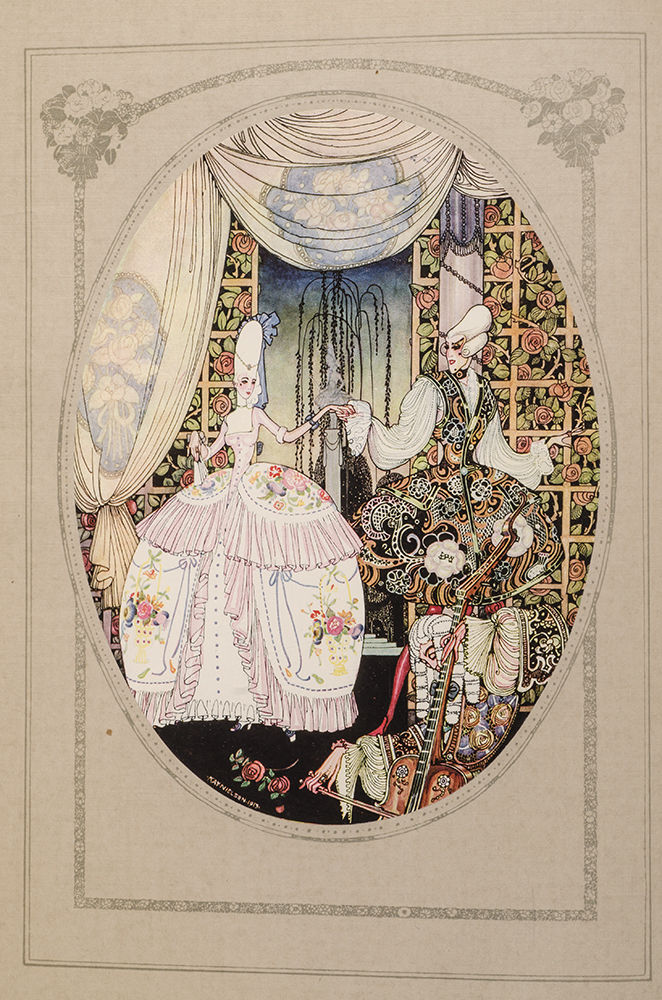
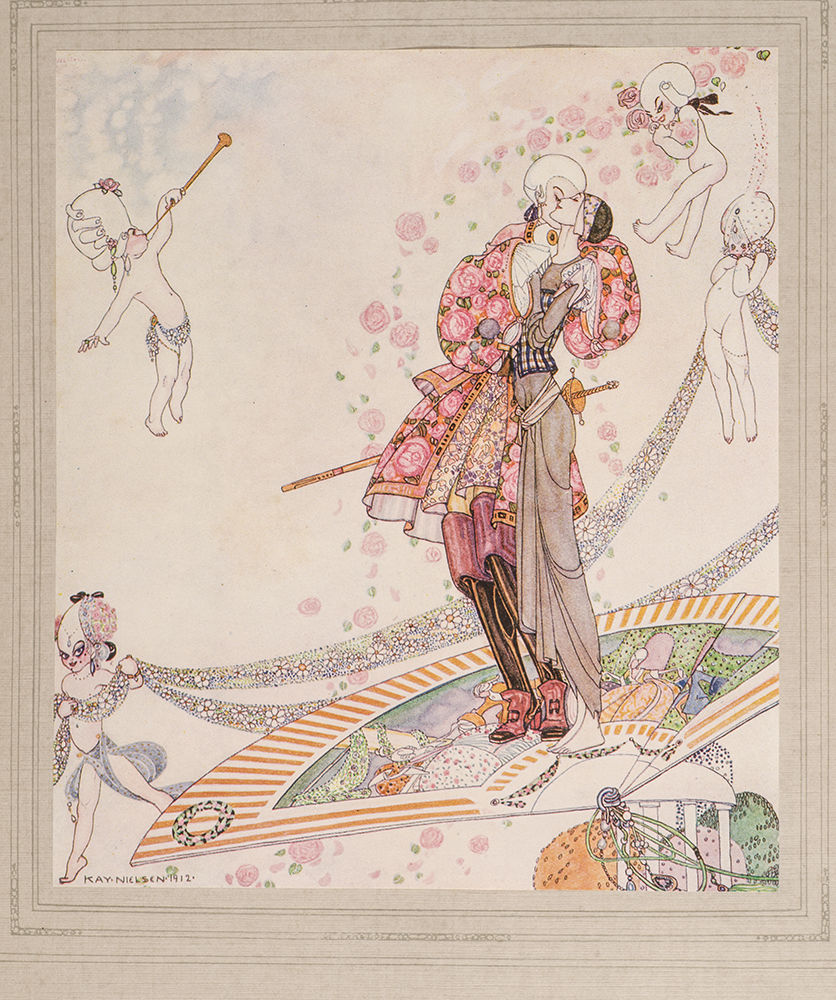
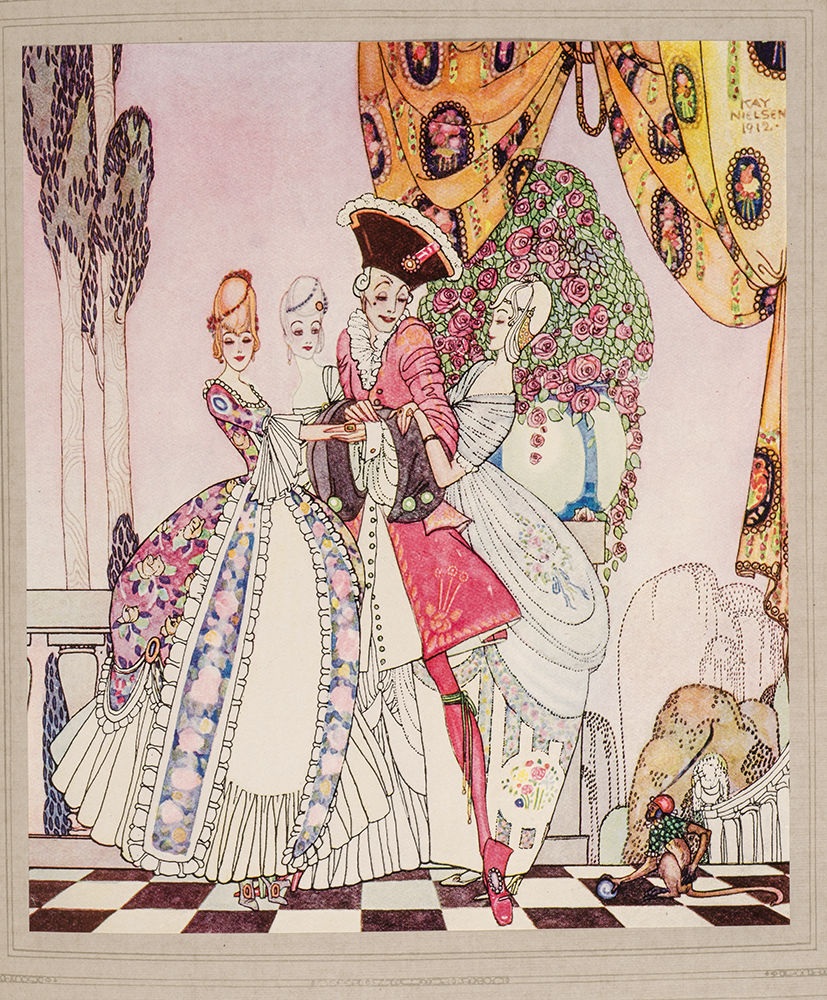
The writer and compiler Arthur Quiller-Couch (1863-1944), is known in part for his anthologies of fairy tales. Here we present his third collection, In Powder and Crinoline: Old Fairy Tales Retold (1913), which includes Minon-Minette, Felicia or The Pot of Pinks, Rosanie or The Inconstant Prince, The Man Who Never Laughed, John and the Ghosts, The Czarina's Violet, and a version of The Twelve Dancing Princesses (The Oxford Companion to Fairy Tales). Danish illustrator and designer Kay Nielsen (1886-1957) created the fantastical illustrations. Nielsen “was drawn early on to fairy tales and illustrated many volumes for Hodder & Stoughton: In Powder and Crinoline (1913), East of the Sun, West of the Moon (1914), Hans Andersen’s Fairy Tales (drawings completed in 1912, but first published in 1924), Hansel and Gretel (1925), and Red Magic (Jonathan Cape, 1930), a collections of fairy tales from around the world. Nielsen’s designs unite strong linearity with delicate colouring…Characterized by a sense of two-dimensional flatness, Nielsen’s objects and people are highly stylized: foxglove blossoms hang in measured asymmetry; princes and princesses stand on improbably long legs; and their garments billow in gravity-defying parabolas. The power of his illustrations lies in his uncanny ability to retrieve a story’s emotional effect on its reader and to recreate it visually in two dimensions” (The Oxford Companion to Fairy Tales).
An excellent example of a mid 1920s binding by Sangorski & Sutcliffe, very similar to the bindings used for The Golden Cockerel Press Troilus and Criseyde (1927) and The Canterbury Tales (1929-31). The story of the Sangorski & Sutcliffe Bindery reads like something out of a novel—when two of Douglas Cockrell’s talented apprentices, Frances Sangorski and George Sutcliffe, were laid off during an economic downturn they began working out of an attic. Eventually their bindery would be famous for its intricate multicolored leather inlays and elaborate gold and jeweled bindings. Fine.
The writer and compiler Arthur Quiller-Couch (1863-1944), is known in part for his anthologies of fairy tales. Here we present his third collection, In Powder and Crinoline: Old Fairy Tales Retold (1913), which includes Minon-Minette, Felicia or The Pot of Pinks, Rosanie or The Inconstant Prince, The Man Who Never Laughed, John and the Ghosts, The Czarina's Violet, and a version of The Twelve Dancing Princesses (The Oxford Companion to Fairy Tales). Danish illustrator and designer Kay Nielsen (1886-1957) created the fantastical illustrations. Nielsen “was drawn early on to fairy tales and illustrated many volumes for Hodder & Stoughton: In Powder and Crinoline (1913), East of the Sun, West of the Moon (1914), Hans Andersen’s Fairy Tales (drawings completed in 1912, but first published in 1924), Hansel and Gretel (1925), and Red Magic (Jonathan Cape, 1930), a collections of fairy tales from around the world. Nielsen’s designs unite strong linearity with delicate colouring…Characterized by a sense of two-dimensional flatness, Nielsen’s objects and people are highly stylized: foxglove blossoms hang in measured asymmetry; princes and princesses stand on improbably long legs; and their garments billow in gravity-defying parabolas. The power of his illustrations lies in his uncanny ability to retrieve a story’s emotional effect on its reader and to recreate it visually in two dimensions” (The Oxford Companion to Fairy Tales).
An excellent example of a mid 1920s binding by Sangorski & Sutcliffe, very similar to the bindings used for The Golden Cockerel Press Troilus and Criseyde (1927) and The Canterbury Tales (1929-31). The story of the Sangorski & Sutcliffe Bindery reads like something out of a novel—when two of Douglas Cockrell’s talented apprentices, Frances Sangorski and George Sutcliffe, were laid off during an economic downturn they began working out of an attic. Eventually their bindery would be famous for its intricate multicolored leather inlays and elaborate gold and jeweled bindings. Fine.