

Recueil de Planches, sur Les Science, Les Arts Liberaux, et Les Arts Méchaniques, avec Leur Explication (Dictionnaire des Sciences) - 11 volumes in 6 books
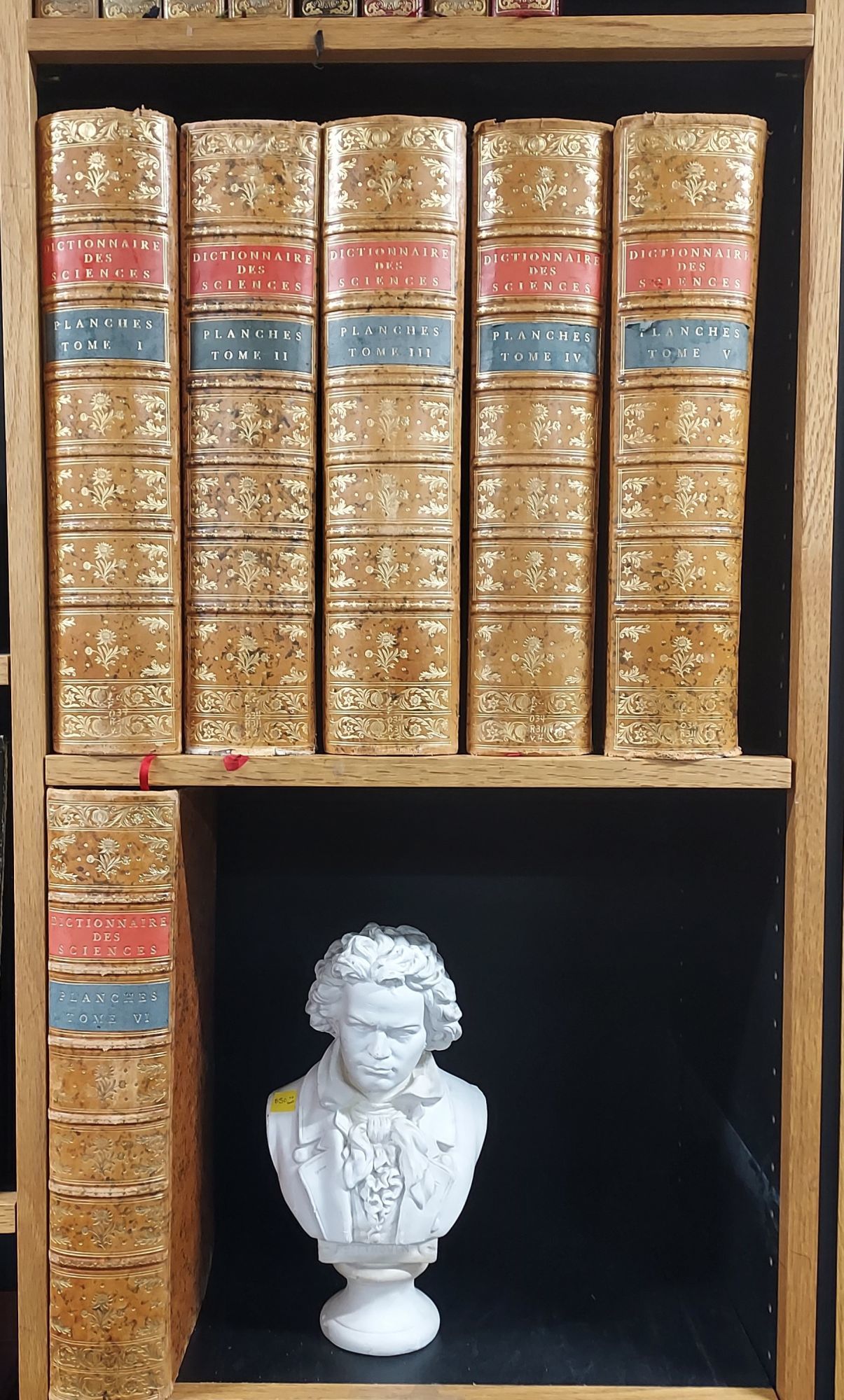
- Leather bound
- Paris: Cercle du Livre Précieux, 1966
Paris: Cercle du Livre Précieux, 1966. Reprint. Leather bound. Very Good. ***Will require extra postage due to weight (it is very heavy), shipping outside of the United States is greatly discouraged!!! Folio [39 cm] Ex-library with several discreet library marks (including very faint library numbers on the spines). Sprinkled calf with 7 compartments in gilt on the spines. Red and green spine labels. Marbled endpapers. Silk ribbon page-markers. The extremities are rubbed and the spine ends are lightly chipped. French text. Number 840 in an edition of 3000. Chock full of lavish plates, some double, some folded.
Ce Volume constitute la première reproduction rigoureuse et intégral de l'édition originale des planches de L'Encyclopédie ou Dictionnaire des Sciences des Arts et des Métiers mis en ordre et publiés par MM. Diderot et d'Alembert.
Denis Diderot (1713-1784) was a French writer, philosopher, and art critic, who with Voltaire to a large extent defined the French Enlightenment during the greater part of the 18th century. This is his major work, a monument of the French Enlightenment and a representation of the standard of scholarly knowledge of the time and of the spirit of rationalism which pervaded 18th century thought.
Ce Volume constitute la première reproduction rigoureuse et intégral de l'édition originale des planches de L'Encyclopédie ou Dictionnaire des Sciences des Arts et des Métiers mis en ordre et publiés par MM. Diderot et d'Alembert.
Denis Diderot (1713-1784) was a French writer, philosopher, and art critic, who with Voltaire to a large extent defined the French Enlightenment during the greater part of the 18th century. This is his major work, a monument of the French Enlightenment and a representation of the standard of scholarly knowledge of the time and of the spirit of rationalism which pervaded 18th century thought.