

Edward Bok: an Autobiography. With Illustrations [Inscribed Copy]
- SIGNED
- London: Thornton Butterworth Ltd, 1921
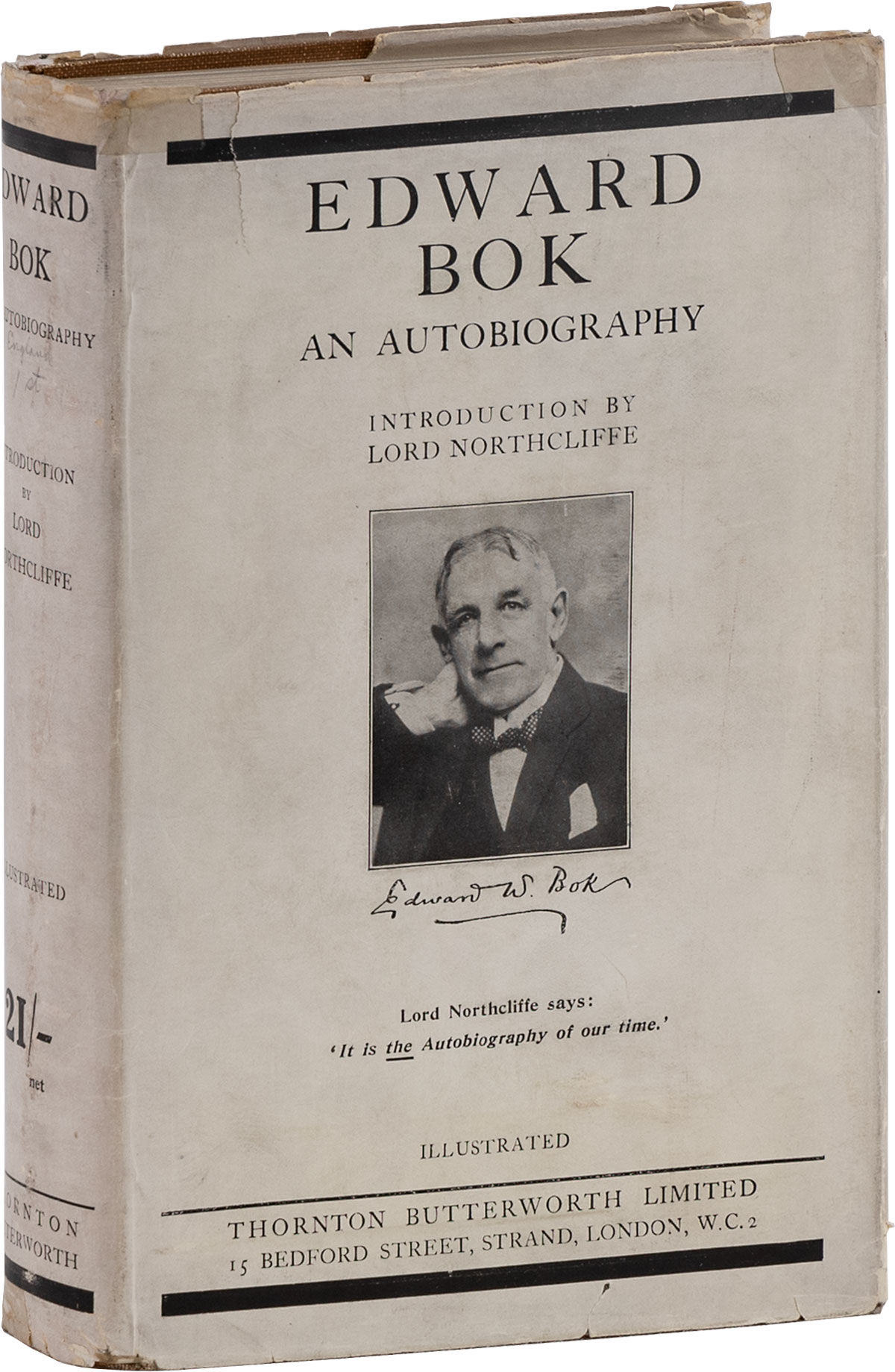
London: Thornton Butterworth Ltd, 1921. First U.K. Edition. Signed by Bok on front endpaper, and further inscribed in his hand: "Abridged edition published in London June 1921...American portions omitted for then-existing political conditions which tended towards an anti-American feeling." Octavo. Tan publisher's cloth; dustjacket; 318pp; bottom and fore-edges untrimmed. Tight and straight, Near Fine; in the original dustwrapper, lightly rubbed and soiled, with clear-tape reinforcements at spine ends; Very Good. "Priced 21/– net" on spine panel.
Bok's Pulitzer Prize-winning autobiography was originally published in the U.S. with the title The Americanization of Edward Bok: the Autobiography of a Dutch Boy Fifty Years After (NY:1920). Bok, whose family emigrated from the Netherlands to Brooklyn around 1870, went on to become a leading figure in American publishing; he was editor of the Ladies Home Journal for thirty years (1889-1919), a position from which he exerted a strong influence on American tastes and politics, advocating reforms in architecture, diplomacy, and education but also taking an unwavering stance against woman suffrage. The "political conditions" to which Bok refers in his inscription are no doubt the ill feelings brought about by America's failure to join the League of Nations, a proposal which had been squarely defeated by a Senate vote in 1920. Uncommon in dustwrapper, more so signed, and a somewhat elusive Pulitzer title.
Bok's Pulitzer Prize-winning autobiography was originally published in the U.S. with the title The Americanization of Edward Bok: the Autobiography of a Dutch Boy Fifty Years After (NY:1920). Bok, whose family emigrated from the Netherlands to Brooklyn around 1870, went on to become a leading figure in American publishing; he was editor of the Ladies Home Journal for thirty years (1889-1919), a position from which he exerted a strong influence on American tastes and politics, advocating reforms in architecture, diplomacy, and education but also taking an unwavering stance against woman suffrage. The "political conditions" to which Bok refers in his inscription are no doubt the ill feelings brought about by America's failure to join the League of Nations, a proposal which had been squarely defeated by a Senate vote in 1920. Uncommon in dustwrapper, more so signed, and a somewhat elusive Pulitzer title.