

AIRCRAFT RIVETING


- (Scranton, Pennsylvania): (International Textbook Company), 1943
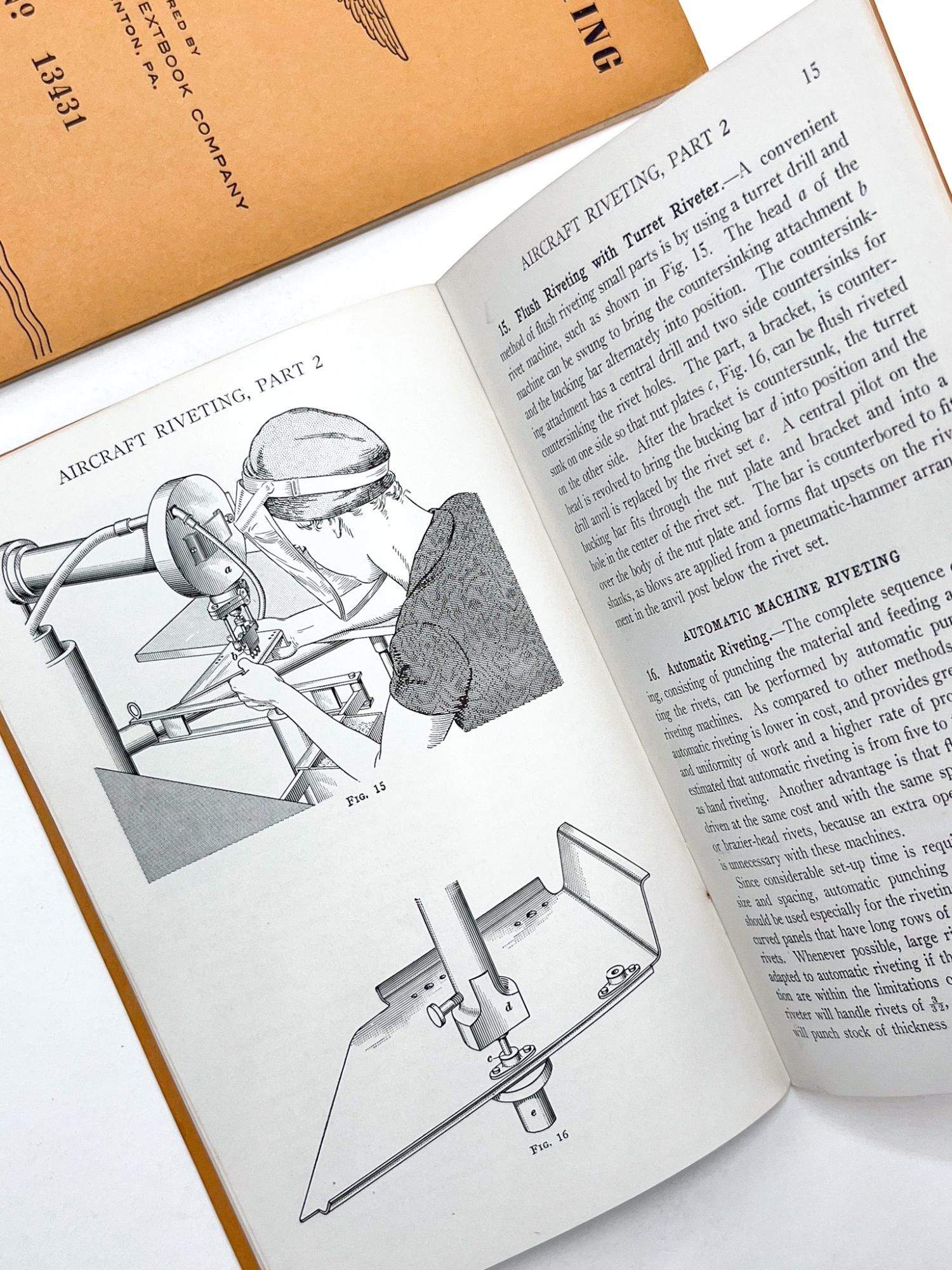
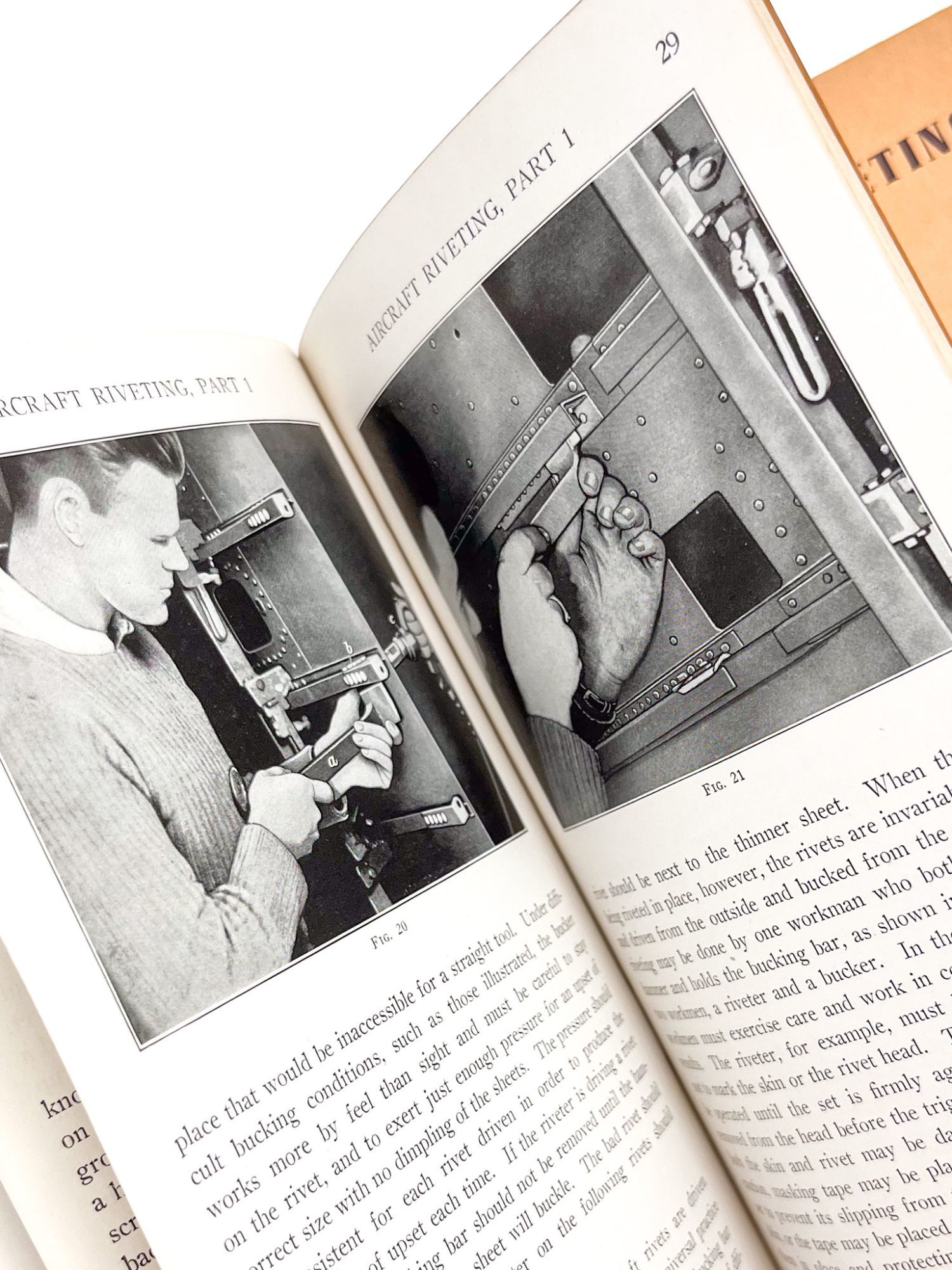
(Scranton, Pennsylvania): (International Textbook Company), 1943. First printings. Very good plus.. World War II-era Navy manual on aircraft riveting applications, materials, and methods, illustrated with photographs and line drawings of the women who famously flooded into heavy construction machinery jobs during the war. At the peak of wartime aircraft industry employment in 1943, women workers made up more than a third of the labor force, building bombers and stylized in song, film, and popular art as "Rosie the Riveters." As a technical manual, AIRCRAFT RIVETING is largely free of the gendered persuasion common to recruiting advertisements of the time, assuming the reader may be a woman new to the field while making little fuss about it. ("Since the squeezer is to [sic] heavy for a woman operator, it is suspended by a cable [...].")
The contemporary popular song "Rosie the Riveter," written by Evans & Loeb in 1942, glorifies the hardy female riveter ("All the day long, whether rain or shine / She's a part of the assembly line") and 1944's ROSIE THE RIVETER was a jolly musical comedy of rivet guns and wartime housing shortages. Like the idealized propaganda-poster Rosies of J. Howard Miller and Norman Rockwell, the women pictured in AIRCRAFT RIVETING are dressed practically in trousers, hair tied back in bandanas and fingernails sensibly short, with their eyes on their work, hands on their power tools, and their minds set on victory.
A powerful, ephemeral document — connecting wartime realities with a quintessentially American archetype. Two volumes, 7.5'' x 4.75'' each. Parts I and II, separately issued. Original orange printed saddle-stapled wrappers. Both volumes illustrated with black and white photographs and line drawings. Part 1: 46 pages, Part 2: 37, [1] pages. Light soil and edgewear to wrappers.
The contemporary popular song "Rosie the Riveter," written by Evans & Loeb in 1942, glorifies the hardy female riveter ("All the day long, whether rain or shine / She's a part of the assembly line") and 1944's ROSIE THE RIVETER was a jolly musical comedy of rivet guns and wartime housing shortages. Like the idealized propaganda-poster Rosies of J. Howard Miller and Norman Rockwell, the women pictured in AIRCRAFT RIVETING are dressed practically in trousers, hair tied back in bandanas and fingernails sensibly short, with their eyes on their work, hands on their power tools, and their minds set on victory.
A powerful, ephemeral document — connecting wartime realities with a quintessentially American archetype. Two volumes, 7.5'' x 4.75'' each. Parts I and II, separately issued. Original orange printed saddle-stapled wrappers. Both volumes illustrated with black and white photographs and line drawings. Part 1: 46 pages, Part 2: 37, [1] pages. Light soil and edgewear to wrappers.