

[Doctoral Thesis Draft] The Negro Miner in West Virginia: Dissertation
![[Doctoral Thesis Draft] The Negro Miner in West Vi](https://d3525k1ryd2155.cloudfront.net/h/876/592/1621592876.0.x.jpg)
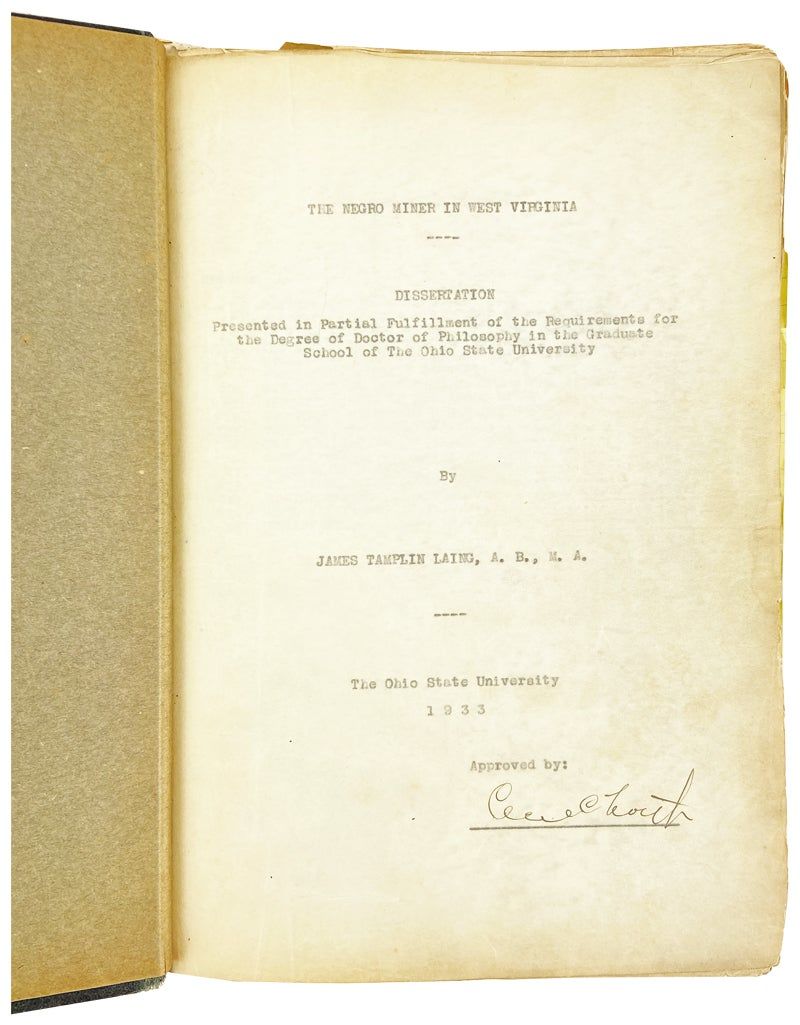

- Columbus, OH: Ohio State University, 1933
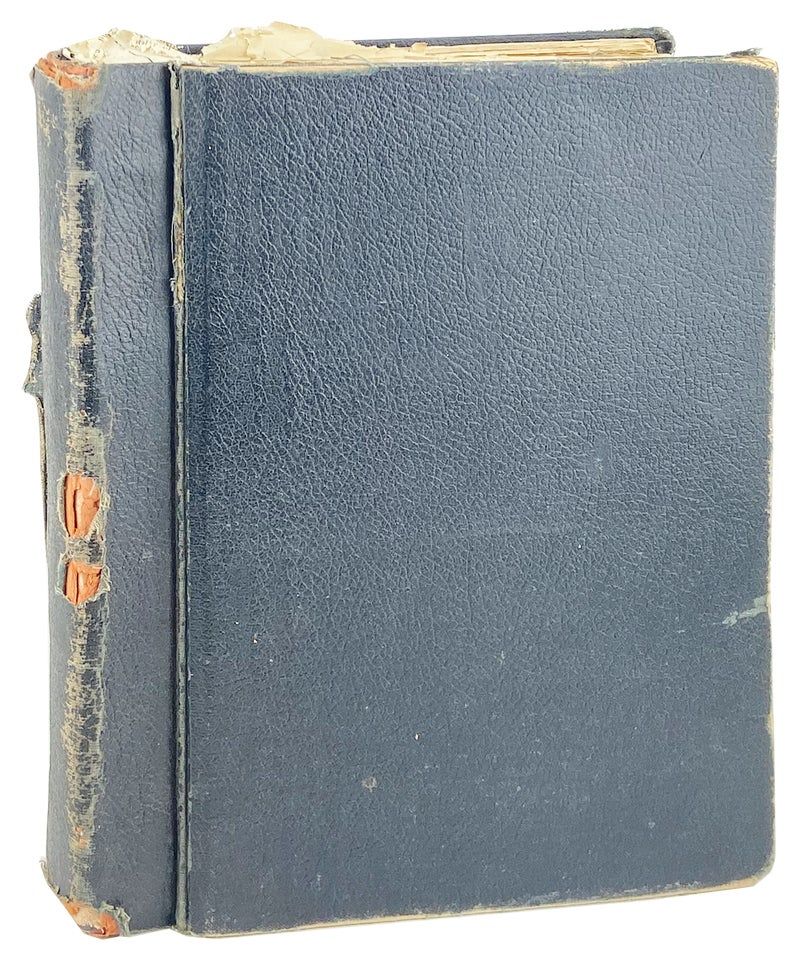
Columbus, OH: Ohio State University, 1933. Very Good. [Columbus]: Ohio State University, 1933. Thick quarto (29cm.) postbound in original black textured cloth boards; [3],520,[4]ll. printed from typescript; five map illus., some with ink-drawn additions, two hand-drawn graphs in pencil or ink, one original snapshot photo mounted in. Cloth worn with large split along rear spine edge, losses at spine ends, margins threadbare with boards exposed underneath; contents meanwhile in excellent condition, early leaves with fairly extensive marginalia and ink corrections either in Laing's hand or his advisor's. Overall Very Good and sound despite cosmetic issues with the binding.
Late working draft of white anthropologist James T. Laing's doctoral thesis - a detailed account of Black miners and their families in the mining communities and company towns across the state of West Virginia, based in part on surveys, interviews, and first-hand sociological studies of the people, towns, and working conditions under which they often dangerously toiled. Evidently not the finished work, the first half of the text with fairly substantial ink corrections either in Laing's hand or that of his thesis advisor's.
The text lay-out includes space for, and captions to, additional photographic illus. not present here with a single exception: a snapshot captioned "Negro miners and their hogs sometimes have adjoining bedrooms." The photo shows the exterior of a house's siding, which abuts a pen for hogs (not pictured). Other captions, while lacking images, are still evocative: "Wife of Negro miner and her 9 children living in three rooms"; "A checkers club"; "Negro and white miners working together making a baseball field."
Arguably almost no aspect of a Black coal miner's life goes unexamined in this exhaustive study. Charts provide statistical data on population members' birth place and last place of residence; church membership and attendance; and not just their education level but the education of their children.
In the chapter on religion and church-going, Laing observes the tension that had arisen within the Black mining community, a result of the early waves of the Great Migration: "Simple Negro peasants lately from the south, caught in the maelstrom of economic maladjustment, desiring the ecstasy which only a certain type of religion can give them, complain that they cannot 'understand' the preacher. Educated and race conscious Negro ministers, for whom the adoption of white standards is the most important desideratum complain because they must 'talk down' to their congregants. Both are dissatisfied" (p. 449).
The history and sociological study of Black Appalachia has recently begun to attract greater academic attention to counter the popular narrative of the inaccurate mythological whiteness of the area. Though this dissertation was written by a white man, it remains a rich eyewitness source, generous with its use of oral history in capturing a historically overlooked community.
Late working draft of white anthropologist James T. Laing's doctoral thesis - a detailed account of Black miners and their families in the mining communities and company towns across the state of West Virginia, based in part on surveys, interviews, and first-hand sociological studies of the people, towns, and working conditions under which they often dangerously toiled. Evidently not the finished work, the first half of the text with fairly substantial ink corrections either in Laing's hand or that of his thesis advisor's.
The text lay-out includes space for, and captions to, additional photographic illus. not present here with a single exception: a snapshot captioned "Negro miners and their hogs sometimes have adjoining bedrooms." The photo shows the exterior of a house's siding, which abuts a pen for hogs (not pictured). Other captions, while lacking images, are still evocative: "Wife of Negro miner and her 9 children living in three rooms"; "A checkers club"; "Negro and white miners working together making a baseball field."
Arguably almost no aspect of a Black coal miner's life goes unexamined in this exhaustive study. Charts provide statistical data on population members' birth place and last place of residence; church membership and attendance; and not just their education level but the education of their children.
In the chapter on religion and church-going, Laing observes the tension that had arisen within the Black mining community, a result of the early waves of the Great Migration: "Simple Negro peasants lately from the south, caught in the maelstrom of economic maladjustment, desiring the ecstasy which only a certain type of religion can give them, complain that they cannot 'understand' the preacher. Educated and race conscious Negro ministers, for whom the adoption of white standards is the most important desideratum complain because they must 'talk down' to their congregants. Both are dissatisfied" (p. 449).
The history and sociological study of Black Appalachia has recently begun to attract greater academic attention to counter the popular narrative of the inaccurate mythological whiteness of the area. Though this dissertation was written by a white man, it remains a rich eyewitness source, generous with its use of oral history in capturing a historically overlooked community.