

[Autograph manuscript, his description of the Glossy Ibis for publication in his Ornithological Biography, the text for the elephant folio first edition of Birds of America]
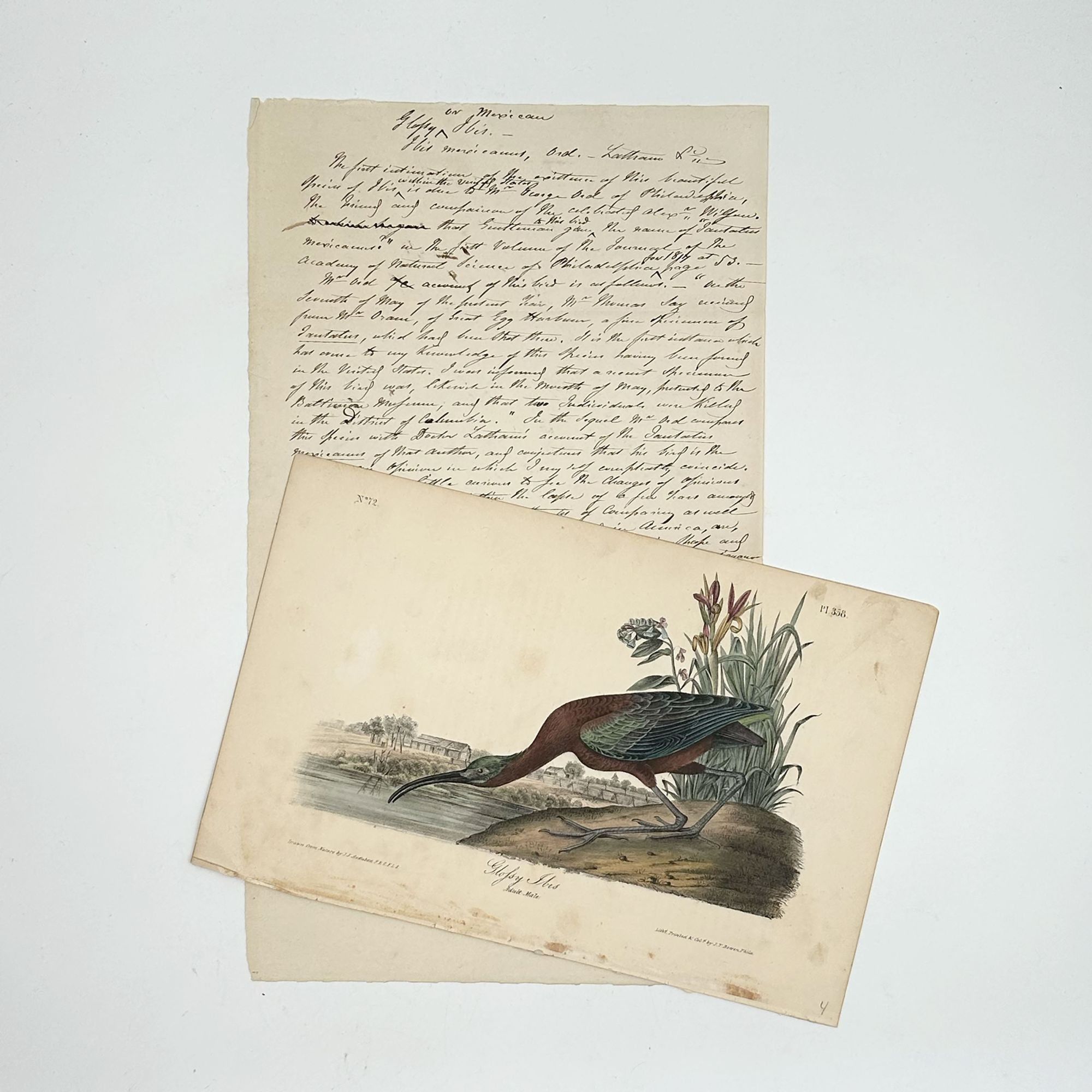
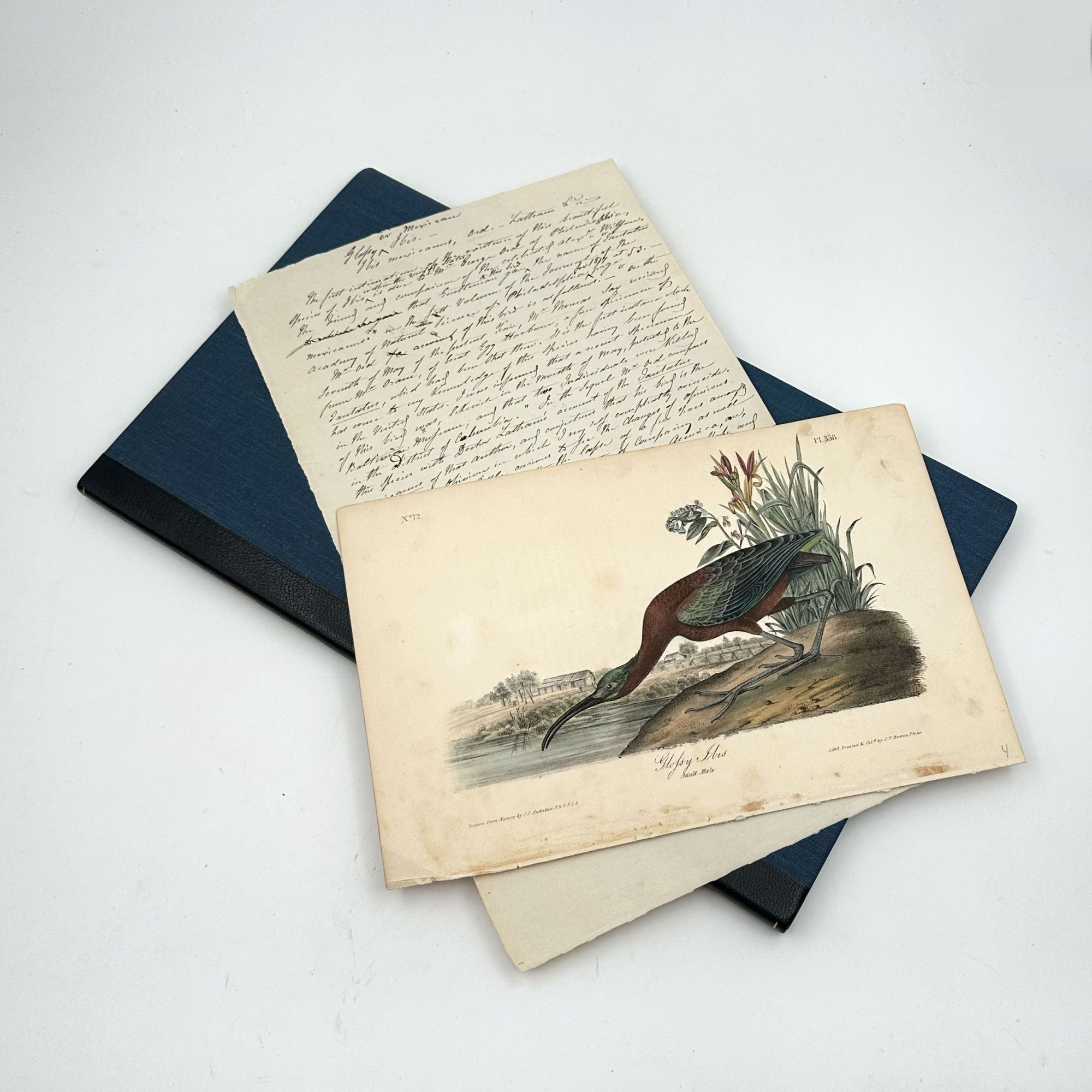
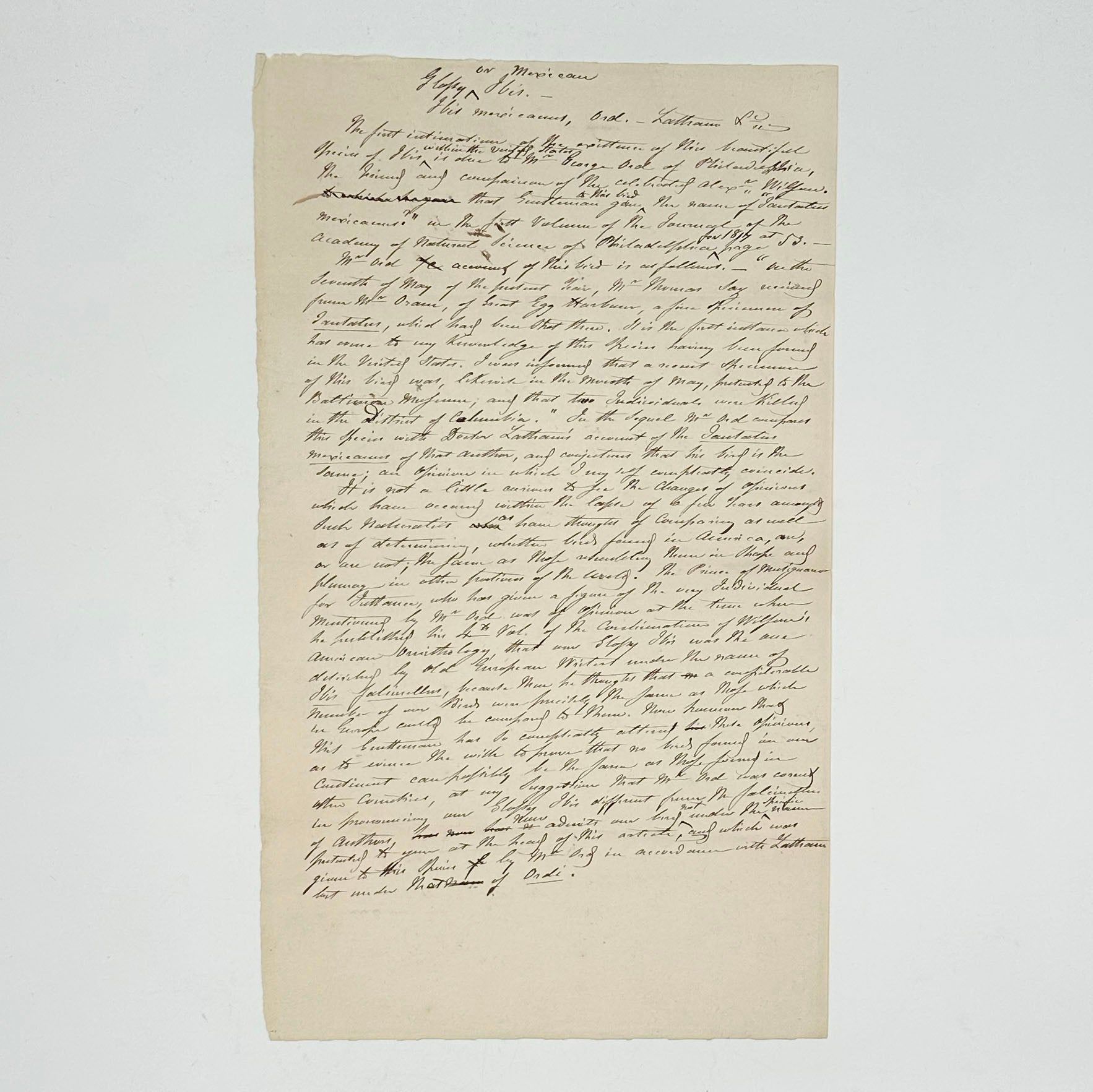
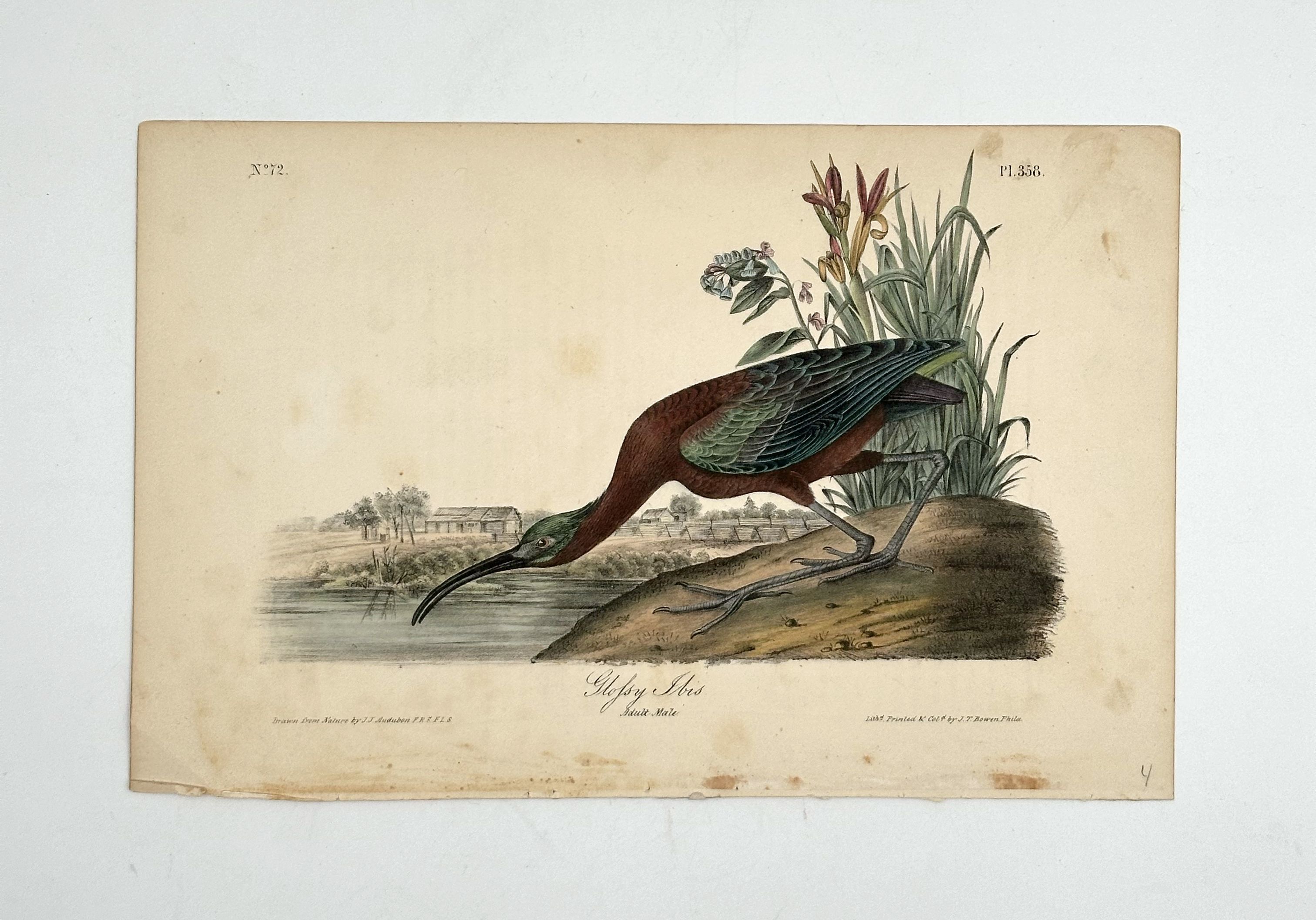
- [1]p., about 400 words in ink, with cross outs and corrections, small folio sheet. With a handcolored lithographed print of the
- [London] , 1837
[London], 1837. [1]p., about 400 words in ink, with cross outs and corrections, small folio sheet. With a handcolored lithographed print of the ibis from the first octavo edition. 13–1/2 x 7–7/8 inches. Old folds. Housed in a blue morocco backed slipcase. [1]p., about 400 words in ink, with cross outs and corrections, small folio sheet. With a handcolored lithographed print of the ibis from the first octavo edition. 13–1/2 x 7–7/8 inches. To accompany his ambitious elephant folio edition of the Birds, Audubon separately published the text under the title Ornithological Biography. Although text and plates were planned together, British copyright law compelled Audubon to publish the volumes under a separate title or else risk bankruptcy by having to deposit sets of the Birds in all nine depository libraries within the United Kingdom.
This manuscript was evidently a draft for the sketch on the ibis which appears on pp. 607–8 of the fourth volume of Audubon's Ornithological Biography,which Audubon had first seen in Florida in 1832. The warm-weather migratory water bird, known for its stunning colors in the breeding adults, can be found in Europe, Asia, Africa, Australia, and the Americas.
Interestingly, the text of Audubon's manuscript differs from the published version. The first part of the manuscript corresponds to the published version, but when Audubon reaches a discussion of his disagreement with ornithologists George Ord and Charles Bonaparte over the nature of the species, the present manuscript descends into pure vitriol. Instead of the critical but balanced comment which appears in the published version, Audubon attacks both his old enemy, Ord, and his former friend (now enemy), Bonaparte, in sarcastic terms. Since the manuscript breaks off there, instead of turning to a discussion of feeding habits, as in the published version, it would seem that this is a first draft, and that Audubon later gained control of his anger over the betrayal of Bonaparte, with whom he had formerly been on good terms, but whom he felt had plagiarized his work.
Transcribed in full:
“The first intimation of the existence of this beautiful species of Ibis within the United States is due to Mr. George Ord of Philadelphia, the friend and companion of the celebrated Alexr. Wilson. That Gentleman gave to this bird the name of ‘Tantalus Mexicanus’ in the first volume of the Journal of the Academy of Natural Sciences of Philadelphia for 1817 at page 53.
“Mr. Ord’s account of this bird is as follows: ‘on the seventh of May of the present year, Mr. Thomas Say received from Mr. Oram, of Great Egg Harbour, a fine specimen of Tantalus, which had been shot there. It is the first instance which has come to my knowledge of this species having been found in the United States. I was informed that a recent specimen of this bird was, likewise in the month of May, presented to the Baltimore Museum, and that two individuals were killed in the District of Columbia.' In the sequel Mr. Ord compares this species with Dr. Latham's account of the Tantalus Mexicanus of that author, and conjectures that his bird is the same; an opinion in which I myself completely coincide.
“It is not a little curious to see the changes of opinion which have occurred within the lapse of a few years among naturalists as have thought of comparing as well as of determining, whether birds found in America are, or are not, the same as those resembling them in shape and plumage in other parts of the World. The Prince of Musignano, for instance, who has given a figure of the very individual mentioned by Mr. Ord, was of opinion at the time when he published the fourth volume of his continuation of Wilson’s American Ornithology, that our Glossy Ibis was the one described by the old European writers under the name of Ibis Falcinellus, because then he thought that a considerable number of our Birds were precisely[?] the same as those which in Europe could be compared to these. Now, however, that this gentleman has so completely altered his opinions, as to evince the wish to prove that no bird found in our continent can possibly be the same as those found in other countries; at my suggestion that Mr. Ord was correct in pronouncing our Glossy Ibis different from the Falcinellus of Authors, has now has now admits our bird not under the specific name presented to you at the head of this article, and was given to this species by Mr. Ord in accordance with Latham, but under that of Ord.”.
This manuscript was evidently a draft for the sketch on the ibis which appears on pp. 607–8 of the fourth volume of Audubon's Ornithological Biography,which Audubon had first seen in Florida in 1832. The warm-weather migratory water bird, known for its stunning colors in the breeding adults, can be found in Europe, Asia, Africa, Australia, and the Americas.
Interestingly, the text of Audubon's manuscript differs from the published version. The first part of the manuscript corresponds to the published version, but when Audubon reaches a discussion of his disagreement with ornithologists George Ord and Charles Bonaparte over the nature of the species, the present manuscript descends into pure vitriol. Instead of the critical but balanced comment which appears in the published version, Audubon attacks both his old enemy, Ord, and his former friend (now enemy), Bonaparte, in sarcastic terms. Since the manuscript breaks off there, instead of turning to a discussion of feeding habits, as in the published version, it would seem that this is a first draft, and that Audubon later gained control of his anger over the betrayal of Bonaparte, with whom he had formerly been on good terms, but whom he felt had plagiarized his work.
Transcribed in full:
“The first intimation of the existence of this beautiful species of Ibis within the United States is due to Mr. George Ord of Philadelphia, the friend and companion of the celebrated Alexr. Wilson. That Gentleman gave to this bird the name of ‘Tantalus Mexicanus’ in the first volume of the Journal of the Academy of Natural Sciences of Philadelphia for 1817 at page 53.
“Mr. Ord’s account of this bird is as follows: ‘on the seventh of May of the present year, Mr. Thomas Say received from Mr. Oram, of Great Egg Harbour, a fine specimen of Tantalus, which had been shot there. It is the first instance which has come to my knowledge of this species having been found in the United States. I was informed that a recent specimen of this bird was, likewise in the month of May, presented to the Baltimore Museum, and that two individuals were killed in the District of Columbia.' In the sequel Mr. Ord compares this species with Dr. Latham's account of the Tantalus Mexicanus of that author, and conjectures that his bird is the same; an opinion in which I myself completely coincide.
“It is not a little curious to see the changes of opinion which have occurred within the lapse of a few years among naturalists as have thought of comparing as well as of determining, whether birds found in America are, or are not, the same as those resembling them in shape and plumage in other parts of the World. The Prince of Musignano, for instance, who has given a figure of the very individual mentioned by Mr. Ord, was of opinion at the time when he published the fourth volume of his continuation of Wilson’s American Ornithology, that our Glossy Ibis was the one described by the old European writers under the name of Ibis Falcinellus, because then he thought that a considerable number of our Birds were precisely[?] the same as those which in Europe could be compared to these. Now, however, that this gentleman has so completely altered his opinions, as to evince the wish to prove that no bird found in our continent can possibly be the same as those found in other countries; at my suggestion that Mr. Ord was correct in pronouncing our Glossy Ibis different from the Falcinellus of Authors, has now has now admits our bird not under the specific name presented to you at the head of this article, and was given to this species by Mr. Ord in accordance with Latham, but under that of Ord.”.