

Statistical Atlas of Southern Counties: Listing and Analysis of Socio-Economic Indices of 1104 Southern Counties [Johnson's Copy, With His Bookplate Designed by Aaron Douglas]

- Chapel Hill: The University of North Carolina Press, 1941
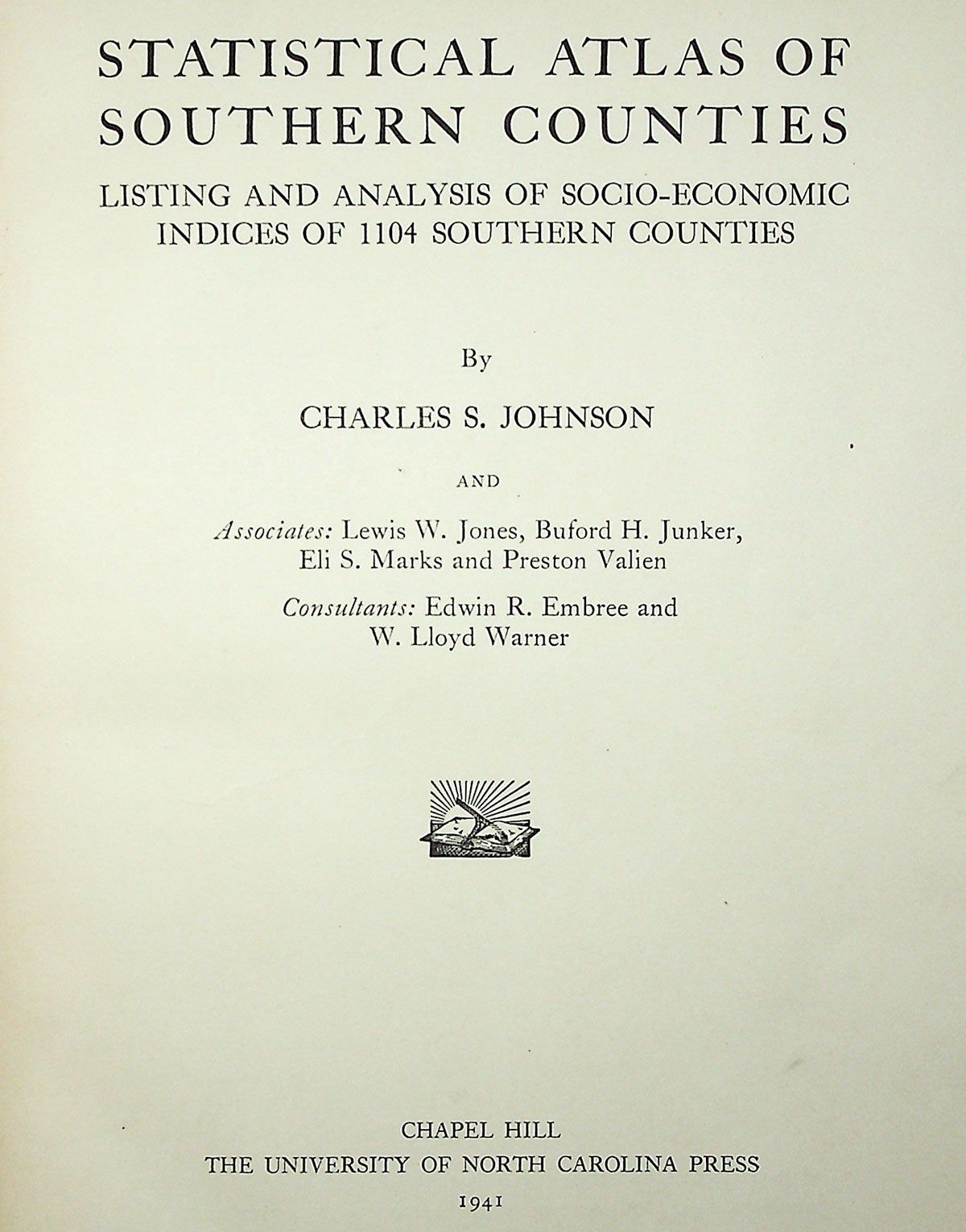
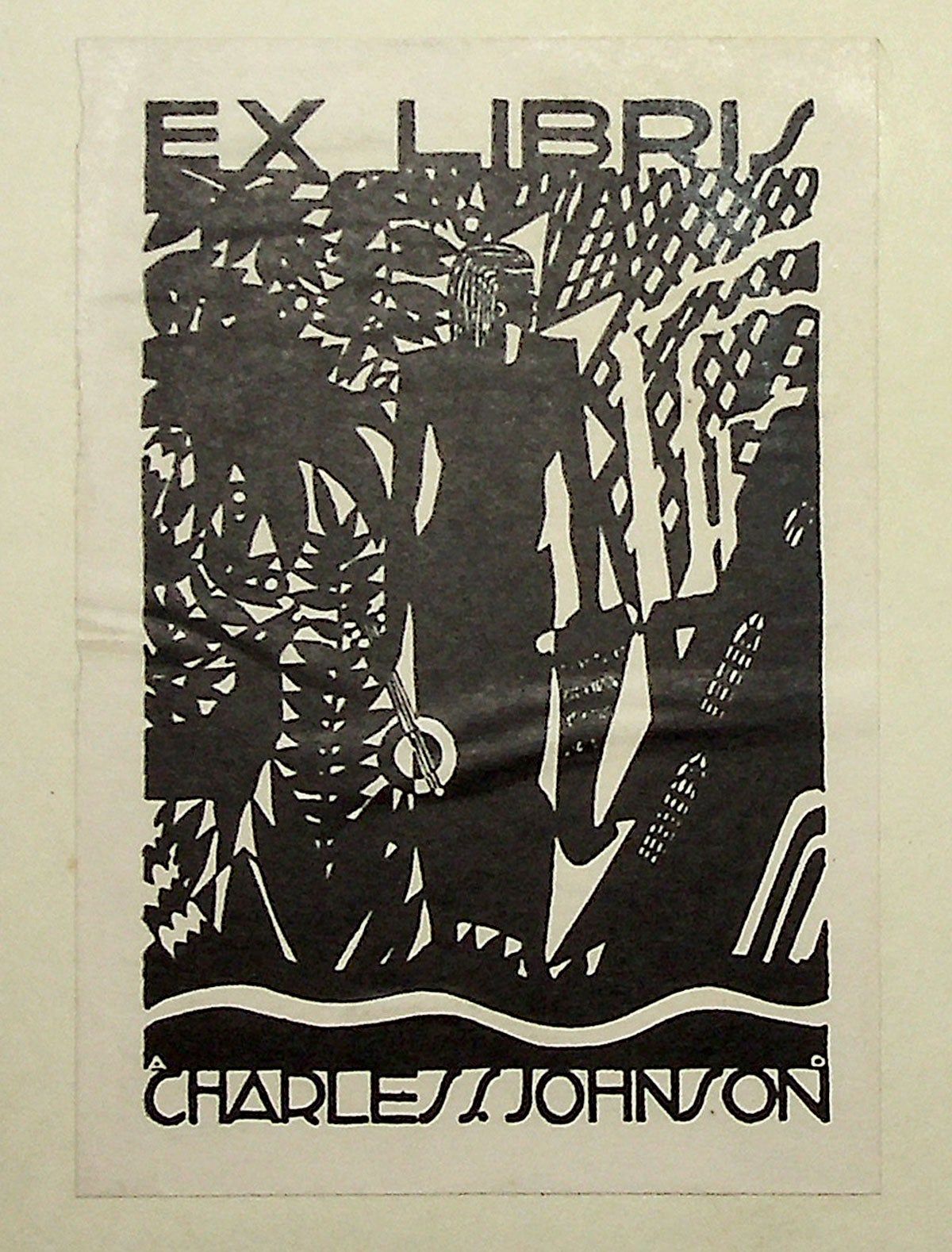
Chapel Hill: The University of North Carolina Press, 1941. First Edition. First Printing. Small quarto (26cm); black cloth, with titles stamped in gilt on spine; xii,355,[1]pp. Johnson's own copy, with his pictorial bookplate designed by Aaron Douglas (printed in black on cream wove paper, measuring 4.25" x 3") mounted to front pastedown. Modest external wear, a few faint scuffs to covers, mild dust-soil to text edges, with some softening and minute board exposure to corner tips; contents clean; Very Good+, lacking the scarce dustjacket.
Sociological study of the Southern Counties, financed by the Julius Rosenwald Fund, in an effort to reform rural education. "In conversations among the various students it soon came about that if one reported the crop system and the degree of ruralization of a given county, it was at once possible to described with astonishing accuracy the "social conditions" that were to be expected: the kind of school system, the state of the public health, the economic order, the relations between the races. We found that crops, degree of ruralization, and certain other standard criteria were an index to many very significant characteristics. It was apparent, therefore, that if we could compile a comprehensive county index or statistical atlas of the South (by crops, industries, and degree of rurality) we would have an excellent guide to conditions which vitally affected education and all other social relationships throughout the region" (p.v).
Johnson (1893-1956) was a prominent sociologist and college president, who played a pivotal role in the Harlem Renaissance in his role as editor of the National Urban League's journal Opportunity, where he published the work of Langston Hughes, Countee Cullen, Zora Neale Hurston, and artist Aaron Douglas. "More quietly than Du Bois or Locke...Johnson exerted perhaps the longest lasting impact on Douglas. It was at Johnson's insistence that Ethel Ray Nance encouraged the artist's move to New York. From his helm at the Urban League's Opportunity magazine, Johnson, too, found illustration work for Douglas almost immediately. In addition, it was Johnson who, after gaining his position as the first black president of Fisk University, recruited Douglas to develop the arts program there, offering a position he held for more than three decades. Johnson often worked behind the scenes making opportunities for others. Douglas described him as someone who "understood how to make the way, how to get the next step, how to indicate the next stop for many of these younger people" (Earle, Susan. Aaron Douglas: African American Modernist, p.84).
This bookplate is one of two that Douglas designed in the 1920s for Harlem Renaissance figures (the other being for Alain Locke) – an excellent example of his early, often imitated style, employing the silhouette of a female figure holding a banjo, flanked by palm fronds and angular buildings. Uncommon in commerce; the only example of this bookplate known to us was offered at Swann's African American Art sale (April 4, 2024). 81731.
Sociological study of the Southern Counties, financed by the Julius Rosenwald Fund, in an effort to reform rural education. "In conversations among the various students it soon came about that if one reported the crop system and the degree of ruralization of a given county, it was at once possible to described with astonishing accuracy the "social conditions" that were to be expected: the kind of school system, the state of the public health, the economic order, the relations between the races. We found that crops, degree of ruralization, and certain other standard criteria were an index to many very significant characteristics. It was apparent, therefore, that if we could compile a comprehensive county index or statistical atlas of the South (by crops, industries, and degree of rurality) we would have an excellent guide to conditions which vitally affected education and all other social relationships throughout the region" (p.v).
Johnson (1893-1956) was a prominent sociologist and college president, who played a pivotal role in the Harlem Renaissance in his role as editor of the National Urban League's journal Opportunity, where he published the work of Langston Hughes, Countee Cullen, Zora Neale Hurston, and artist Aaron Douglas. "More quietly than Du Bois or Locke...Johnson exerted perhaps the longest lasting impact on Douglas. It was at Johnson's insistence that Ethel Ray Nance encouraged the artist's move to New York. From his helm at the Urban League's Opportunity magazine, Johnson, too, found illustration work for Douglas almost immediately. In addition, it was Johnson who, after gaining his position as the first black president of Fisk University, recruited Douglas to develop the arts program there, offering a position he held for more than three decades. Johnson often worked behind the scenes making opportunities for others. Douglas described him as someone who "understood how to make the way, how to get the next step, how to indicate the next stop for many of these younger people" (Earle, Susan. Aaron Douglas: African American Modernist, p.84).
This bookplate is one of two that Douglas designed in the 1920s for Harlem Renaissance figures (the other being for Alain Locke) – an excellent example of his early, often imitated style, employing the silhouette of a female figure holding a banjo, flanked by palm fronds and angular buildings. Uncommon in commerce; the only example of this bookplate known to us was offered at Swann's African American Art sale (April 4, 2024). 81731.