

Code de Musique Pratique, ou Methodes pour apprendre la Musique, même à des aveugles, pour former la voix & l'oreille, pour la position de la main avec une méchanique des doigts sur le Clavecin & l'Orgue, pour l'accompagnement sur tous les Instrumens qui en sons susceptibles, & pour le Prélude: Avec de Nouvelles Réflexions sur le Principe sonore
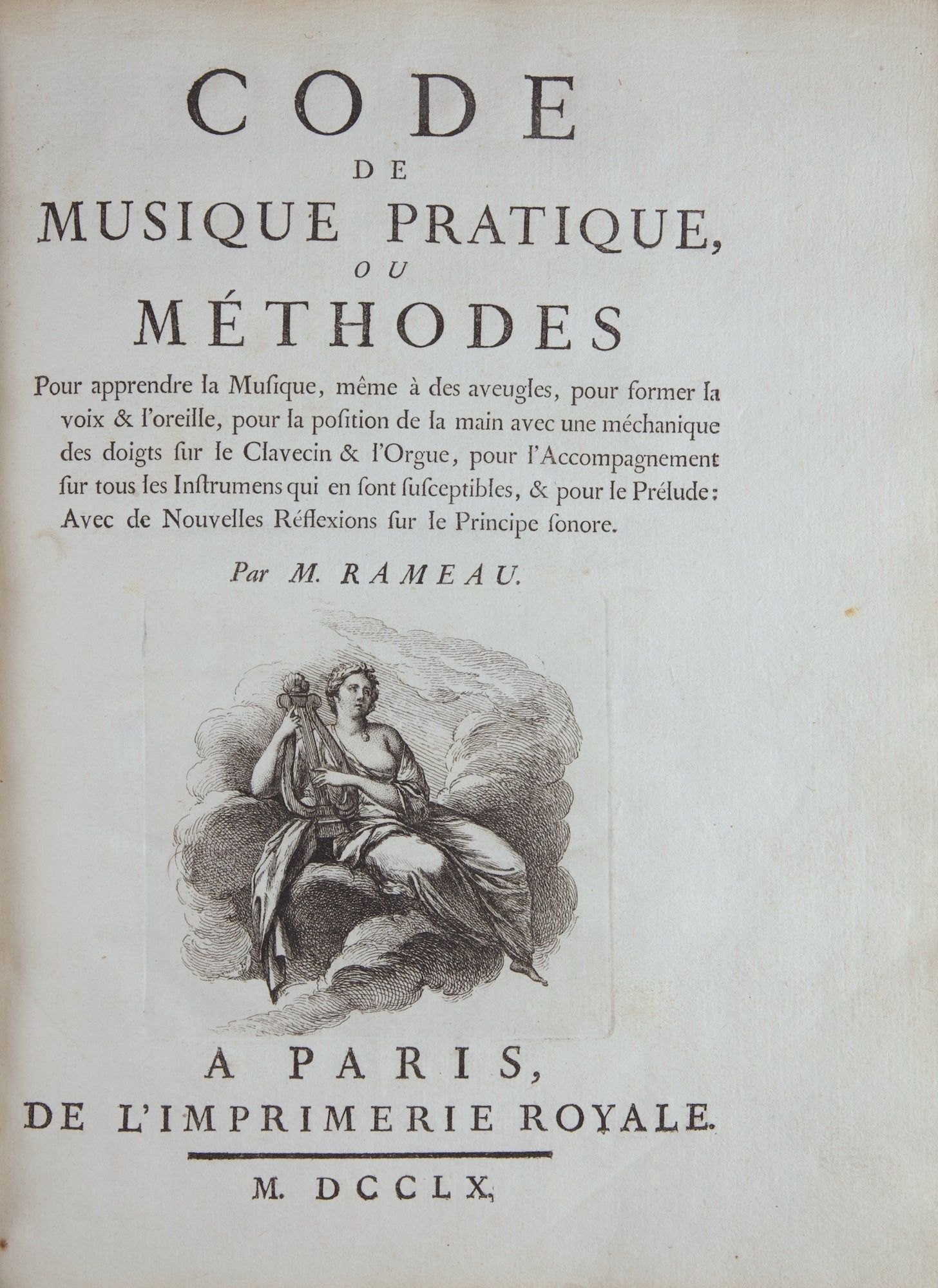
- Paris: de l'Imprimerie Royale, 1760
Paris: de l'Imprimerie Royale, 1760. Quarto. 1f. (recto title, verso blank), vii (contents), viii (errata), ix-xx ("Plan de l'Ouvrage"), 237 pp. With fine large engraved vignette of a female figure with lyre to title; occasional diagrams and decorative woodcut head- and tailpieces.
Corrections in early manuscript to pp. 236 and 237. Lacking frontispiece, the 33 pp. of engraved music, and the 13 folding plates.
First Edition. Gregory-Bartlett p. 223. Cortot p. 163. Hirsch I, 490. RISM Écrits p. 682.
Bound with:
Lettre a M. D'Alembert, sur ses opinions en Musique, inférées dans les articles Fondamental & Gamme de l'Encyclopédie. 14 pp. With a correction in early manuscript to p. 2 and early manuscript paraph at conclusion.
Binding heavily worn, with only very small remnants of dark brown mottled calf, spine lacking, endpapers faded and slightly stained. Minor wear; uniform light browning; occasional light foxing; small hole to blank inner margins of several leaves; stub of blank preliminary leaf preceding title. An attractive, wide-margined copy internally, despite defects.
Together with:
"Observations de M. Rameau, sur son Ouvrage intitulé, Origine des Sciences." 2 pp. of a bifolium laid in. Browned; edges ragged. "In Rameau’s later writings, beginning with his manuscript L’art de la basse fondamentale from the early 1740s (published as Gianotti, F1759) and particularly in the Code de musique pratique, his last and most comprehensive composition treatise (1760), Rameau loosened the rigorously deductive structuring of his theory. He allowed greater flexibility in the rules governing the fundamental bass (to produce, for example, various kinds of chromatic and enharmonic progressions). Of special note was his increasing willingness to explain chords of supposition as products of melodic suspension and his acceptance of equal temperament as a necessity demanded by reason and taste." Graham Sadler and Thomas Christensen in Grove Music Online.
Corrections in early manuscript to pp. 236 and 237. Lacking frontispiece, the 33 pp. of engraved music, and the 13 folding plates.
First Edition. Gregory-Bartlett p. 223. Cortot p. 163. Hirsch I, 490. RISM Écrits p. 682.
Bound with:
Lettre a M. D'Alembert, sur ses opinions en Musique, inférées dans les articles Fondamental & Gamme de l'Encyclopédie. 14 pp. With a correction in early manuscript to p. 2 and early manuscript paraph at conclusion.
Binding heavily worn, with only very small remnants of dark brown mottled calf, spine lacking, endpapers faded and slightly stained. Minor wear; uniform light browning; occasional light foxing; small hole to blank inner margins of several leaves; stub of blank preliminary leaf preceding title. An attractive, wide-margined copy internally, despite defects.
Together with:
"Observations de M. Rameau, sur son Ouvrage intitulé, Origine des Sciences." 2 pp. of a bifolium laid in. Browned; edges ragged. "In Rameau’s later writings, beginning with his manuscript L’art de la basse fondamentale from the early 1740s (published as Gianotti, F1759) and particularly in the Code de musique pratique, his last and most comprehensive composition treatise (1760), Rameau loosened the rigorously deductive structuring of his theory. He allowed greater flexibility in the rules governing the fundamental bass (to produce, for example, various kinds of chromatic and enharmonic progressions). Of special note was his increasing willingness to explain chords of supposition as products of melodic suspension and his acceptance of equal temperament as a necessity demanded by reason and taste." Graham Sadler and Thomas Christensen in Grove Music Online.