

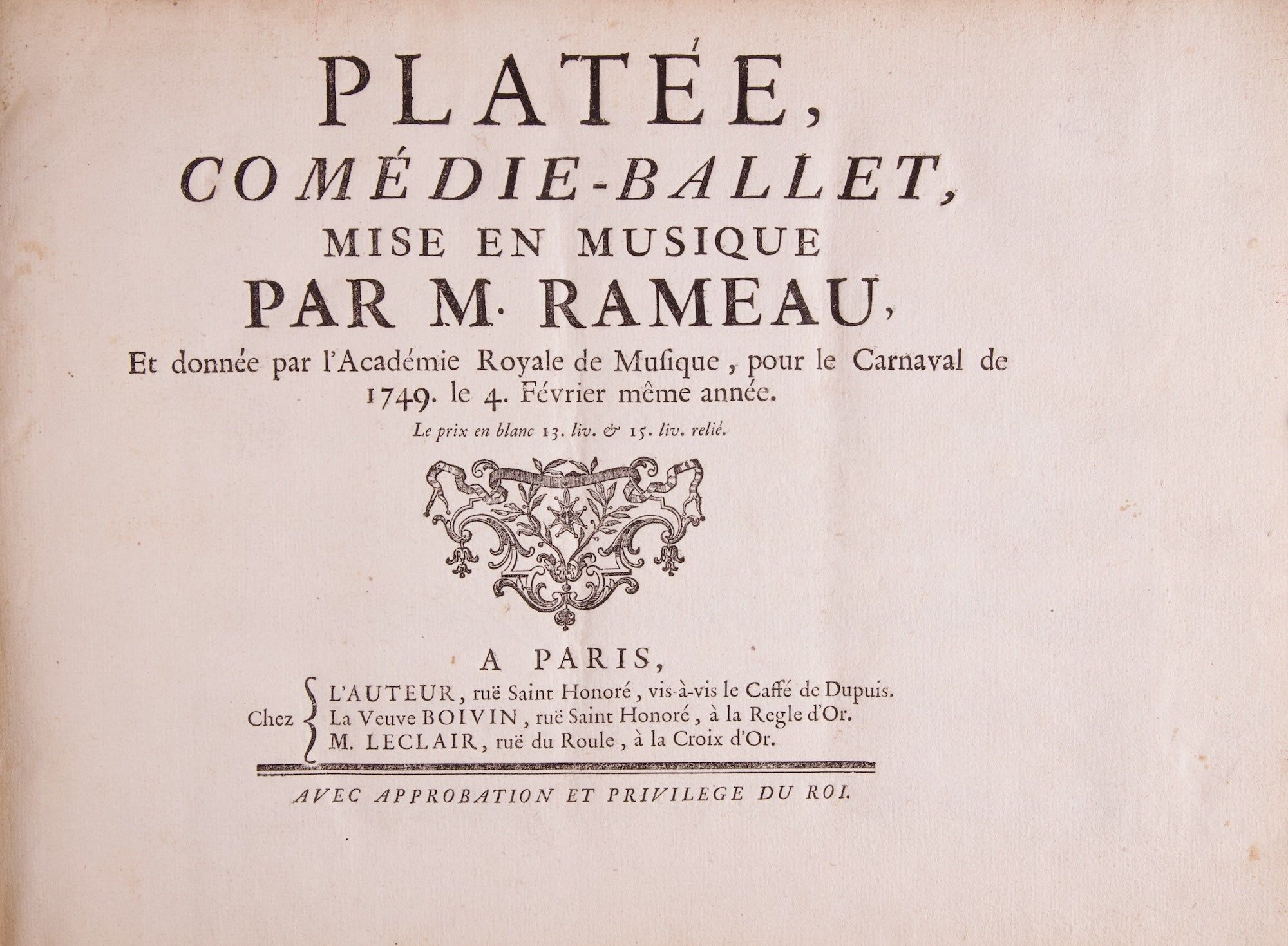
Platée, Comédie-Ballet ... donnée par l'Academie Royale de Musique, pour le Carnaval de 1749. le 4. Février même année. Le prix en blanc 13. liv. & 15. liv. relié. [Condensed score]
- Paris: Chez l'Auteur, ruë Saint Honoré, vis-à-vis le Caffé de Dupuis. La Veuve Boivin, ruë Saint Honorè, à la Regle d'Or. M. Lec, 1749
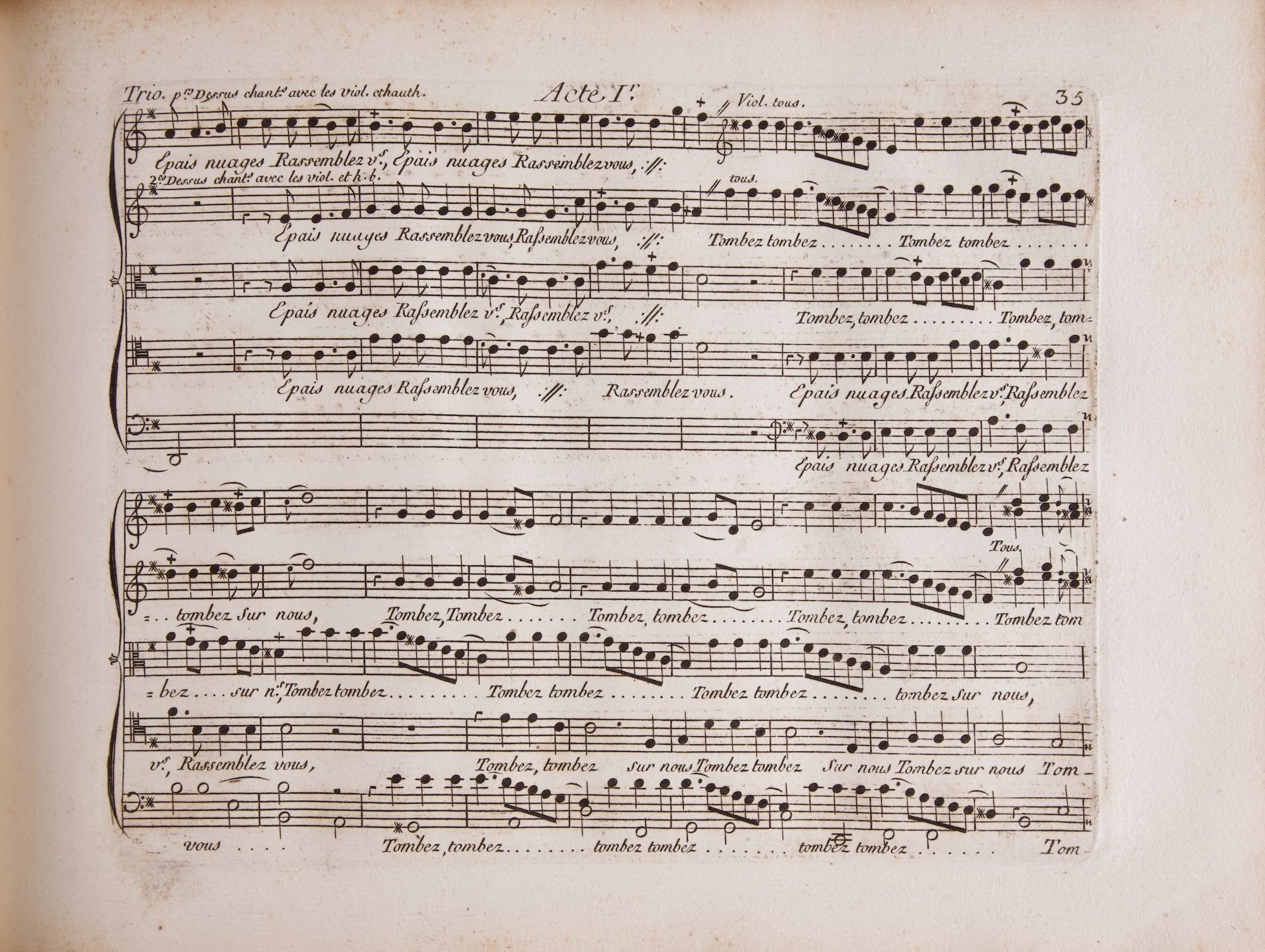
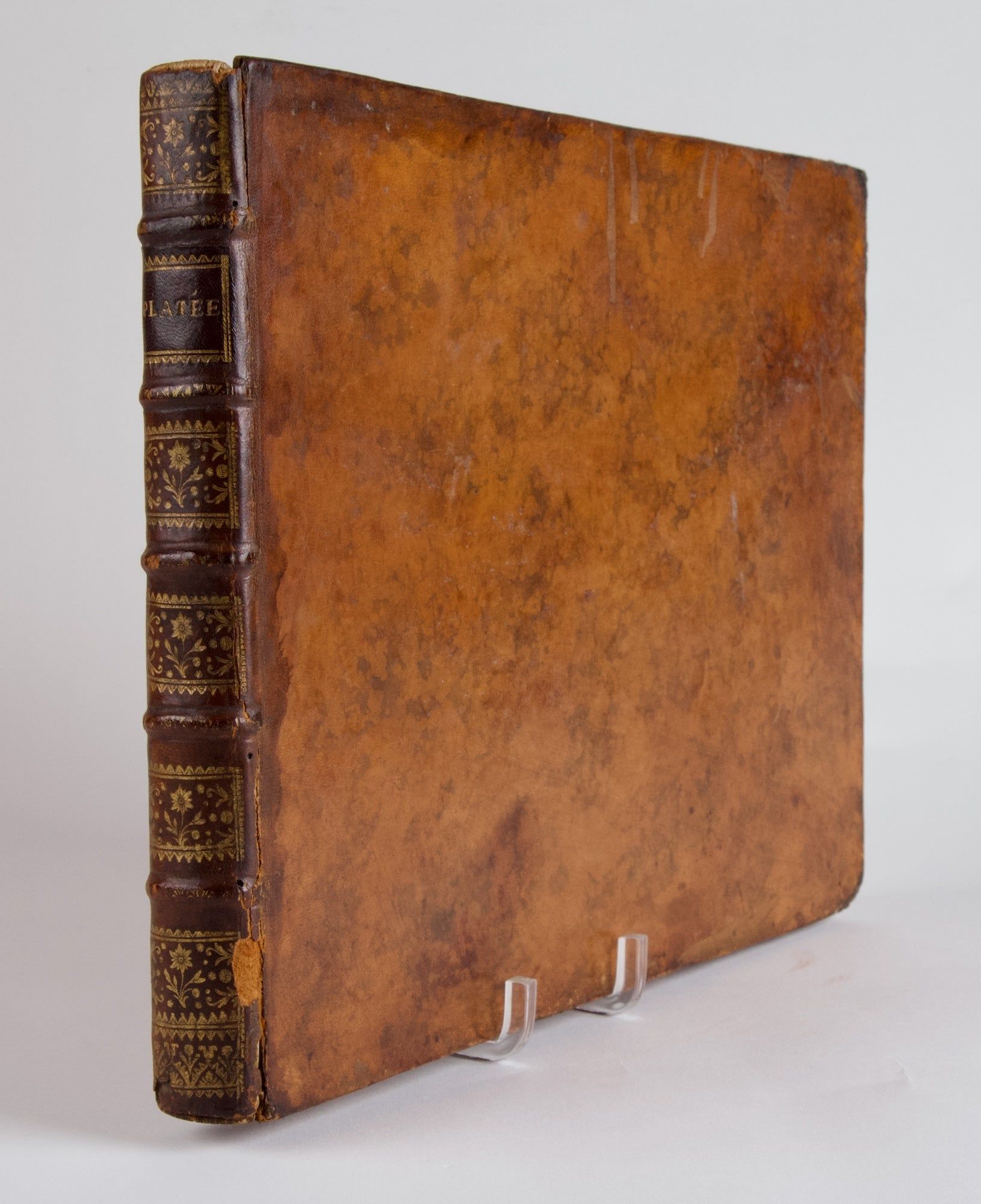
Paris: Chez l'Auteur, ruë Saint Honoré, vis-à-vis le Caffé de Dupuis. La Veuve Boivin, ruë Saint Honorè, à la Regle d'Or. M. Leclair, ruë du Roule à la Crois d'Or. Avec Approbation et Privilege du Roi, 1749. Oblong folio. Contemporary dark tan mottled calf with raised bands on spine in decorative compartments gilt, title gilt, marbled endpapers. 1f. (recto title, verso blank), 38 (prologue), 125 (acts i-iii), [i] (blank) pp. Title typeset, music engraved.
With attractive contemporary engraved label of Parisian music publisher Lemoine to front pastedown.
Binding slightly worn, rubbed, and bumped, with minor abrasions; endpapers worn and slightly faded. Slightly worn and browned; minor staining to extreme lower edges. First Edition. Lesure p. 527. Sonneck Dramatic Music p. 137. Hirsch II, 783. BUC p. 872. RISM R164 and RR164.
"The comédie lyrique was the least established of all the genres that Rameau cultivated. Since the mid-1670s, when Lully eliminated comic roles from his operas, instances of deliberate humour were rare at the Paris Opéra. Isolated examples may be found by Campra (1699), Destouches (1704), La Barre (1705), Mouret (1714 and 1742) and Boismortier (1743). It was perhaps the example of these last two works (Mouret's Les amours de Ragonde and Boismortier's Don Quichotte chez la duchesse) that stimulated Rameau to choose a comic subject, Platée, for the celebration of the dauphin's marriage in 1745. Much of the humour derives from the ugliness and incongruous behaviour of the marsh-nymph Plataea, a travesty role created by the haute-contre Pierre de Jélyotte. To the modern mind the choice of subject may seem distasteful or even mischievous (the dauphine herself is said to have been plain). But Rameau's contemporaries were less fastidious and apparently voiced no such criticism. Though not immediately successful, Platée came to be regarded as a masterpiece." Graham Sadler and Thomas Christensen in Grove Music Online
An attractive copy of the first and only edition of Rameau's Platée, his artful and irreverent comic ballet.
With attractive contemporary engraved label of Parisian music publisher Lemoine to front pastedown.
Binding slightly worn, rubbed, and bumped, with minor abrasions; endpapers worn and slightly faded. Slightly worn and browned; minor staining to extreme lower edges. First Edition. Lesure p. 527. Sonneck Dramatic Music p. 137. Hirsch II, 783. BUC p. 872. RISM R164 and RR164.
"The comédie lyrique was the least established of all the genres that Rameau cultivated. Since the mid-1670s, when Lully eliminated comic roles from his operas, instances of deliberate humour were rare at the Paris Opéra. Isolated examples may be found by Campra (1699), Destouches (1704), La Barre (1705), Mouret (1714 and 1742) and Boismortier (1743). It was perhaps the example of these last two works (Mouret's Les amours de Ragonde and Boismortier's Don Quichotte chez la duchesse) that stimulated Rameau to choose a comic subject, Platée, for the celebration of the dauphin's marriage in 1745. Much of the humour derives from the ugliness and incongruous behaviour of the marsh-nymph Plataea, a travesty role created by the haute-contre Pierre de Jélyotte. To the modern mind the choice of subject may seem distasteful or even mischievous (the dauphine herself is said to have been plain). But Rameau's contemporaries were less fastidious and apparently voiced no such criticism. Though not immediately successful, Platée came to be regarded as a masterpiece." Graham Sadler and Thomas Christensen in Grove Music Online
An attractive copy of the first and only edition of Rameau's Platée, his artful and irreverent comic ballet.