

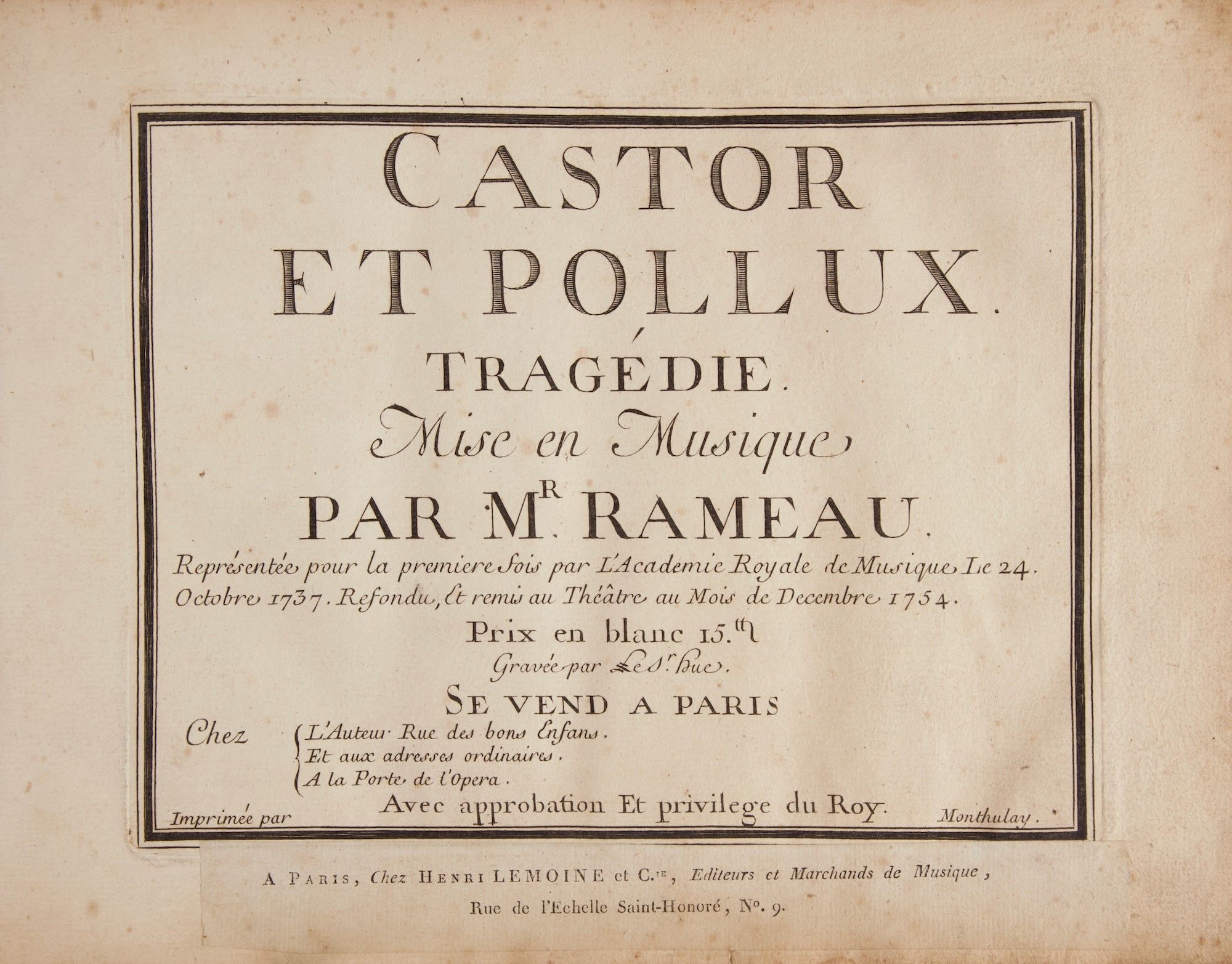
Castor et Pollux Tragedie Mise en Musique ... Représentée pour la premiere fois par L'Academie Royale de Musique Le 24 Octobre 1737. Refondu, Et remis au Théâtre au Mois de Decembre 1754. Prix en blanc 15 tt. Gravée par Le Sr. Hue ... Imprimée par Monthulay. [Short score]
- Paris: Se Vend a Paris Chez L'Auteur Rue des Bons Enfans. Et aux adresses ordinaires, A la Porte de l'Opera. ... Avec approbation et pr, 1754
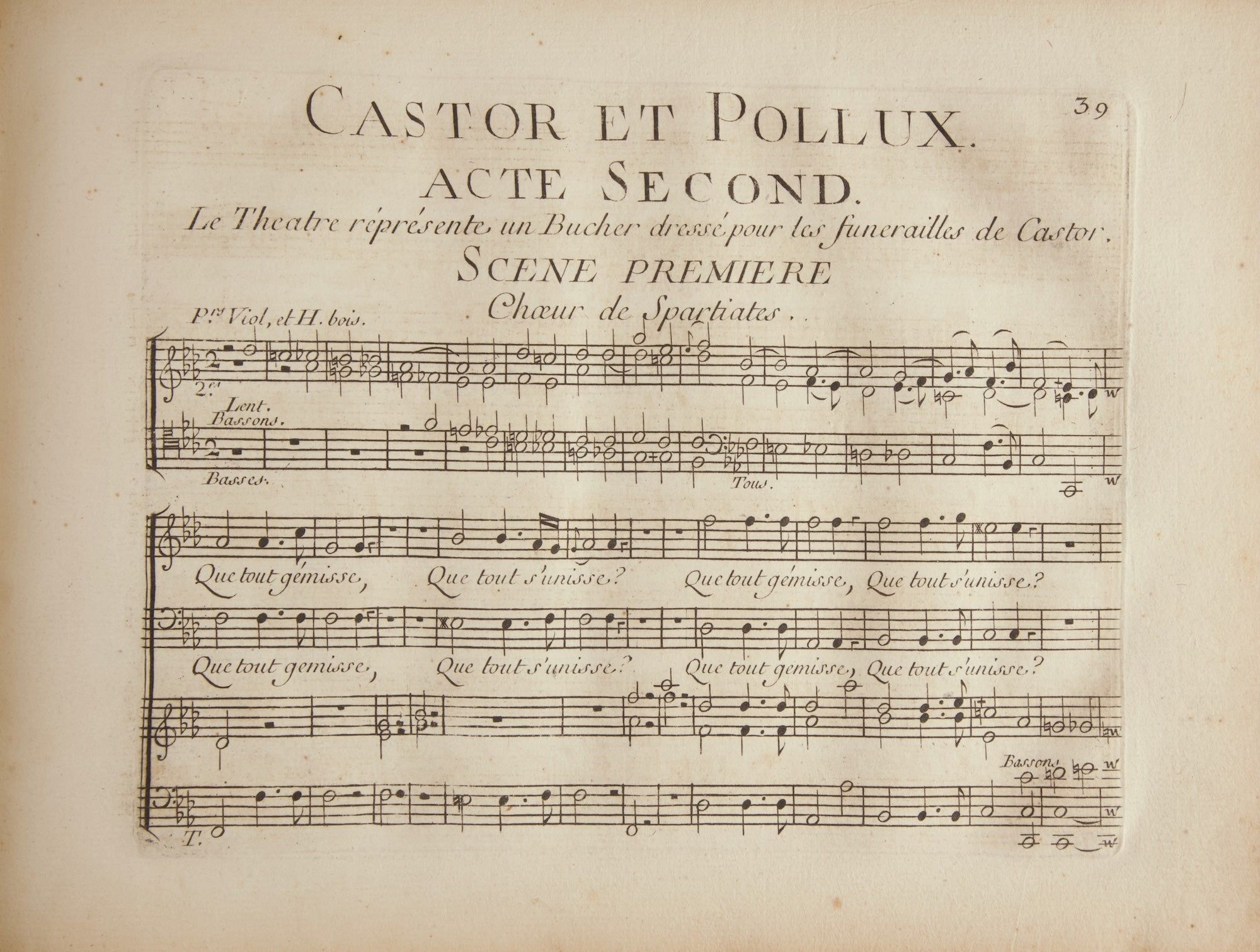
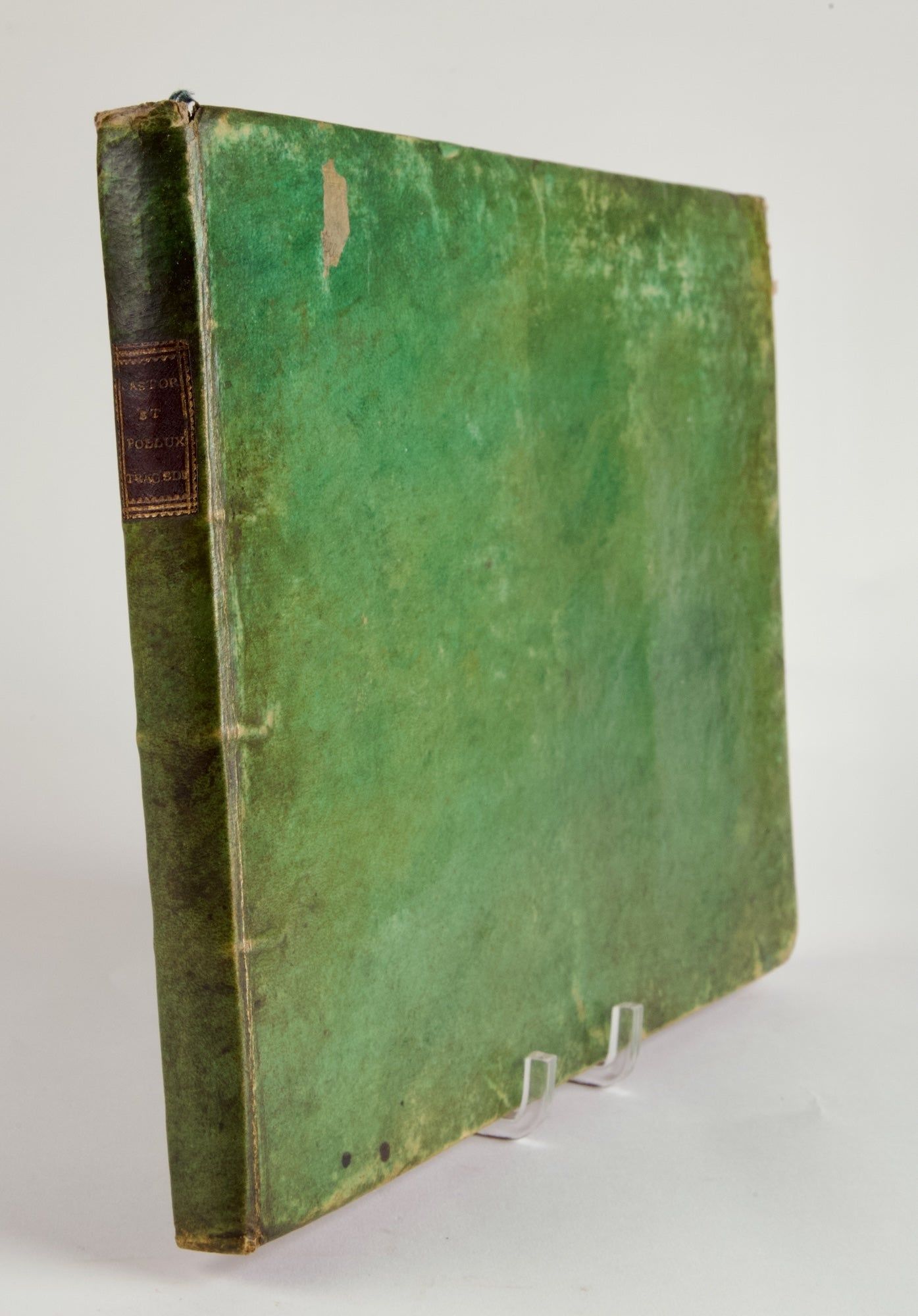
Paris: Se Vend a Paris Chez L'Auteur Rue des Bons Enfans. Et aux adresses ordinaires, A la Porte de l'Opera. ... Avec approbation et privilege du Roy, 1754. Oblong folio. Contemporary green vellum, red leather label to spine with title gilt. 1f. (recto title, verso blank), 163, [i] (blank), pp. Engraved throughout.
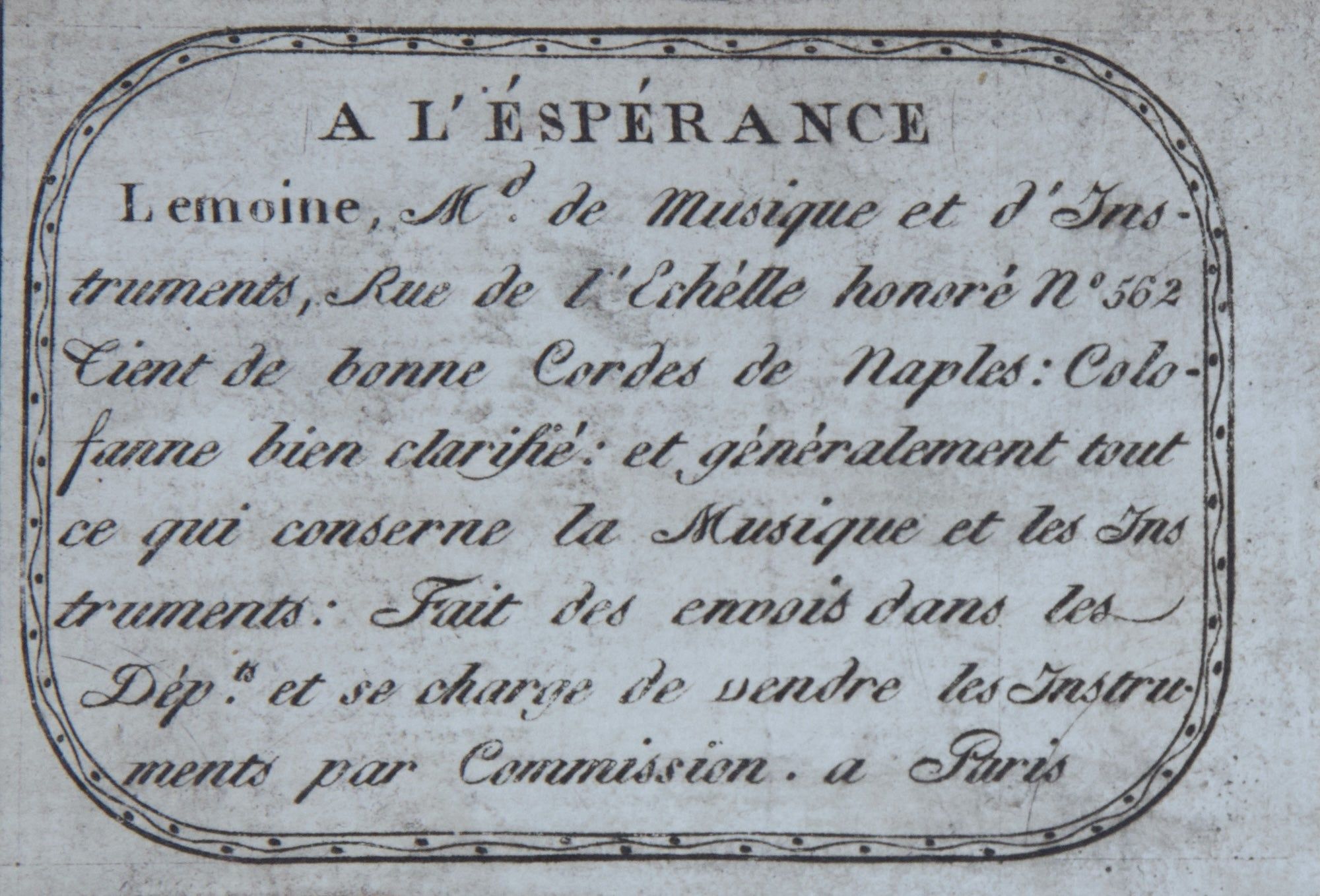
With attractive contemporary engraved label of Parisian music publisher Lemoine to front pastedown and overpaste to lower margin of title "A Paris, Chez Henri Lemoine et Cie., Editeurs et Marchands de Musique, Rue de l'Echelle Saint-Honoré, No. 9."
Ownership inscription to front pastedown in contemporary ink "de Louis LeGrand" partially obscured by Lemoine label.
Binding somewhat worn, rubbed, and bumped. Light browning, slightly heavier to some leaves; occasional foxing, soiling, and stains; occasional minor imperfections.
Quite a good copy overall. First Edition of the revised version. Lesure p. 525. Hirsch II, 763. BUC p. 761. RISM R127 and RR127.
Castor et Pollux, in a prologue and five acts by Rameau to a libretto by Pierre-Joseph Bernard, was first performed at the Paris Opéra on 24 October 1737. The opera enjoyed considerable success in the autumn of that year, with 12 performances, and was revived in 1754, "when it was used as a weapon, common to Lullists and Ramists, to oust La Serva Padrona. ... It was performed thirty times in the course of this year and at least ten times in 1755. At one of these performances Jélyotte made his farewell appearance. It was revived in 1764 with Sophie Arnould as Telaira. ... There were further revivals in 1772, 1773 and 1778 - this one against Gluck - 1779 and 1780." Girdlestone pp. 229-230. In all, the work received more than 300 performances by the end of 1785.
As regards the previous owner, "A number of French 18th-century musicians bore this name (or ‘Legrand’) ... Leopold Mozart's reference to a ‘Le Grand’ has drawn more attention to the name than it might otherwise have received. Louis-Alexandre Le Grand (b ?Châlons-sur-Marne; d Paris, 30 Nov 1773) was a pupil of Daquin and his successor as organist of the convent of the Cordeliers (July 1772). He was also organist at St Côme (from before 1759), St Nicolas-des-Champs (c1761–5, again from 1771) and the Premonstratensians in rue de Sèvres. Either he or a Louis Le Grand, an organist living in the rue de Grenelle on 28 November 1741 (Laborde), was probably the Le Grand recommended as among the best harpsichord teachers in Paris by Pascal Taskin in a letter of 6 October 1765." David Fuller in Grove Music Online.
With attractive contemporary engraved label of Parisian music publisher Lemoine to front pastedown and overpaste to lower margin of title "A Paris, Chez Henri Lemoine et Cie., Editeurs et Marchands de Musique, Rue de l'Echelle Saint-Honoré, No. 9."
Ownership inscription to front pastedown in contemporary ink "de Louis LeGrand" partially obscured by Lemoine label.
Binding somewhat worn, rubbed, and bumped. Light browning, slightly heavier to some leaves; occasional foxing, soiling, and stains; occasional minor imperfections.
Quite a good copy overall. First Edition of the revised version. Lesure p. 525. Hirsch II, 763. BUC p. 761. RISM R127 and RR127.
Castor et Pollux, in a prologue and five acts by Rameau to a libretto by Pierre-Joseph Bernard, was first performed at the Paris Opéra on 24 October 1737. The opera enjoyed considerable success in the autumn of that year, with 12 performances, and was revived in 1754, "when it was used as a weapon, common to Lullists and Ramists, to oust La Serva Padrona. ... It was performed thirty times in the course of this year and at least ten times in 1755. At one of these performances Jélyotte made his farewell appearance. It was revived in 1764 with Sophie Arnould as Telaira. ... There were further revivals in 1772, 1773 and 1778 - this one against Gluck - 1779 and 1780." Girdlestone pp. 229-230. In all, the work received more than 300 performances by the end of 1785.
As regards the previous owner, "A number of French 18th-century musicians bore this name (or ‘Legrand’) ... Leopold Mozart's reference to a ‘Le Grand’ has drawn more attention to the name than it might otherwise have received. Louis-Alexandre Le Grand (b ?Châlons-sur-Marne; d Paris, 30 Nov 1773) was a pupil of Daquin and his successor as organist of the convent of the Cordeliers (July 1772). He was also organist at St Côme (from before 1759), St Nicolas-des-Champs (c1761–5, again from 1771) and the Premonstratensians in rue de Sèvres. Either he or a Louis Le Grand, an organist living in the rue de Grenelle on 28 November 1741 (Laborde), was probably the Le Grand recommended as among the best harpsichord teachers in Paris by Pascal Taskin in a letter of 6 October 1765." David Fuller in Grove Music Online.