

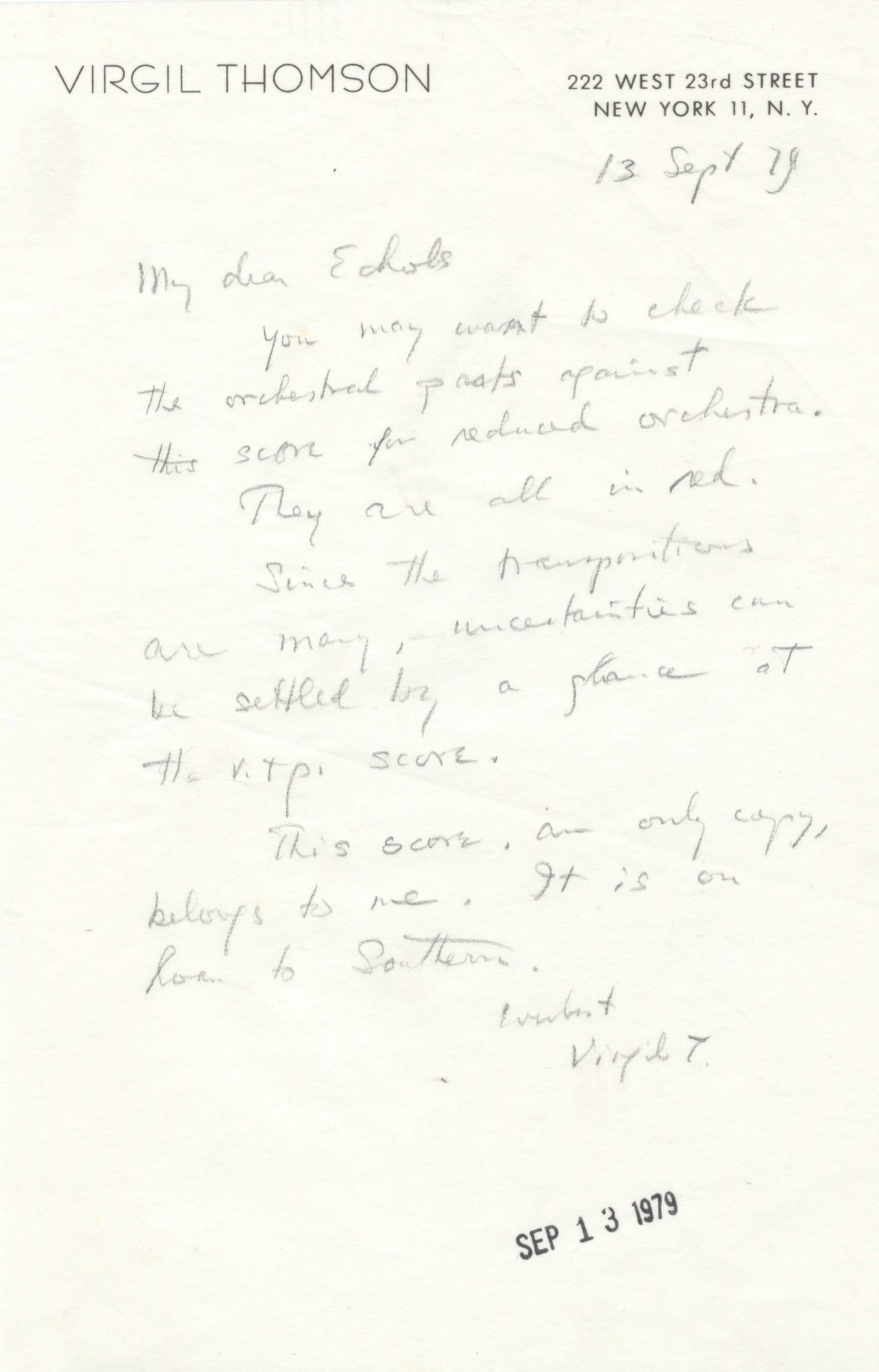
Autograph letter signed ("Virgil T") to American musicologist and conductor, Paul Echols (1944-1994)
- SIGNED
1 page. Octavo. In pencil. Dated "13 September 79." On lightweight personal letterhead with "Virgil Thomson, 222 West 23rd Street, New York 11, N.Y." printed in black at head. With small date handstamp in black to blank lower outer corner "Sep 13 1979."
Thomson asks Echols to "check the orchestral parts against this score for reduced orchestra," saying that because of the numerous transpositions "uncertainties can be settled by a glance at the v. + p. score," and signing off with "Ever best Virgil T." An American composer and critic, "[Thomson] produced a sizeable catalog of stylistically diverse compositions characterized by expressive directness and textural transparency, written in a language that drew from hymnbook harmony, popular song, and dance idioms of the late 19th century, and utilizing plain-spoken tonal procedures but also diatonic dissonance and polytonal elements. In his many vocal works, and his two path-breaking operatic collaborations with Gertrude Stein, Thomson demonstrated a mastery of prosody. His settings of English convey American speech patterns with naturalness and clarity. He brought strong predilections for living composers and American music to his criticism. The wit, vitality, and descriptive precision of his writing, which demystified the complexities of music for lay readers, made him among the most influential and lasting critics of the 20th century." Anthony Tommasini and Richard Jackson in Grove Music Online.
Thomson asks Echols to "check the orchestral parts against this score for reduced orchestra," saying that because of the numerous transpositions "uncertainties can be settled by a glance at the v. + p. score," and signing off with "Ever best Virgil T." An American composer and critic, "[Thomson] produced a sizeable catalog of stylistically diverse compositions characterized by expressive directness and textural transparency, written in a language that drew from hymnbook harmony, popular song, and dance idioms of the late 19th century, and utilizing plain-spoken tonal procedures but also diatonic dissonance and polytonal elements. In his many vocal works, and his two path-breaking operatic collaborations with Gertrude Stein, Thomson demonstrated a mastery of prosody. His settings of English convey American speech patterns with naturalness and clarity. He brought strong predilections for living composers and American music to his criticism. The wit, vitality, and descriptive precision of his writing, which demystified the complexities of music for lay readers, made him among the most influential and lasting critics of the 20th century." Anthony Tommasini and Richard Jackson in Grove Music Online.