

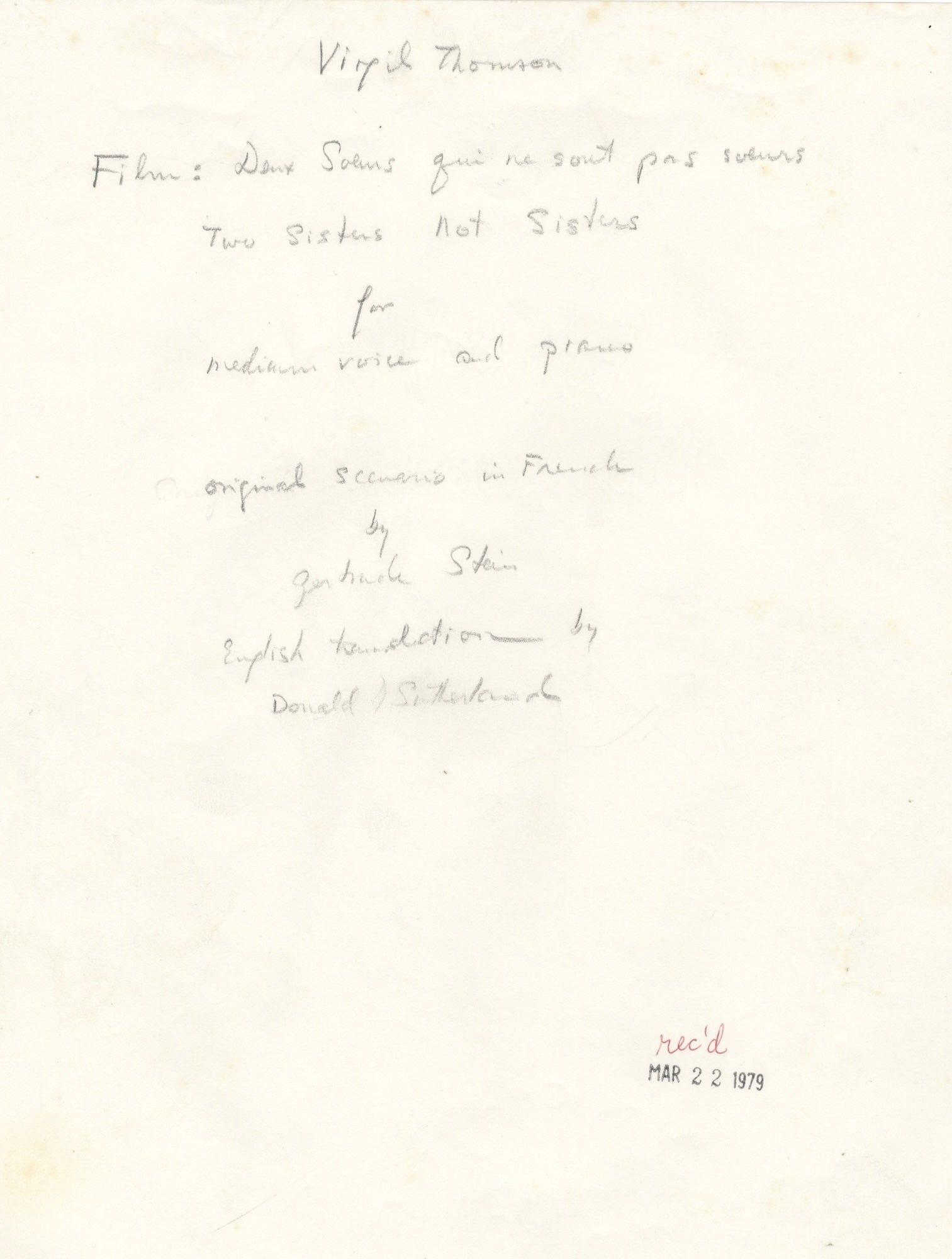
Autograph note relative to an unproduced film scored by Thomson in 1930 and text by Gertrude Stein
- SIGNED
1 page. Quarto. In pencil. With "rec'd" in manuscript in red and small date handstamp in black "Mar 22 1979" to lower outer corner.
"Virgil Thomson. Film: Deux Soeurs qui ne sont pas soeurs. Two Sisters Not Sisters for medium voice and piano. Original scenario in French by Gertrude Stein. English translation by Donald Sutherland."
Very slightly worn and creased. An American composer and critic, "[Thomson] produced a sizeable catalog of stylistically diverse compositions characterized by expressive directness and textural transparency, written in a language that drew from hymnbook harmony, popular song, and dance idioms of the late 19th century, and utilizing plain-spoken tonal procedures but also diatonic dissonance and polytonal elements. In his many vocal works, and his two path-breaking operatic collaborations with Gertrude Stein, Thomson demonstrated a mastery of prosody. His settings of English convey American speech patterns with naturalness and clarity. He brought strong predilections for living composers and American music to his criticism. The wit, vitality, and descriptive precision of his writing, which demystified the complexities of music for lay readers, made him among the most influential and lasting critics of the 20th century." Anthony Tommasini and Richard Jackson in Grove Music Online
Government support of the arts increased in the 1930s, perhaps providing an incentive to Thomson during this time to compose the music for Deux Soeurs. The period also saw his score for a 1936 production of Shakespeare's Macbeth directed by a young Orson Welles and two important documentary films in support of the New Deal, The Plow That Broke the Plains and The River. Thomson won the 1949 Pulitzer Prize in Music for the Robert Flaherty film Louisiana Story, the only time the Pulitzer had been awarded to film music.
"Virgil Thomson. Film: Deux Soeurs qui ne sont pas soeurs. Two Sisters Not Sisters for medium voice and piano. Original scenario in French by Gertrude Stein. English translation by Donald Sutherland."
Very slightly worn and creased. An American composer and critic, "[Thomson] produced a sizeable catalog of stylistically diverse compositions characterized by expressive directness and textural transparency, written in a language that drew from hymnbook harmony, popular song, and dance idioms of the late 19th century, and utilizing plain-spoken tonal procedures but also diatonic dissonance and polytonal elements. In his many vocal works, and his two path-breaking operatic collaborations with Gertrude Stein, Thomson demonstrated a mastery of prosody. His settings of English convey American speech patterns with naturalness and clarity. He brought strong predilections for living composers and American music to his criticism. The wit, vitality, and descriptive precision of his writing, which demystified the complexities of music for lay readers, made him among the most influential and lasting critics of the 20th century." Anthony Tommasini and Richard Jackson in Grove Music Online
Government support of the arts increased in the 1930s, perhaps providing an incentive to Thomson during this time to compose the music for Deux Soeurs. The period also saw his score for a 1936 production of Shakespeare's Macbeth directed by a young Orson Welles and two important documentary films in support of the New Deal, The Plow That Broke the Plains and The River. Thomson won the 1949 Pulitzer Prize in Music for the Robert Flaherty film Louisiana Story, the only time the Pulitzer had been awarded to film music.