

The Long Shadow of Little Rock [Review Copy, from the Library of the Amsterdam News]
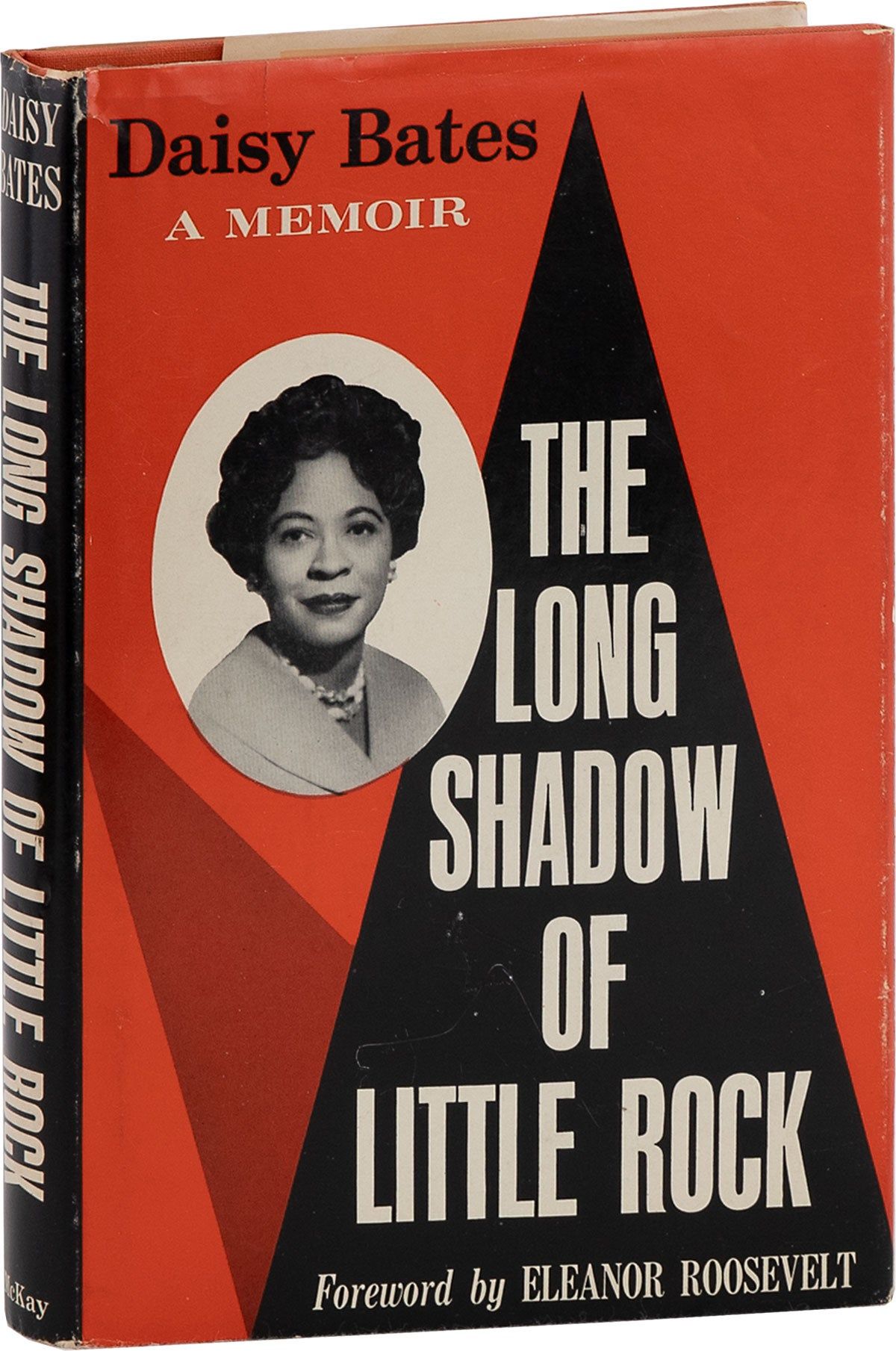
- New York: David McKay Company, Inc, 1962
New York: David McKay Company, Inc, 1962. First Edition. First printing. Review copy, with publisher's slip laid in; ink annotation to front pastedown: "Amsterdam News / Oct 2 1962 /Review Copy;" pictorial bookplate of C[ilian] B. Powell. Octavo (21cm); full red cloth, with titles stamped in black on spine; dustjacket; xviii,234,[4]pp; illus. Faint foxing to endpapers, else clean throughout; Near Fine. Dustjacket is unclipped (priced $4.75), gently spine-sunned and lightly edgeworn, with a few closed tears and attendant creases, and some scattered foxing on verso; Near Fine.
Terrific association copy of Bates's National Book Award-winning memoir. Daisy Bates (1914-1999), was one of the unsung heroines of the Little Rock school integration crisis. As President of the Arkansas NAACP and publisher of the Arkansas State Press she became a primary spokesperson for the integrationist cause, and privately filled the role of chief advisor to the Little Rock Nine. The Long Shadow of Little Rock was awarded a long-belated National Book Award following its 1987 reissue by the University of Arkansas Press. Cilian B. Powell (1894-1977) purchased the Amsterdam News in 1935 and was its publisher until 1971, a period during which the paper became the flagship African-American newspaper in the country.
Terrific association copy of Bates's National Book Award-winning memoir. Daisy Bates (1914-1999), was one of the unsung heroines of the Little Rock school integration crisis. As President of the Arkansas NAACP and publisher of the Arkansas State Press she became a primary spokesperson for the integrationist cause, and privately filled the role of chief advisor to the Little Rock Nine. The Long Shadow of Little Rock was awarded a long-belated National Book Award following its 1987 reissue by the University of Arkansas Press. Cilian B. Powell (1894-1977) purchased the Amsterdam News in 1935 and was its publisher until 1971, a period during which the paper became the flagship African-American newspaper in the country.