

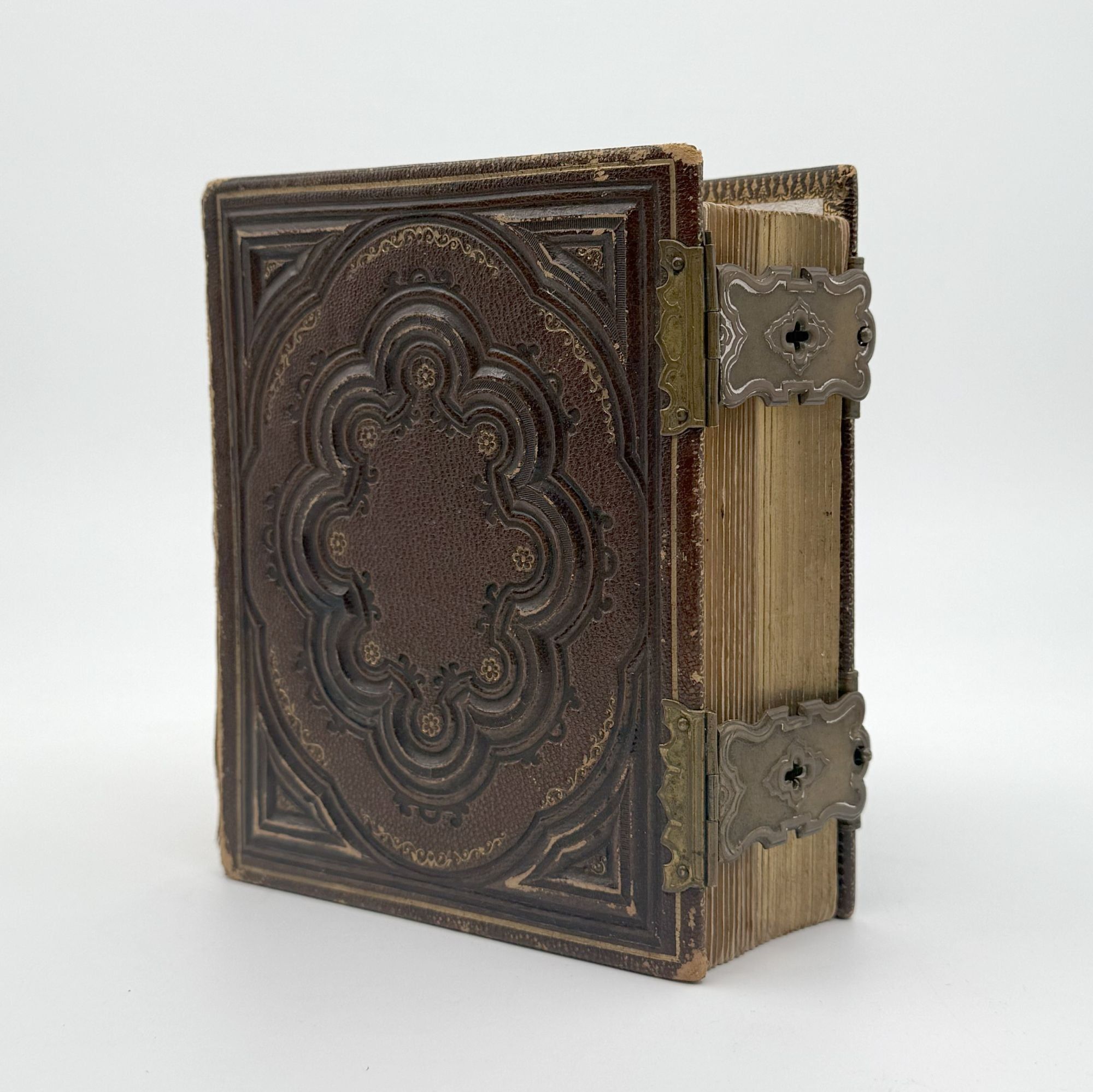
[Collection of 35 cartes-de-visite photographs of Santee Sioux and Chippewa (Ojibwe) Indians, many taken at Fort Snelling in the aftermath of the Sioux Uprising, housed in a contemporary album]
- Thirty-two cdvs (27 by Whitney, 4 by James Martin, 2 by Benjamin Upton and 2 on unidentified mounts), plus three albumen photogr
- St. Paul, MN , 1862
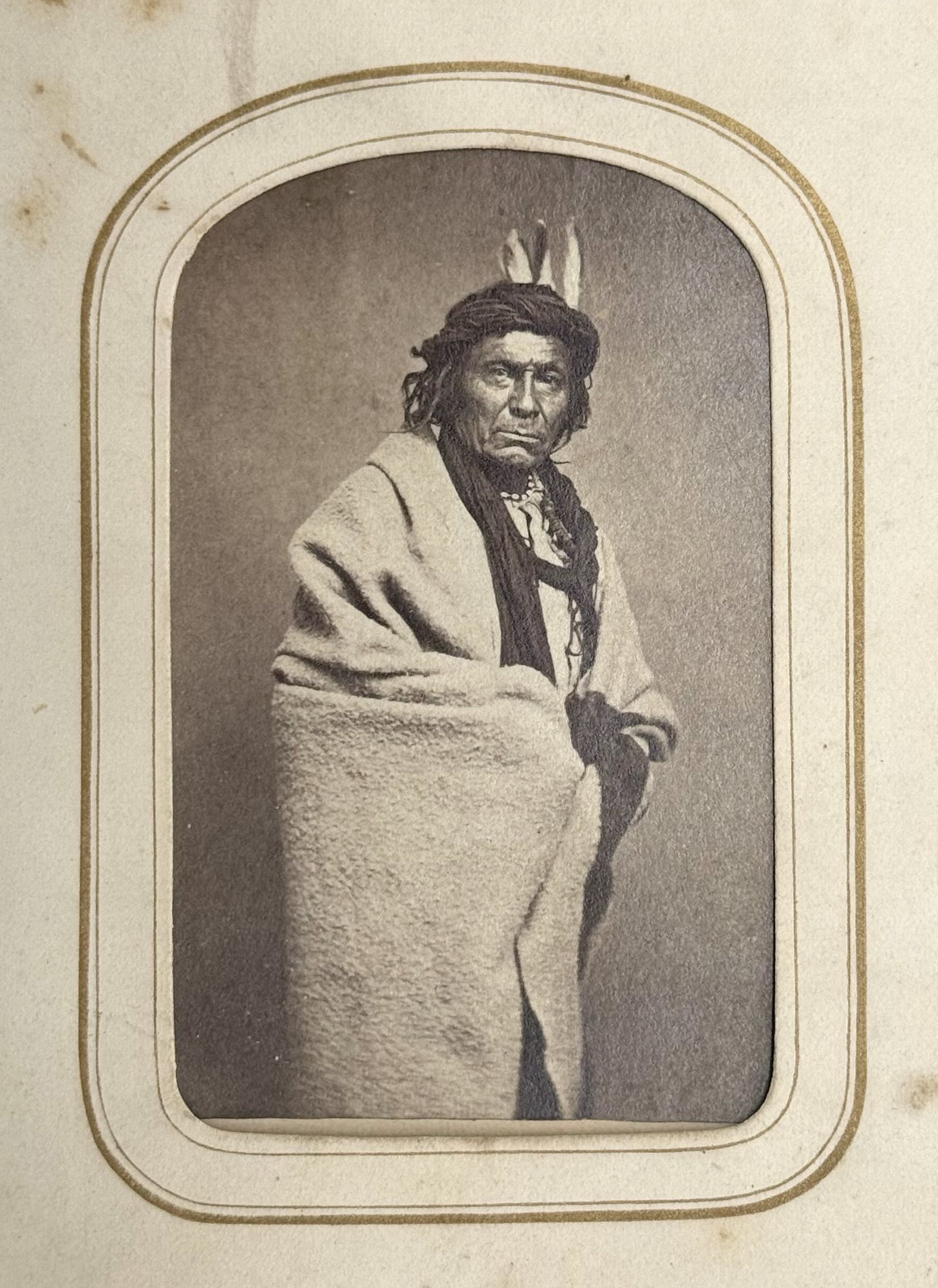
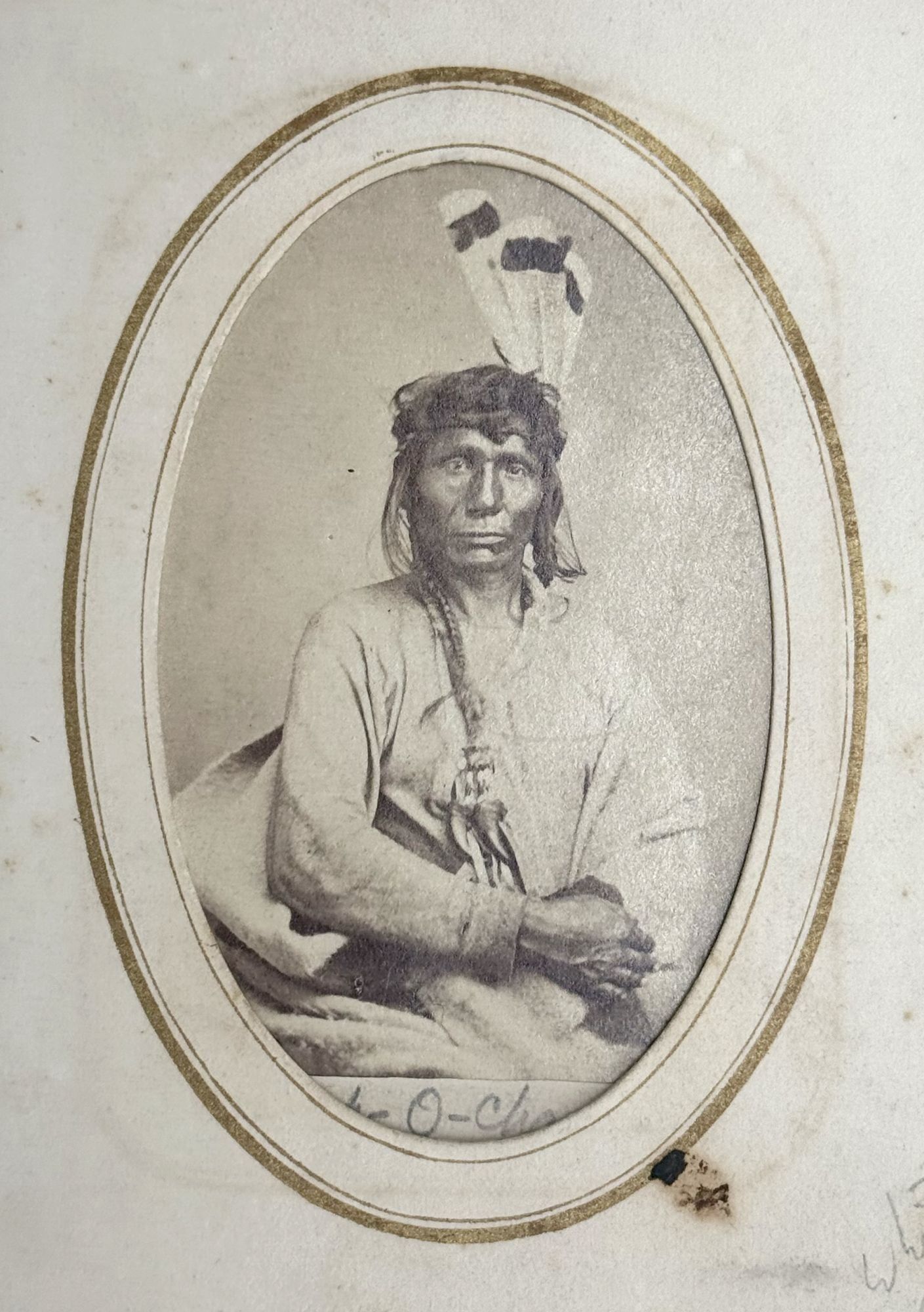
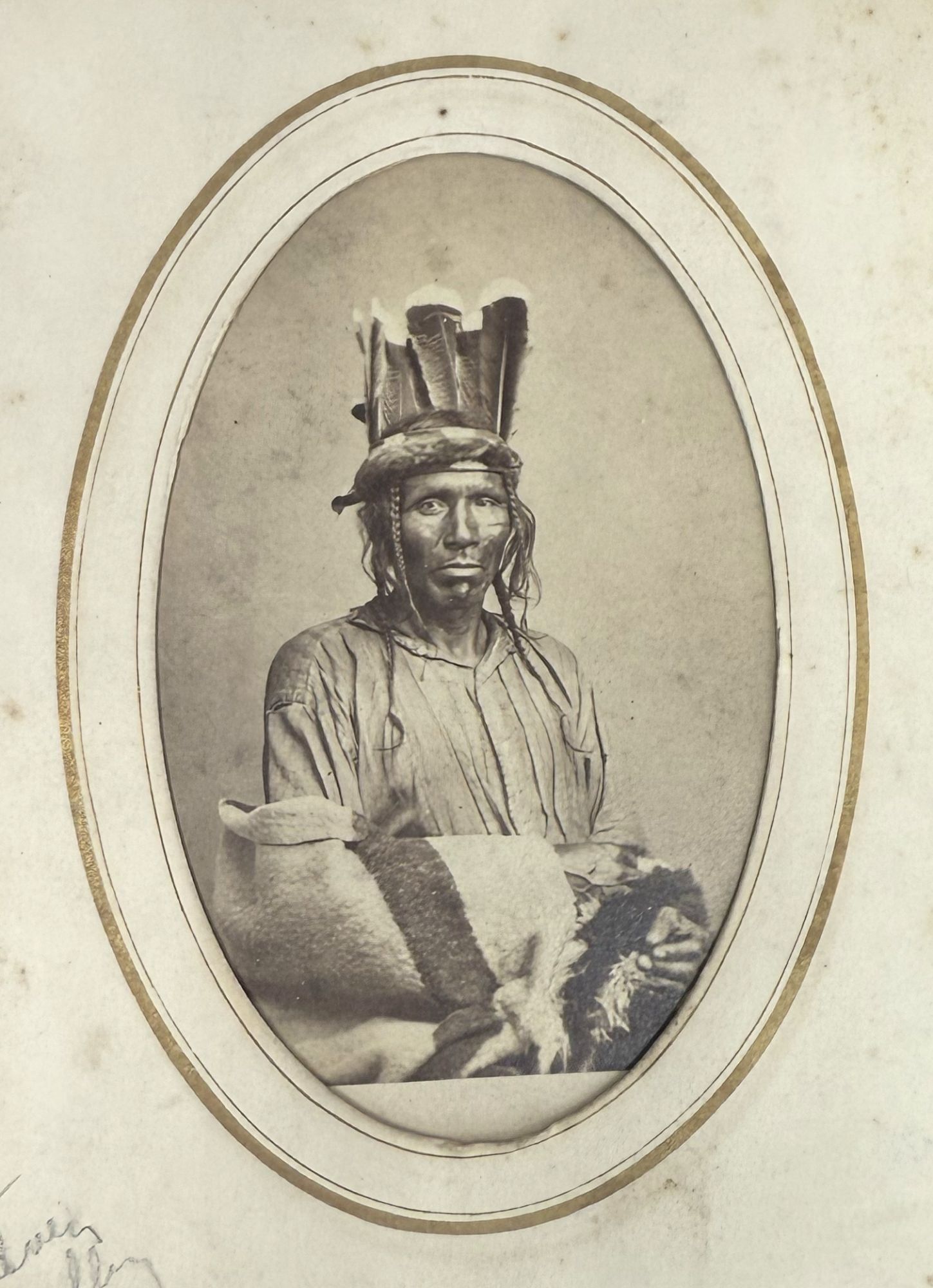
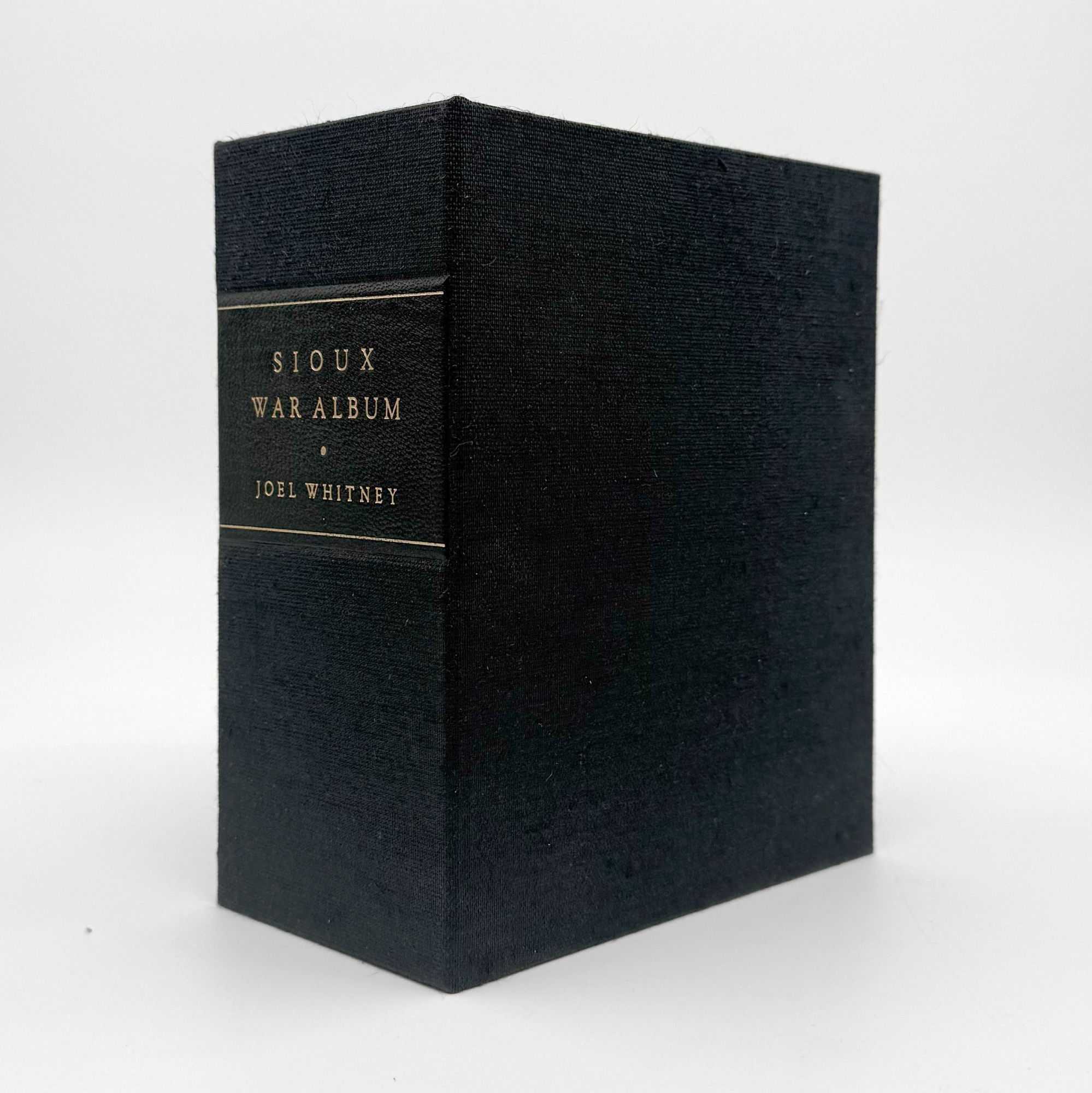
St. Paul, MN, 1862. Thirty-two cdvs (27 by Whitney, 4 by James Martin, 2 by Benjamin Upton and 2 on unidentified mounts), plus three albumen photographs, one mounted on card stock measuring 5¼ x 4¼ inches, and two mounted on card stock measuring 6 x 4 inches. Contemporary morocco album, covers elaborately blocked in blind and gilt in high relief, spine perished. Housed in a cloth box. Provenance: Minnesota Historical Society (inked stamps on verso of images, deaccesioned in 1981). Thirty-two cdvs (27 by Whitney, 4 by James Martin, 2 by Benjamin Upton and 2 on unidentified mounts), plus three albumen photographs, one mounted on card stock measuring 5¼ x 4¼ inches, and two mounted on card stock measuring 6 x 4 inches. A striking and important group of Indian portraits taken by Joel Whitney in St. Paul, Minnesota, around the time of the Sioux Uprising of 1862. The Dakota War, or Sioux Uprising, was one of the last large scale attempts by Native Americans to expel white settlers from their territory. Denied rations and annuities promised by treaty in return for the forfeiture of the majority of their land, the Sioux decided that an armed revolt was the only option to save their people. Dakota warriors in Minnesota felt the time was ripe for victory, as more and more American men joined the Union during the Civil War, leaving Minnesota largely unprotected by the American military. U.S. Army regiments recalled from the battlefields of the Civil War defeated the Sioux at Wood Lake on September 23, 1862. In the weeks following, U.S. Army Colonel Henry Hastings Sibley arrested more than 2,000 Santee Sioux and instituted a military commission that found 303 guilty of capital crimes under legally circumspect proceedings. President Lincoln upheld the convictions of thirty-eight Sioux and ordered their execution by hanging at Mankato, Minnesota, on December 26, 1862, the largest mass execution in U.S. history.
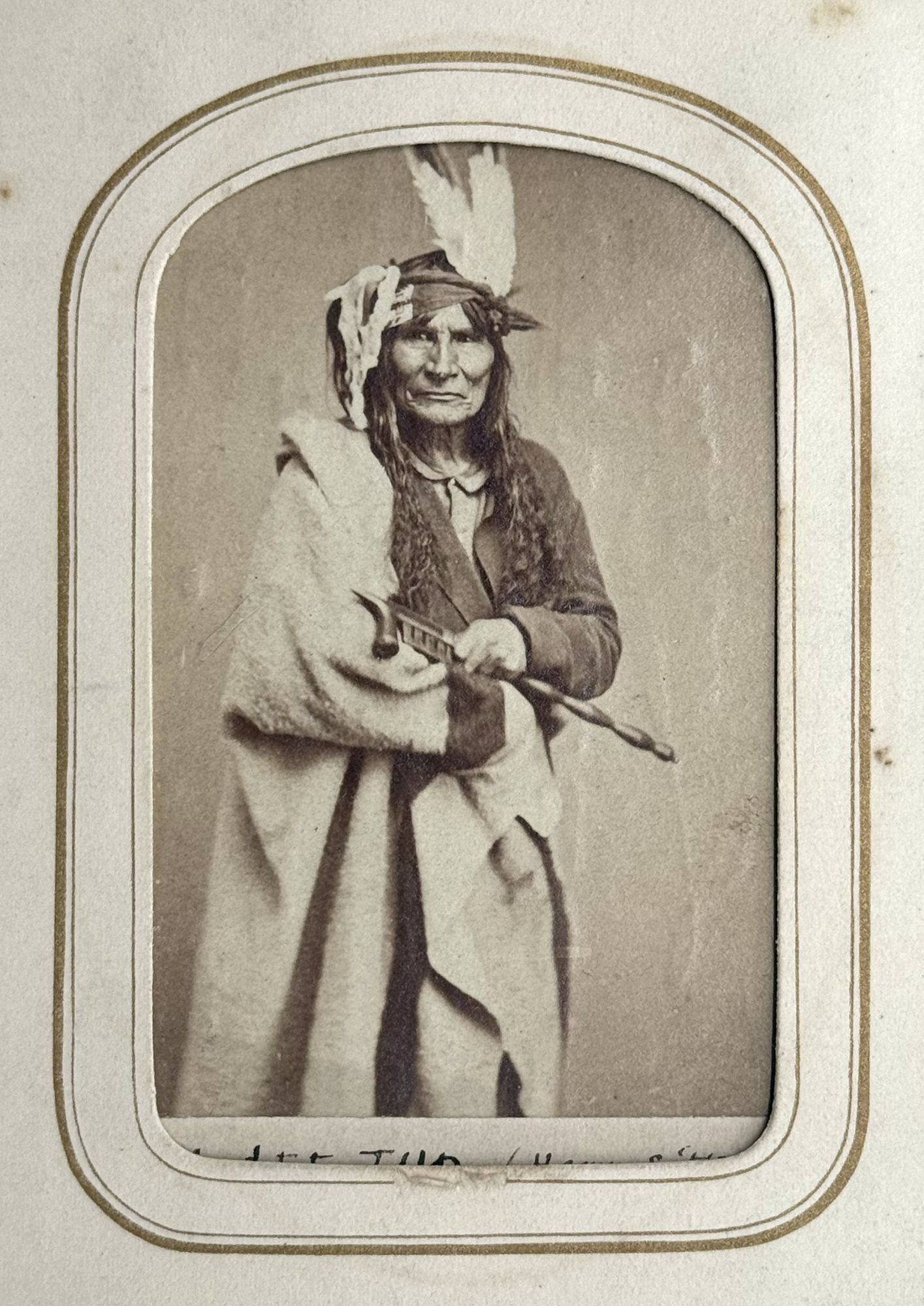
The present group of photographs includes portraits of five men who are identified as having participated in the massacre: Thaóyate Dúta (Little Crow), the Chief of the Santee Sioux who led his people into battle; PaHa Uza Tanka (The Great Scalp Taker), Te-He-Do-Ne-Cha (One Who Forbids His House), Marpiya Okinajin (Cut Nose) and Do-Wan-Sa (The Singer) – all of whom were executed. Also pictured are Ta-Tanka-Nazin (Chief Standing Buffalo), who argued for peace, and "Old Bets," a Sioux squaw reputed to be 120 years old, who was kind to white captives in her village and is arguably one of the most identifiable and most photographed Sioux from this period. Other identified persons in the group include: Ma-Za-Oo-Nie (The Little Bird Hunter); Can-Ku Was-Te-Win (Good Road Woman) and Anpetu-Sapa-Win (Black Day Woman); Winnesheik and other Winnebago chiefs in the prison at Fort Snelling (who, although non-combatant, were forced into the camp at Fort Snelling with their people and ultimately exiled to the Dakotas). In addition to the portraits of the Santee Sioux, there are thirteen additional portraits of representatives from various bands of the Chippewa people.
Joel Emmons Whitney (1822-86) was a pioneering Minnesota photographer and businessman. Whitney learned the art of daguerreotyping from Alexander Hesler, and opened a studio in St. Paul in 1851. He continuously updated his techniques, innovating and offering new products. By 1855, he was advertising paper photographs, which were touted as significantly cheaper than daguerreotypes. In 1860 he introduced the public to the carte-de-visite, which was an incredibly popular format throughout the decade. Whitney produced views of the area, portraits upon request, and - perhaps most notably - portraits and images of the local Native Americans. Whitney had been photographing Native Americans in the area and those who came through the town on their way to Washington for treaty talks. In the summer of 1862, however, the Sioux Uprising spurred new interest in Native American photographs and gave Whitney a unique opportunity for his enterprise. After the Sioux Uprising, Whitney became the principal portrait photographer of those captured and held at Ft. Snelling.
Other photographers represented include James Martin and Benjamin Franklin Upton. Little is known about James E. Martin. He is first listed as a photographer in St. Paul's business directory in 1858. He issued cartes-de-visite and stereoscopic photographs, including subjects related to the 1862 Sioux Uprising. Martin's Gallery is listed at two or three different locations until 1870, at which time the business directory shows the gallery under different ownership. Martin remained active after the sale of his studio in partnership with B. F. Upton of St. Paul. Benjamin Franklin Upton (1818-1901) was born in Dixmont, Maine and began his photography career as a daguerreotypist. In 1856, he started working in St. Anthony, Minnesota, where he established a reputation as a photographer of the Sioux and Chippewa Indians. Upton did not make studio photographs; instead, he preferred to work in the out of doors, and develop his photographs out of a wagon-based studio. As Upton did not have the ability to publishing his photographs for a wider audience, there was a period during which Whitney published Upton’s photographs on his own studio mounts.
The photographs included in the present collection are as follows (captions are within quotes). References are to the Minnesota Historical Photo Collectors Group (MHPCG) catalog list of Whitney cartes-de-visite and to Riggs’ numerical list of Sioux executed in Mankato, Minnesota on December 26, 1862. Three albumen photographs mounted on card stock are loose and not within the album; these portraits are untitled but and bear manuscript identification and are noted below:
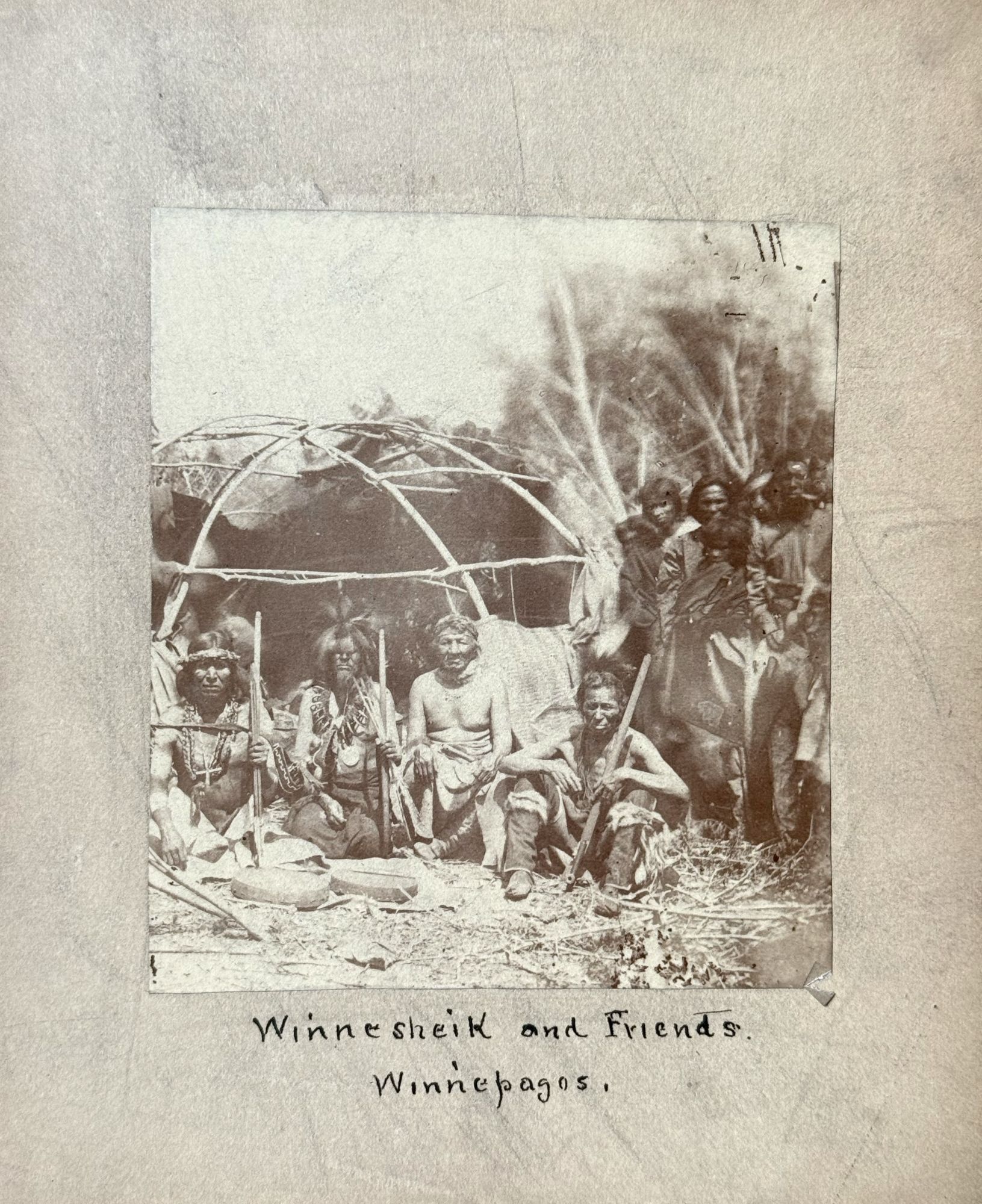
1) “Winnesheik and Friends. Winnebagos.” This photograph is an enlarged version of MHPCG 93. According to the Minnesota Historical Society, Winneshiek appears second from left with other Winnebago (Ho-Chunk) leaders likely at Fort Snelling in 1862 or 1863. Note: Following the Sioux Uprising, all Indian tribes from southwestern Minnesota, which included non-combatant Winnebago bands, were held captive in Fort Snelling and ultimately exiled from Minnesota. MHPCG 93.
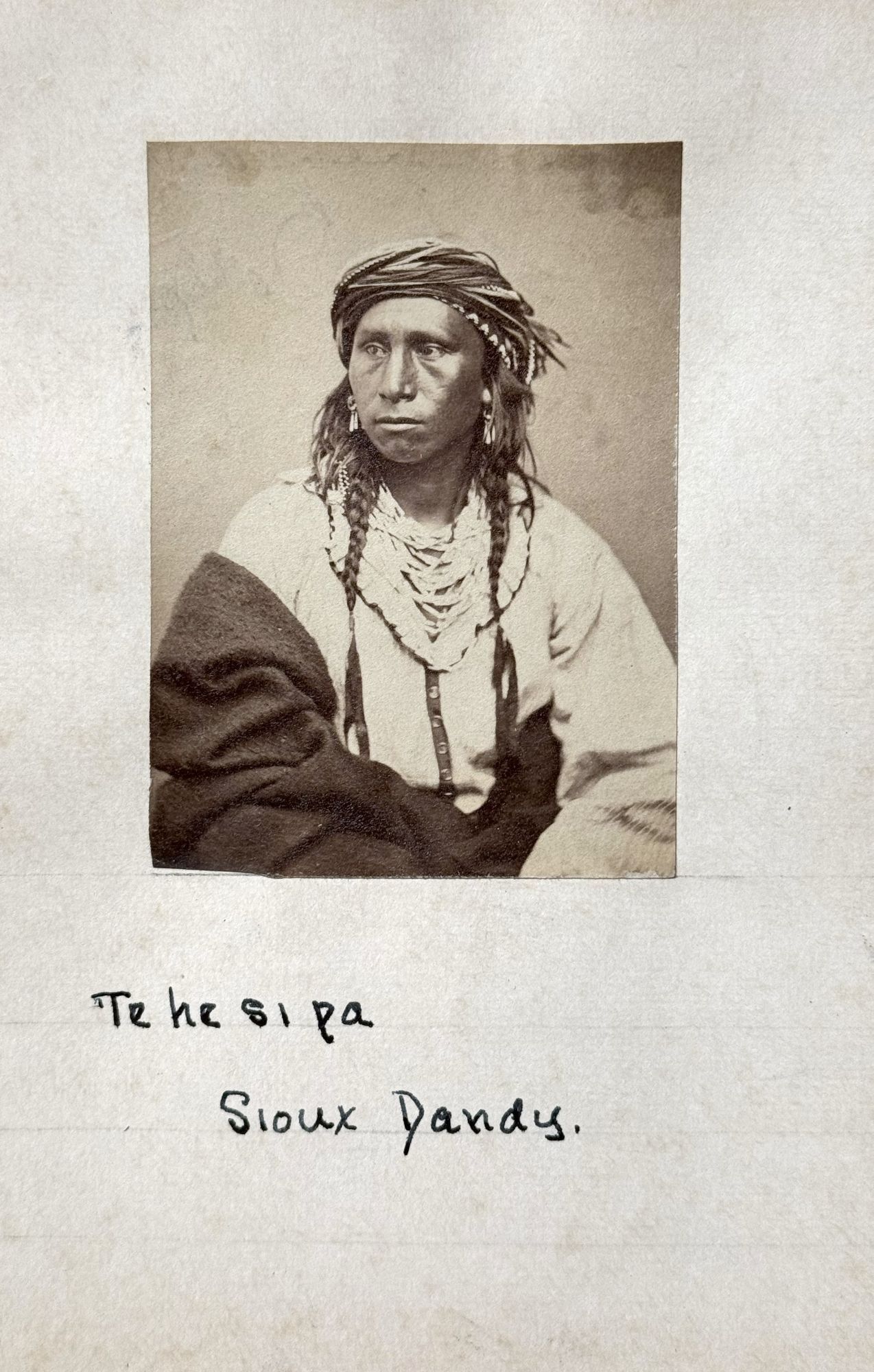
2) “Te he si pa Sioux Dandy.” Misidentification of MHPCG 19, “Te-Na-Se-Pa A Sioux Dandy.” Also known as Do-wan-sa (The Singer). Do-wan-sa was executed in Mankato, MN on December 26, 1862 with thirty-seven other Sioux for their participation in the 1862 Dakota Uprising. According to Shannon, this portrait was taken in the early spring of 1862, before the uprising. MHPCG 19, Riggs 11.
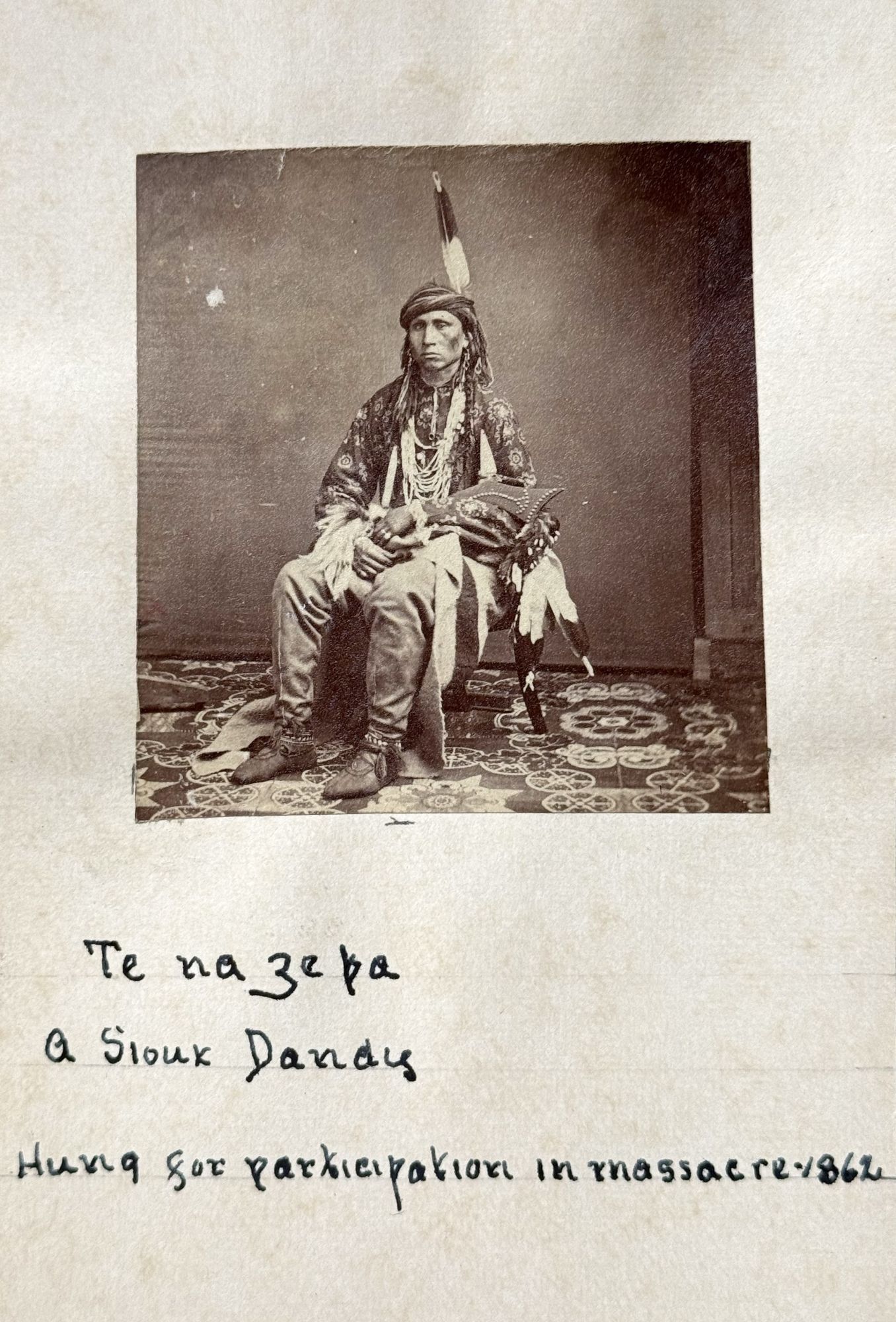
3) “Te na ze pa a Sioux Dandy Hung for participation in massacre-1862.” A full portrait of Te-Na-Se-Pa, also known as Do-wan-sa (The Singer). The Minnesota Historical Society’s online collection contains a CdV of this portrait with the caption, “TE-NA-ZE PA Dakota (Sioux) Warrior”, with photography credits to Upton at Martin’s Gallery. Riggs 11.
Thirty-two carte de visite (CdV) photographs housed in the album include:
1) “LITTLE CROW. A Sioux Chief and Leader of the Indian massacre of 1862, in Minnesota. Whitney, Saint Paul.”
Little Crow escaped hanging with the other Sioux in December 1862 by leaving Minnesota, but was killed by a settler for bounty money when he returned the following year. According to Shannon, this portrait was likely taken before the uprising likely at the request of Little Crow himself. MHPCG 8.
2) “TA-TANKA-NAZIN, (Standing Buffalo.) A hereditary Chief of the Sioux, and a Participator in the Massacre of 1862, in Minnesota. Whitney’s Gallery, Saint Paul.” MHPCG 12, not in Riggs.
3) “CUT NOSE, Who in the Massacre of 1862, in Minnesota, murdered 18 Women and Children and 5 men. Published by J. E. Whitney, St. Paul, Minn.” According to The Clements Library at the University of Michigan, “Cut Nose” was the English name for Marpiya Okinajin, whose name meant “He Who Stands in the Clouds.” Marpiya Okinajin was executed in December 1862 with the other Sioux for the Dakota Uprising. MHPCG 13, Riggs 18.
4) “TE-HE-DO-NE-CHA, (ONE WHO FORBIDS HIS HOUSE.) Executed for participation [in] the Massacre of 1862, in Minnesota.” On verso: “Whitney’s Gallery, Saint Paul”. MHPCG 14, Riggs 1.
5) “PAHA UZA-TANKA. The great Scalp taker (Sioux.) The number of Feathers (16) in the head dress denotes the number of Scalps taken. Whitney, Saint Paul.” According to Shannon, this portrait was taken during Paha Uza-Tanka’s incarceration at Fort Sibley prior to his execution in December, 1862. MHPCG 26. Not in Riggs.
6) “MA-ZA-OO-NIE. (The Little Bird Hunter). Whitney’s Gallery, Saint Paul.” MHPCG 35.
7) “OLD BETS. Squaw who will long be remembered with gratitude by many of [the] Minnesota Captives [sic], for her kindness to them while among the Sioux in 1862. Whit[ney]. St. Paul.” MHPCG 37.
8) “ANPETU-SAPA-WIN. (Black Day Woman.) A Sioux Belle. Whitney’s Gallery, Saint Paul.” This photograph matches that of MHPCG 48, but the caption for MHPCG 48 is “CAN-KU WAS-TE WIN (Good Road Woman).” MHPCG 48.
9) “HAN-YE-TU WAS-TE. (Beautiful Night.) A Dakotah [sic] (Sioux) Belle.” Photographer’s name not given. MHPCG 46.
10) “Can-ku was-te win. (Good Road Woman). A Sioux Beauty.” Photographer’s name not given. This photograph matches that of MHPCG 49, but the caption for MHPCG 49 is “ANPETU-SAPA-WIN. (Black Day Woman.) A Sioux Belle.” MHPCG 49.
11) “SQUAWS WINNOWING WHEAT. Published by Whitney’s Gallery, St. Paul, Minn.” Dated by MHPCG to 1866 – 1867.
12) “Shena (Sioux Squaw).” No matching image in MHPCG.
13) “Little Crow’s wife and Two Children” in manuscript on verso. No photographer noted. According to Shannon, this photograph was originally entitled “Sioux Captives” and was taken by in 1863 B. F. Upton during the Sioux incarceration in the Fort Sibley concentration camp, and was later printed by Whitney.
14) “PO-GO-NAY-KE-SHICK. (Hole-in-the-Day.) The Celebrated Chippewa Chief. Whitney’s Gallery, Saint Paul.” MHPCG 59.
15) “PO-GO NAY-KE-SHICK, (Hole in the Day.) The Celebrated Chippewa Chief.” MHPCG 61.
16) “BE-SHE-KEE. (BUFFLO.) Head Chief of Leech Lake Chippewas. Opposed Hole in-the-Day in his designs of making war upon the Whites. Whitney’s Gallery, Saint Paul.” MHPCG 64.
17) “NAH-BON-A-AUSH. (One Sided Winner.) Chief of Leech lake Chippewas. Opposed Hole-in-the-Day in his designs of making war upon the whites. Whitney’s Gallery, Saint Paul.” MHPCG 67.
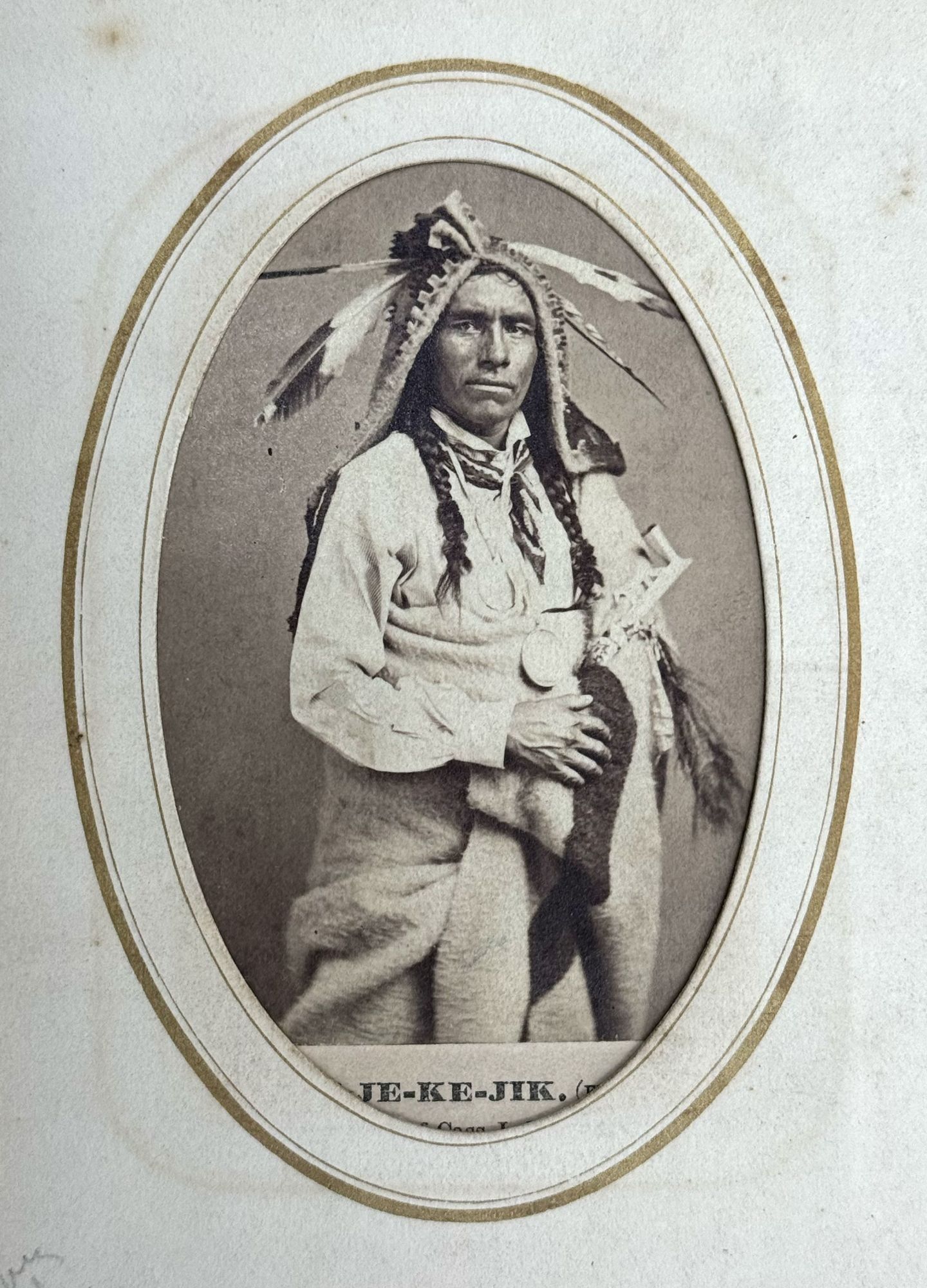
18) “MAW-JE-KE-JIK. (FLYING SHY.) First Chief of Cass Lake Chippewas. Whitney’s Gallery, Saint Paul.” MHPCG 68.
19) “O-GEE-TUB, (Heavy Sitter.) Chief of the Cass Lake Chippewas.” On verso: “[name of photographer obscured], “Portrait and Landscape Photographer, Bridge Square. St. Paul, - Minn”. MHPCG 70.
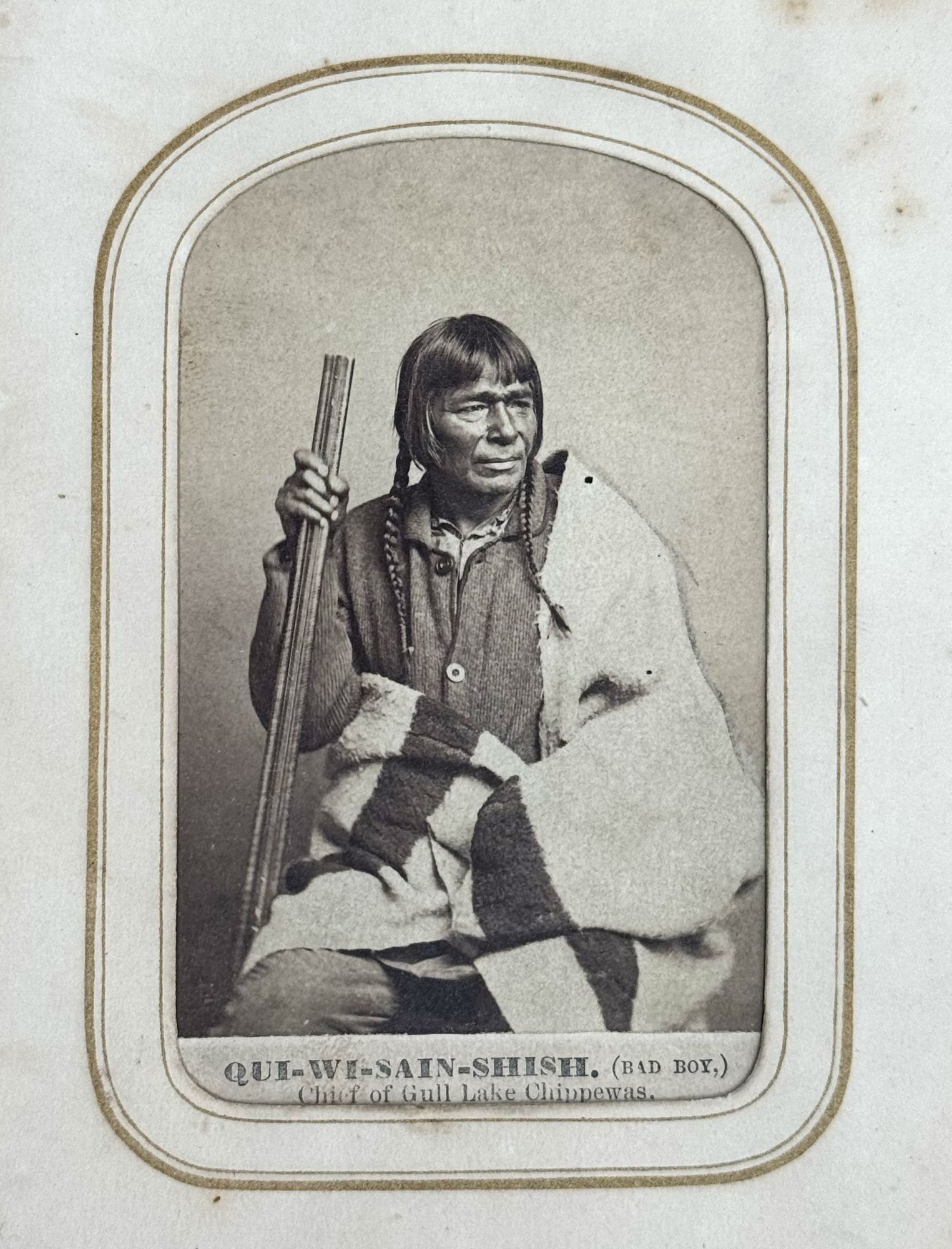
20) “QUI-WI-SAIN-SHISH. (Bad Boy,) Chief of Gull Lake Chippewas. Who to escape the vengeance of the Indians when they discovered his friendship for the whites, in the outbreak of 1862, was obliged to seek protection in Fort Ripley. Whitney’s Gallery, Saint Paul.” MHPCG 71.
21) “NAH GUN E GAH BOW. (Standing Forward) Chief of Rabbit Lake Band of Chippewas. Whitney’s Gallery, Saint Paul.” MHPCG 73.
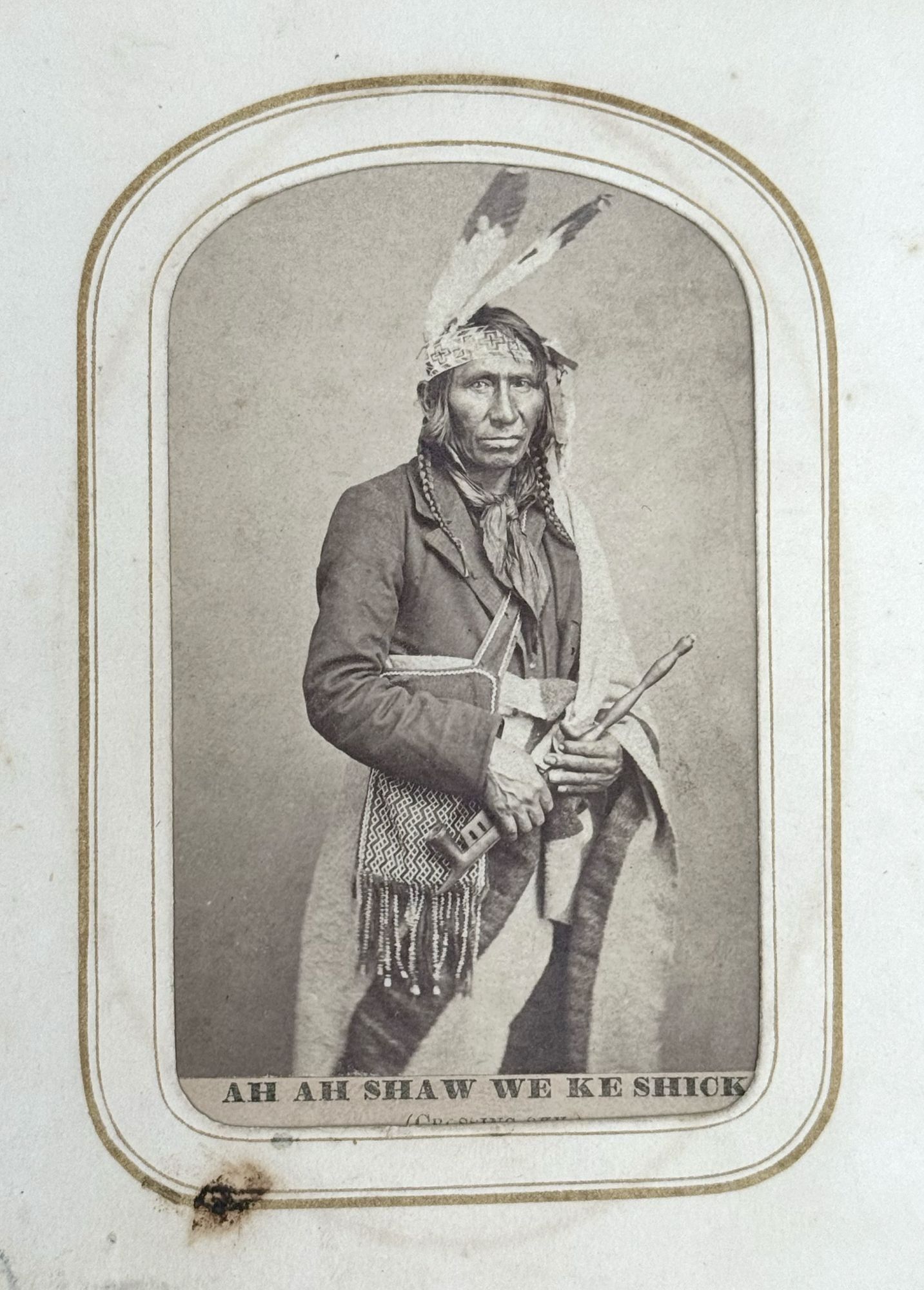
22) “AH AH SHAW WE KE SHICK. (Crossing Sky.) Chief of Rabbit Lake Chippewas. A brave and good Indian. Whitney’s Gallery, Saint Paul.” MHPCG 74.
23) “NOW-WE-KE-SHICK (Noon Day.) A Chippewa chief. Whitney’s Gallery, Saint Paul.” This photograph matches that of MHPCG 80, but the caption for MHPCG 80 is “We-Ke-Mah-Wah-Jee-Wabe. (Chief of the Mountain) A Chippewa Chief. Whitney’s Gallery, Saint Paul.” MHPCG 80.
24) “NOW-WE-KE-SHICK. (Noon Day). A Chippewa Chief. Whitney’s Gallery, Saint Paul.” MHPCG 81.
25) “WINNEBAGO CHIEFS In [sic] Council. Published by Whitney’s Gallery, St. Paul, Minn.” According to the Minnesota Historical Society, Chief Winneshiek appears second from left with other Winnebago (Ho-Chunk) leaders likely at Fort Snelling in 1862 or 1863. MHPCG 93.
26) [Chippewa Warrior]. On verso: “Whitney’s Gallery. 174 Third Street, Saint Paul, Minnesota.” Not in MHPCG.
27) “AH-PE-MA-ZA Dakota (Sioux) Dandy From Martin’s Gallery, St. Paul.”
28) “TA-O-PEE (Wounded Man). A Friendly Sioux Indian chiefly instrumental in bringing the white settlers in safety to camp during the Indian war of 1862. [From] Martin’s Gallery of Minnesota Views, St. Pa[ul.]”
29) “AW-MONSE. (Little Bee) Head Chief of Lac-du-Flambeau Bands of Chippewas. From Martin’s Gallery of Minnesota Views, St. Paul.”
30) “VILLAGE OF YANKTON SIOUX. (Dakotah [sic] Territory.) From Martin’s Gallery of Minnesota Views, Saint Paul.” [reproduction of artwork].
31) “RED-RIVER HALF-BREEDS. (In Camp) From Martin’s Gallery, St. Paul.”
32) “From Upton’s Collection of Photographic Views. St. Anthony, Minn.” Shannon identifies this image as that of “Wowinape, Little Crow’s Son” and places it at the Fort Sibley concentration camp during 1863. Joel E. Whitney: Minnesota's Leading Pioneer Photographer. Catalogue of Cartes de Visite (St. Paul: Minnesota Historical Photo Collectors Group, 2001)
The present group of photographs includes portraits of five men who are identified as having participated in the massacre: Thaóyate Dúta (Little Crow), the Chief of the Santee Sioux who led his people into battle; PaHa Uza Tanka (The Great Scalp Taker), Te-He-Do-Ne-Cha (One Who Forbids His House), Marpiya Okinajin (Cut Nose) and Do-Wan-Sa (The Singer) – all of whom were executed. Also pictured are Ta-Tanka-Nazin (Chief Standing Buffalo), who argued for peace, and "Old Bets," a Sioux squaw reputed to be 120 years old, who was kind to white captives in her village and is arguably one of the most identifiable and most photographed Sioux from this period. Other identified persons in the group include: Ma-Za-Oo-Nie (The Little Bird Hunter); Can-Ku Was-Te-Win (Good Road Woman) and Anpetu-Sapa-Win (Black Day Woman); Winnesheik and other Winnebago chiefs in the prison at Fort Snelling (who, although non-combatant, were forced into the camp at Fort Snelling with their people and ultimately exiled to the Dakotas). In addition to the portraits of the Santee Sioux, there are thirteen additional portraits of representatives from various bands of the Chippewa people.
Joel Emmons Whitney (1822-86) was a pioneering Minnesota photographer and businessman. Whitney learned the art of daguerreotyping from Alexander Hesler, and opened a studio in St. Paul in 1851. He continuously updated his techniques, innovating and offering new products. By 1855, he was advertising paper photographs, which were touted as significantly cheaper than daguerreotypes. In 1860 he introduced the public to the carte-de-visite, which was an incredibly popular format throughout the decade. Whitney produced views of the area, portraits upon request, and - perhaps most notably - portraits and images of the local Native Americans. Whitney had been photographing Native Americans in the area and those who came through the town on their way to Washington for treaty talks. In the summer of 1862, however, the Sioux Uprising spurred new interest in Native American photographs and gave Whitney a unique opportunity for his enterprise. After the Sioux Uprising, Whitney became the principal portrait photographer of those captured and held at Ft. Snelling.
Other photographers represented include James Martin and Benjamin Franklin Upton. Little is known about James E. Martin. He is first listed as a photographer in St. Paul's business directory in 1858. He issued cartes-de-visite and stereoscopic photographs, including subjects related to the 1862 Sioux Uprising. Martin's Gallery is listed at two or three different locations until 1870, at which time the business directory shows the gallery under different ownership. Martin remained active after the sale of his studio in partnership with B. F. Upton of St. Paul. Benjamin Franklin Upton (1818-1901) was born in Dixmont, Maine and began his photography career as a daguerreotypist. In 1856, he started working in St. Anthony, Minnesota, where he established a reputation as a photographer of the Sioux and Chippewa Indians. Upton did not make studio photographs; instead, he preferred to work in the out of doors, and develop his photographs out of a wagon-based studio. As Upton did not have the ability to publishing his photographs for a wider audience, there was a period during which Whitney published Upton’s photographs on his own studio mounts.
The photographs included in the present collection are as follows (captions are within quotes). References are to the Minnesota Historical Photo Collectors Group (MHPCG) catalog list of Whitney cartes-de-visite and to Riggs’ numerical list of Sioux executed in Mankato, Minnesota on December 26, 1862. Three albumen photographs mounted on card stock are loose and not within the album; these portraits are untitled but and bear manuscript identification and are noted below:
1) “Winnesheik and Friends. Winnebagos.” This photograph is an enlarged version of MHPCG 93. According to the Minnesota Historical Society, Winneshiek appears second from left with other Winnebago (Ho-Chunk) leaders likely at Fort Snelling in 1862 or 1863. Note: Following the Sioux Uprising, all Indian tribes from southwestern Minnesota, which included non-combatant Winnebago bands, were held captive in Fort Snelling and ultimately exiled from Minnesota. MHPCG 93.
2) “Te he si pa Sioux Dandy.” Misidentification of MHPCG 19, “Te-Na-Se-Pa A Sioux Dandy.” Also known as Do-wan-sa (The Singer). Do-wan-sa was executed in Mankato, MN on December 26, 1862 with thirty-seven other Sioux for their participation in the 1862 Dakota Uprising. According to Shannon, this portrait was taken in the early spring of 1862, before the uprising. MHPCG 19, Riggs 11.
3) “Te na ze pa a Sioux Dandy Hung for participation in massacre-1862.” A full portrait of Te-Na-Se-Pa, also known as Do-wan-sa (The Singer). The Minnesota Historical Society’s online collection contains a CdV of this portrait with the caption, “TE-NA-ZE PA Dakota (Sioux) Warrior”, with photography credits to Upton at Martin’s Gallery. Riggs 11.
Thirty-two carte de visite (CdV) photographs housed in the album include:
1) “LITTLE CROW. A Sioux Chief and Leader of the Indian massacre of 1862, in Minnesota. Whitney, Saint Paul.”
Little Crow escaped hanging with the other Sioux in December 1862 by leaving Minnesota, but was killed by a settler for bounty money when he returned the following year. According to Shannon, this portrait was likely taken before the uprising likely at the request of Little Crow himself. MHPCG 8.
2) “TA-TANKA-NAZIN, (Standing Buffalo.) A hereditary Chief of the Sioux, and a Participator in the Massacre of 1862, in Minnesota. Whitney’s Gallery, Saint Paul.” MHPCG 12, not in Riggs.
3) “CUT NOSE, Who in the Massacre of 1862, in Minnesota, murdered 18 Women and Children and 5 men. Published by J. E. Whitney, St. Paul, Minn.” According to The Clements Library at the University of Michigan, “Cut Nose” was the English name for Marpiya Okinajin, whose name meant “He Who Stands in the Clouds.” Marpiya Okinajin was executed in December 1862 with the other Sioux for the Dakota Uprising. MHPCG 13, Riggs 18.
4) “TE-HE-DO-NE-CHA, (ONE WHO FORBIDS HIS HOUSE.) Executed for participation [in] the Massacre of 1862, in Minnesota.” On verso: “Whitney’s Gallery, Saint Paul”. MHPCG 14, Riggs 1.
5) “PAHA UZA-TANKA. The great Scalp taker (Sioux.) The number of Feathers (16) in the head dress denotes the number of Scalps taken. Whitney, Saint Paul.” According to Shannon, this portrait was taken during Paha Uza-Tanka’s incarceration at Fort Sibley prior to his execution in December, 1862. MHPCG 26. Not in Riggs.
6) “MA-ZA-OO-NIE. (The Little Bird Hunter). Whitney’s Gallery, Saint Paul.” MHPCG 35.
7) “OLD BETS. Squaw who will long be remembered with gratitude by many of [the] Minnesota Captives [sic], for her kindness to them while among the Sioux in 1862. Whit[ney]. St. Paul.” MHPCG 37.
8) “ANPETU-SAPA-WIN. (Black Day Woman.) A Sioux Belle. Whitney’s Gallery, Saint Paul.” This photograph matches that of MHPCG 48, but the caption for MHPCG 48 is “CAN-KU WAS-TE WIN (Good Road Woman).” MHPCG 48.
9) “HAN-YE-TU WAS-TE. (Beautiful Night.) A Dakotah [sic] (Sioux) Belle.” Photographer’s name not given. MHPCG 46.
10) “Can-ku was-te win. (Good Road Woman). A Sioux Beauty.” Photographer’s name not given. This photograph matches that of MHPCG 49, but the caption for MHPCG 49 is “ANPETU-SAPA-WIN. (Black Day Woman.) A Sioux Belle.” MHPCG 49.
11) “SQUAWS WINNOWING WHEAT. Published by Whitney’s Gallery, St. Paul, Minn.” Dated by MHPCG to 1866 – 1867.
12) “Shena (Sioux Squaw).” No matching image in MHPCG.
13) “Little Crow’s wife and Two Children” in manuscript on verso. No photographer noted. According to Shannon, this photograph was originally entitled “Sioux Captives” and was taken by in 1863 B. F. Upton during the Sioux incarceration in the Fort Sibley concentration camp, and was later printed by Whitney.
14) “PO-GO-NAY-KE-SHICK. (Hole-in-the-Day.) The Celebrated Chippewa Chief. Whitney’s Gallery, Saint Paul.” MHPCG 59.
15) “PO-GO NAY-KE-SHICK, (Hole in the Day.) The Celebrated Chippewa Chief.” MHPCG 61.
16) “BE-SHE-KEE. (BUFFLO.) Head Chief of Leech Lake Chippewas. Opposed Hole in-the-Day in his designs of making war upon the Whites. Whitney’s Gallery, Saint Paul.” MHPCG 64.
17) “NAH-BON-A-AUSH. (One Sided Winner.) Chief of Leech lake Chippewas. Opposed Hole-in-the-Day in his designs of making war upon the whites. Whitney’s Gallery, Saint Paul.” MHPCG 67.
18) “MAW-JE-KE-JIK. (FLYING SHY.) First Chief of Cass Lake Chippewas. Whitney’s Gallery, Saint Paul.” MHPCG 68.
19) “O-GEE-TUB, (Heavy Sitter.) Chief of the Cass Lake Chippewas.” On verso: “[name of photographer obscured], “Portrait and Landscape Photographer, Bridge Square. St. Paul, - Minn”. MHPCG 70.
20) “QUI-WI-SAIN-SHISH. (Bad Boy,) Chief of Gull Lake Chippewas. Who to escape the vengeance of the Indians when they discovered his friendship for the whites, in the outbreak of 1862, was obliged to seek protection in Fort Ripley. Whitney’s Gallery, Saint Paul.” MHPCG 71.
21) “NAH GUN E GAH BOW. (Standing Forward) Chief of Rabbit Lake Band of Chippewas. Whitney’s Gallery, Saint Paul.” MHPCG 73.
22) “AH AH SHAW WE KE SHICK. (Crossing Sky.) Chief of Rabbit Lake Chippewas. A brave and good Indian. Whitney’s Gallery, Saint Paul.” MHPCG 74.
23) “NOW-WE-KE-SHICK (Noon Day.) A Chippewa chief. Whitney’s Gallery, Saint Paul.” This photograph matches that of MHPCG 80, but the caption for MHPCG 80 is “We-Ke-Mah-Wah-Jee-Wabe. (Chief of the Mountain) A Chippewa Chief. Whitney’s Gallery, Saint Paul.” MHPCG 80.
24) “NOW-WE-KE-SHICK. (Noon Day). A Chippewa Chief. Whitney’s Gallery, Saint Paul.” MHPCG 81.
25) “WINNEBAGO CHIEFS In [sic] Council. Published by Whitney’s Gallery, St. Paul, Minn.” According to the Minnesota Historical Society, Chief Winneshiek appears second from left with other Winnebago (Ho-Chunk) leaders likely at Fort Snelling in 1862 or 1863. MHPCG 93.
26) [Chippewa Warrior]. On verso: “Whitney’s Gallery. 174 Third Street, Saint Paul, Minnesota.” Not in MHPCG.
27) “AH-PE-MA-ZA Dakota (Sioux) Dandy From Martin’s Gallery, St. Paul.”
28) “TA-O-PEE (Wounded Man). A Friendly Sioux Indian chiefly instrumental in bringing the white settlers in safety to camp during the Indian war of 1862. [From] Martin’s Gallery of Minnesota Views, St. Pa[ul.]”
29) “AW-MONSE. (Little Bee) Head Chief of Lac-du-Flambeau Bands of Chippewas. From Martin’s Gallery of Minnesota Views, St. Paul.”
30) “VILLAGE OF YANKTON SIOUX. (Dakotah [sic] Territory.) From Martin’s Gallery of Minnesota Views, Saint Paul.” [reproduction of artwork].
31) “RED-RIVER HALF-BREEDS. (In Camp) From Martin’s Gallery, St. Paul.”
32) “From Upton’s Collection of Photographic Views. St. Anthony, Minn.” Shannon identifies this image as that of “Wowinape, Little Crow’s Son” and places it at the Fort Sibley concentration camp during 1863. Joel E. Whitney: Minnesota's Leading Pioneer Photographer. Catalogue of Cartes de Visite (St. Paul: Minnesota Historical Photo Collectors Group, 2001)