

Scottsboro Boy
- New York: Doubleday & Company, Inc, 1950
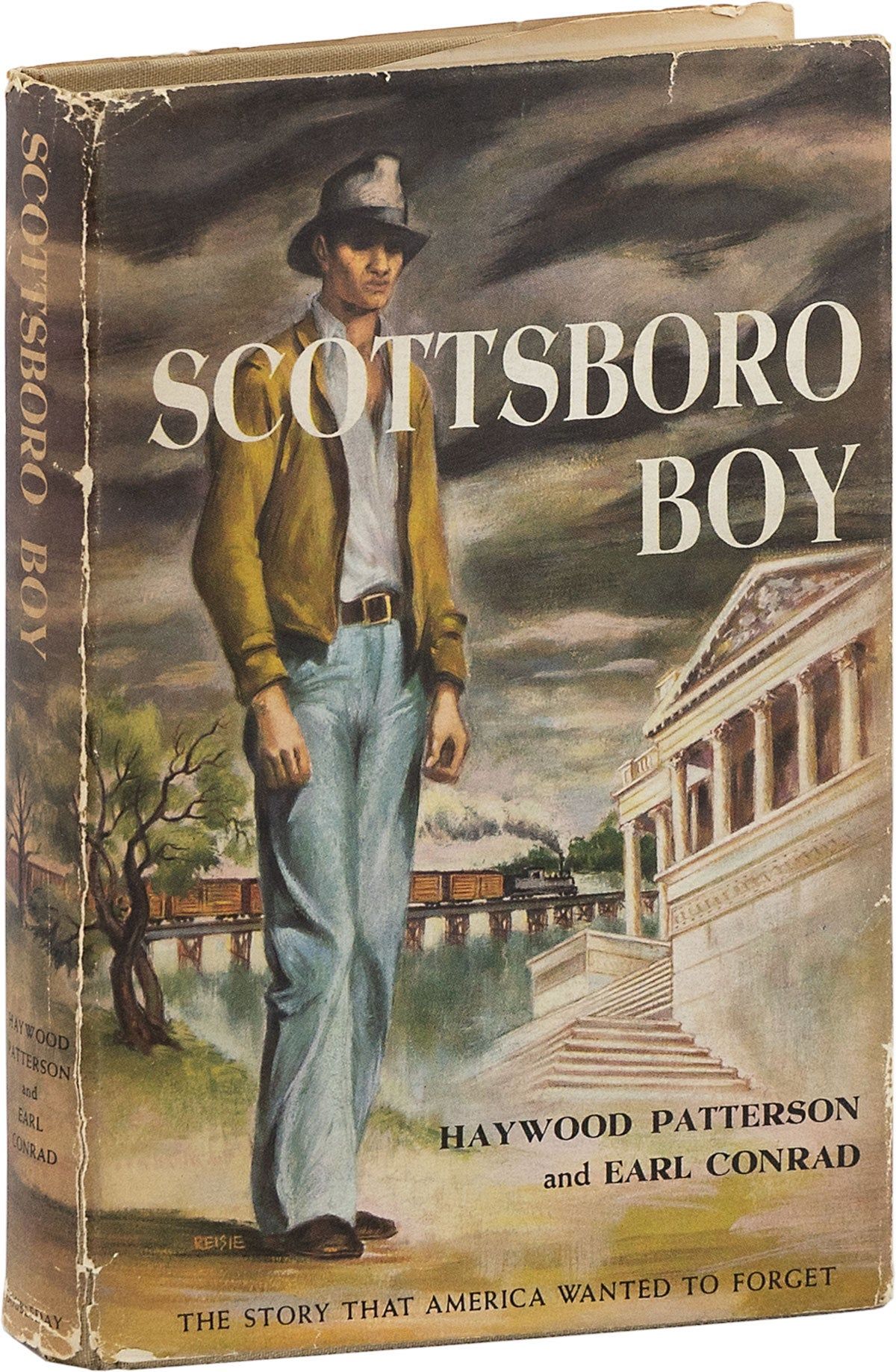
New York: Doubleday & Company, Inc, 1950. First Edition. First Printing. Octavo (21.5cm); beige cloth, with titles stamped in black on spine; dustjacket; x,309,[1]pp. Spine ends lightly nudged, with a stray, tiny ink mark to lower edge of textblock; contents clean; Near Fine. Dustjacket is unclipped (priced $3.00), with remainder price rubber-stamped directly beneath; gently spine-sunned, a bit shelfworn and dusty, with a few tiny nicks and tears, and a 2.5" split alont lower front joint; Very Good.
"As Told To" autobiography of Haywood Patterson, one of the nine defendants in the Scottsboro case. Patterson served 12 years of a life sentence before escaping to New York in 1945. A thorough account of the "crime" (of which the Nine were clearly innocent) and its aftermath, but the book is best for its descriptions of Alabama prison and chain-gang life in the thirties. Patterson's co-author, Earl Conrad, was a white leftist, loosely affiliated with the C.P., and the author a number of African American biographies, all with a Marxist slant. He was drummed out of Party circles after his 1952 novel Rock Bottom was criticized for portraying inner-city Blacks as "degraded" characters. BLOCKSON 4603; SEIDMAN P49; SUVAK 248. 82692.
"As Told To" autobiography of Haywood Patterson, one of the nine defendants in the Scottsboro case. Patterson served 12 years of a life sentence before escaping to New York in 1945. A thorough account of the "crime" (of which the Nine were clearly innocent) and its aftermath, but the book is best for its descriptions of Alabama prison and chain-gang life in the thirties. Patterson's co-author, Earl Conrad, was a white leftist, loosely affiliated with the C.P., and the author a number of African American biographies, all with a Marxist slant. He was drummed out of Party circles after his 1952 novel Rock Bottom was criticized for portraying inner-city Blacks as "degraded" characters. BLOCKSON 4603; SEIDMAN P49; SUVAK 248. 82692.