

Relation of a Voyage from Boston to Newfoundland, for the Observation of the Transit of Venus, June 6, 1761
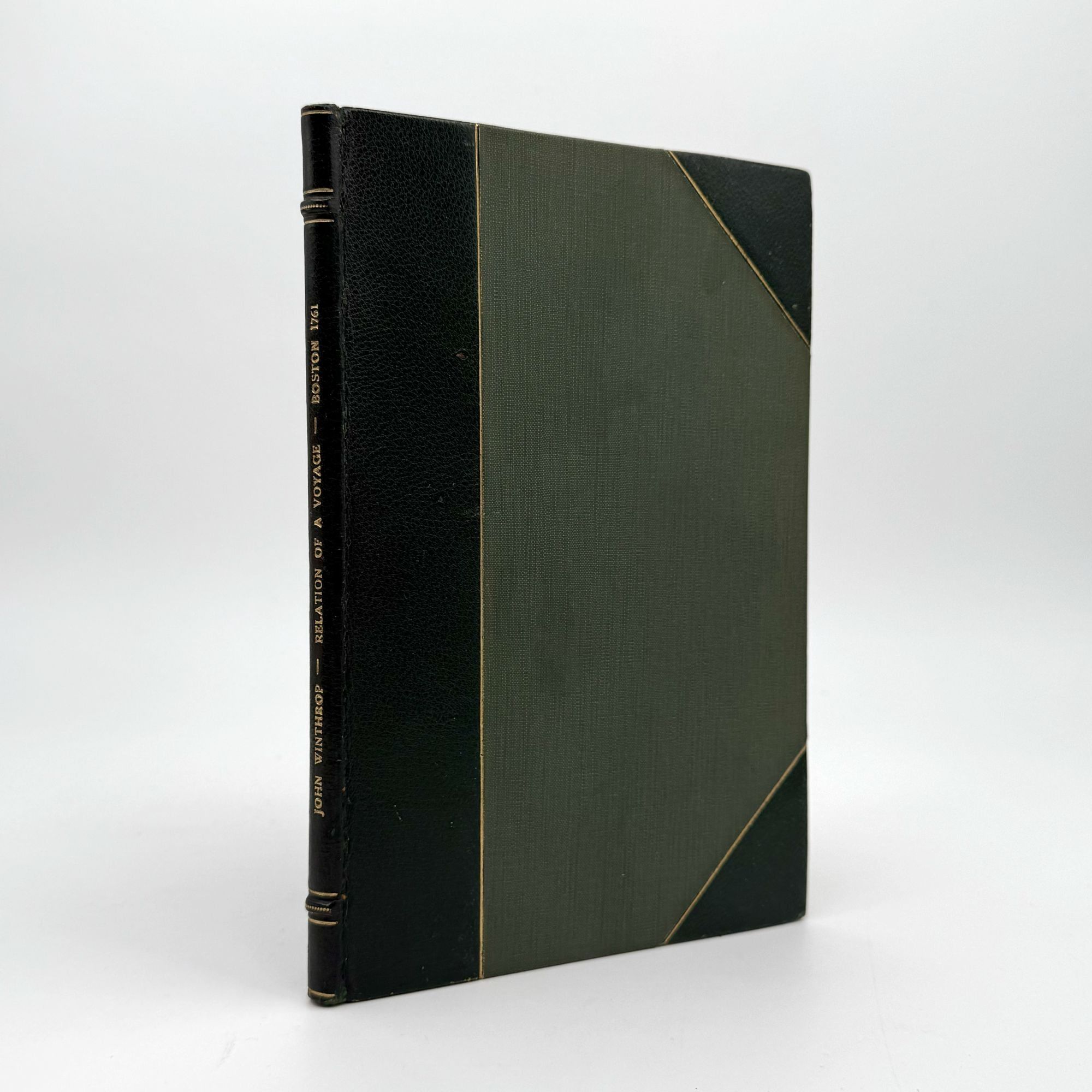
- 24pp. 1 vols. 8vo
- Boston: Edes and Gill, 1761
Boston: Edes and Gill, 1761. First edition. 24pp. 1 vols. 8vo. Later half green morocco and cloth boards. Minor staining, repaired tear to title. Provenance: Jacob Gerrish (signature on title); Spencer Charles Ferguson (bookplate). First edition. 24pp. 1 vols. 8vo. An early work of American astronomy, being John Winthrop's account of his journey to Newfoundland and observations on the transit of Venus. The Transit of Venus in 1761 and 1769, not visible through much of Europe, afforded the American colonies their first real opportunity for scientific contribution. The combined efforts of David West, David Rittenhouse and John Winthrop marked the arrival of American science on the world stage. Winthrop's expedition was funded by the legislature of Massachusetts Bay, in what must be among the first instances of public support of science in North America.
The efforts to view the transit of Venus across the surface of the sun was one of the first great international scientific efforts. David Rittenhouse in Philadelphia also undertook a North American observation, but English and French expeditions went as far as the Pacific Ocean to obtain sightings, and the results allowed the most accurate calculation of the size of the earth up to that time.
"Perhaps [Winthrop's] most important astronomical work was concerned with the two transits of Venus in 1761 and 1769, which engaged astronomers all over the world. For the 1761 transit Winthrop organized an expedition from Harvard to St. John's Newfoundland, which provided material for one of his most important papers ..." (Dictionary of Scientific Biography).
Although well represented among institutions, the work is scarce on the market. Evans 9040; Sabin 104856; ESTC W29009
The efforts to view the transit of Venus across the surface of the sun was one of the first great international scientific efforts. David Rittenhouse in Philadelphia also undertook a North American observation, but English and French expeditions went as far as the Pacific Ocean to obtain sightings, and the results allowed the most accurate calculation of the size of the earth up to that time.
"Perhaps [Winthrop's] most important astronomical work was concerned with the two transits of Venus in 1761 and 1769, which engaged astronomers all over the world. For the 1761 transit Winthrop organized an expedition from Harvard to St. John's Newfoundland, which provided material for one of his most important papers ..." (Dictionary of Scientific Biography).
Although well represented among institutions, the work is scarce on the market. Evans 9040; Sabin 104856; ESTC W29009