

Mormon Expositor: vol. 1, no.1

- Salt Lake City , 1875
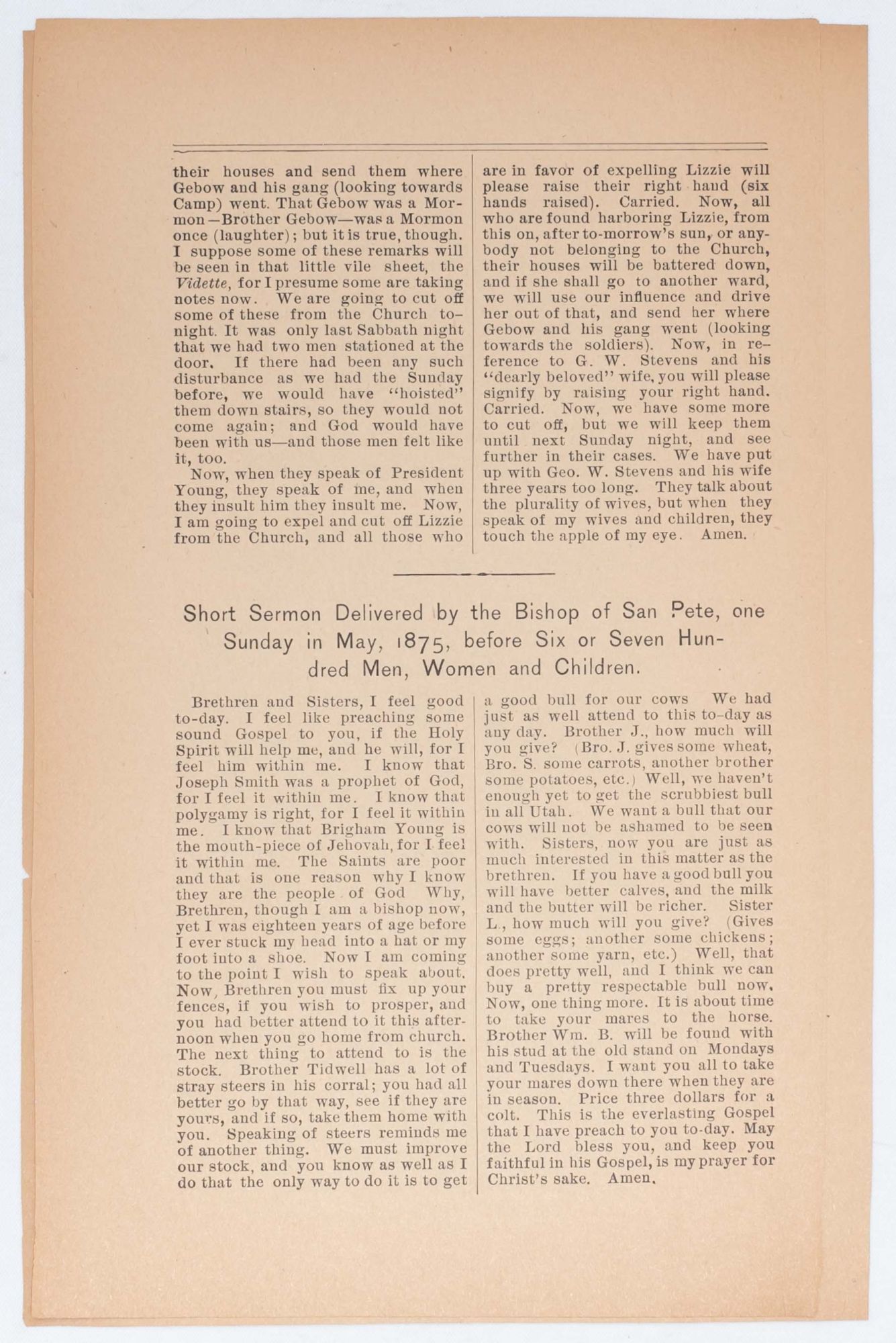
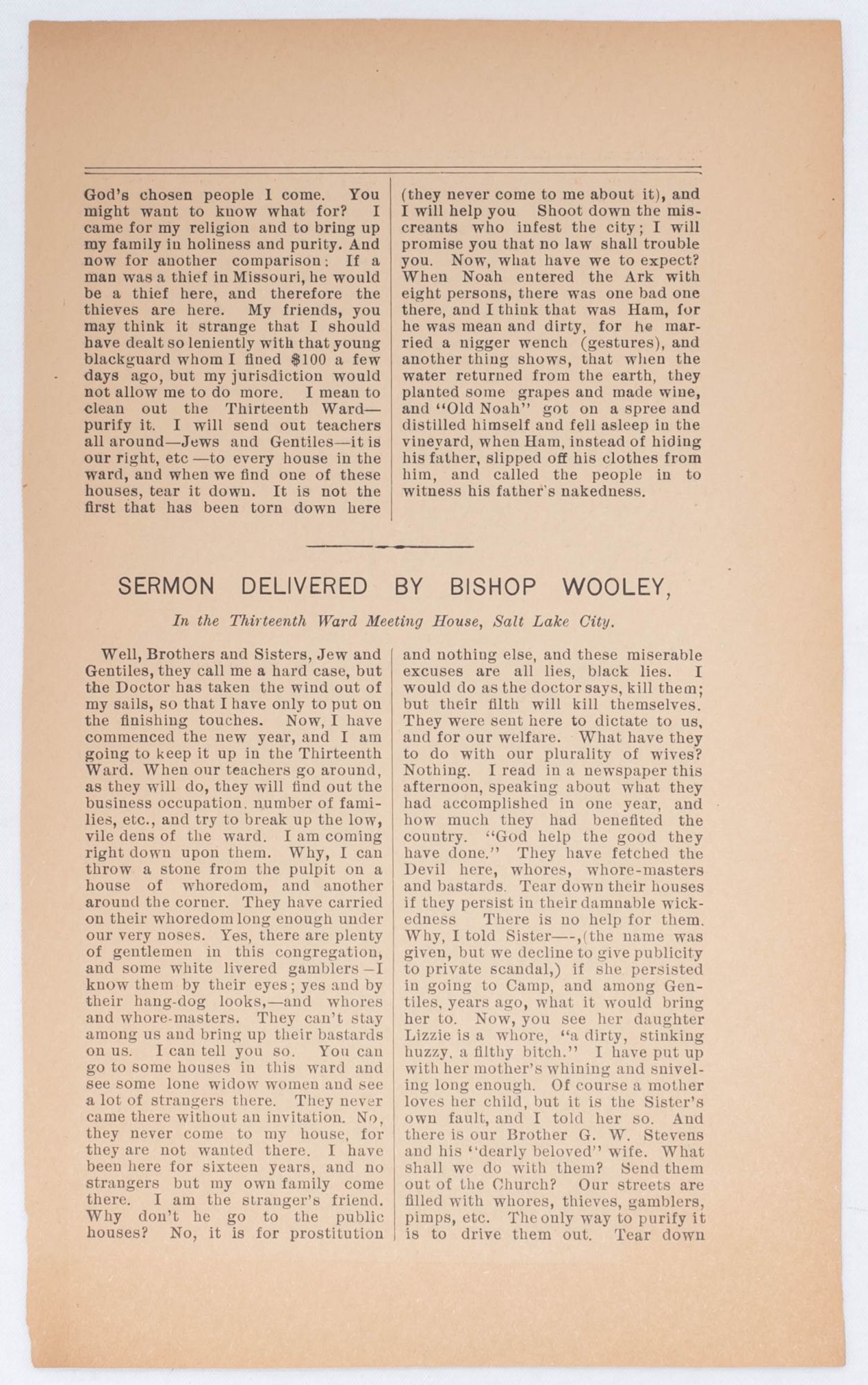
Salt Lake City, 1875. First edition, second printing. Very Good +. The first and only issue of an anti-Mormon publication circulating "obscene" sermons supposedly preached by Mormon leaders including Brigham Young (though Flake-Draper notes that they are "doubtfully authentic"). 150 x 220 mm. [4] pp., complete. Two sheets of paper, somewhat browned and brittle, with a few chips to margins. A Very Good, unblemished copy of a scarce and fragile item.
The publication begins, "It is a fact with which all residents of Utah are familiar that until a few years since many of the sermons of Brigham Young, as delivered in the Tabernacle in this city, were so full of profanity, and abounded with so many obscene and indecent expressions, as to be utterly unfit for publication." The supposed Brigham Young sermon is, in fact, full of profanity, as well as hatred towards non-Mormons: "Who cares about these infernal Gentiles?" he supposedly preached. "If they were to wear a s--t pot on their heads, must I do so?" The other sermons, credited to Jeter Clinton (1813 - 1892), "Bishop Wooley," and "the Bishop of San Pete," are nearly as offensive; the sermon in "San Pete" was, to add insult to injury, delivered "before six or seven hundred men, women and children." This dubious publication was clearly produced to stoke fears about Mormon impropriety and aggression towards non-Mormons. The traditional practice of polygamy was still widespread among Mormons in the 1870s, and many non-Mormons believed that the practice was both sexually deviant and at odds with mainstream Christian values. This publication predates the Edmunds-Tucker Act (sometimes referred to as the Anti-Plural Marriage Act), which restricted polygamy and seize some church properties, by about a decade, and exemplifies the brewing anti-Mormon sentiment of the period.
The title "Mormon Expositor" is almost certainly a reference to the Nauvoo Expositor, the newspaper that led to the arrest and lynching of Joseph Smith, the mayor of Nauvoo, Illinois and the founder of the Mormon Church. The only issue of the Nauvoo Expositor, published by anti-polygamist ex-Mormons in June 1844, exposed Smith's practice of polygamy and accused him of teaching that church members could become gods. Enraged, Smith ordered the destruction of the press and declared martial law in Nauvoo, mobilizing the city militia. Smith was eventually charged with treason by the Governor of Illinois for declaring martial law; Smith fled and was later jailed, though a lynch mob killed both Smith and his brother, Hyrum, before they could be tried. The ambitions of the Mormon Expositor are both clear and lofty: to unearth scandalous information, whether true or false, that would lead to the overthrow of Brigham Young and other Mormon leaders.
Note that this is the second of two printings produced in 1875, printed from the same type except for the title (see Flake-Draper, 5523). All printings are scarce. Flake-Draper calls a publication under the title "To the clergy of the Presbyterian Church" the "probable" first printing (Flake-Draper, 9677), which is rare, with only two recorded copies (both at BYU). The first printing is credited to Josiah Welch, whose name was removed for the second printing. We could not locate any information about Welch, which may have been a pseudonym; if Josiah Welch were the author's real name, however, removing it may have been out of concern for his safety, given the new, inflammatory title and the implication of sparking violence against Mormons. Very Good +.
The publication begins, "It is a fact with which all residents of Utah are familiar that until a few years since many of the sermons of Brigham Young, as delivered in the Tabernacle in this city, were so full of profanity, and abounded with so many obscene and indecent expressions, as to be utterly unfit for publication." The supposed Brigham Young sermon is, in fact, full of profanity, as well as hatred towards non-Mormons: "Who cares about these infernal Gentiles?" he supposedly preached. "If they were to wear a s--t pot on their heads, must I do so?" The other sermons, credited to Jeter Clinton (1813 - 1892), "Bishop Wooley," and "the Bishop of San Pete," are nearly as offensive; the sermon in "San Pete" was, to add insult to injury, delivered "before six or seven hundred men, women and children." This dubious publication was clearly produced to stoke fears about Mormon impropriety and aggression towards non-Mormons. The traditional practice of polygamy was still widespread among Mormons in the 1870s, and many non-Mormons believed that the practice was both sexually deviant and at odds with mainstream Christian values. This publication predates the Edmunds-Tucker Act (sometimes referred to as the Anti-Plural Marriage Act), which restricted polygamy and seize some church properties, by about a decade, and exemplifies the brewing anti-Mormon sentiment of the period.
The title "Mormon Expositor" is almost certainly a reference to the Nauvoo Expositor, the newspaper that led to the arrest and lynching of Joseph Smith, the mayor of Nauvoo, Illinois and the founder of the Mormon Church. The only issue of the Nauvoo Expositor, published by anti-polygamist ex-Mormons in June 1844, exposed Smith's practice of polygamy and accused him of teaching that church members could become gods. Enraged, Smith ordered the destruction of the press and declared martial law in Nauvoo, mobilizing the city militia. Smith was eventually charged with treason by the Governor of Illinois for declaring martial law; Smith fled and was later jailed, though a lynch mob killed both Smith and his brother, Hyrum, before they could be tried. The ambitions of the Mormon Expositor are both clear and lofty: to unearth scandalous information, whether true or false, that would lead to the overthrow of Brigham Young and other Mormon leaders.
Note that this is the second of two printings produced in 1875, printed from the same type except for the title (see Flake-Draper, 5523). All printings are scarce. Flake-Draper calls a publication under the title "To the clergy of the Presbyterian Church" the "probable" first printing (Flake-Draper, 9677), which is rare, with only two recorded copies (both at BYU). The first printing is credited to Josiah Welch, whose name was removed for the second printing. We could not locate any information about Welch, which may have been a pseudonym; if Josiah Welch were the author's real name, however, removing it may have been out of concern for his safety, given the new, inflammatory title and the implication of sparking violence against Mormons. Very Good +.