

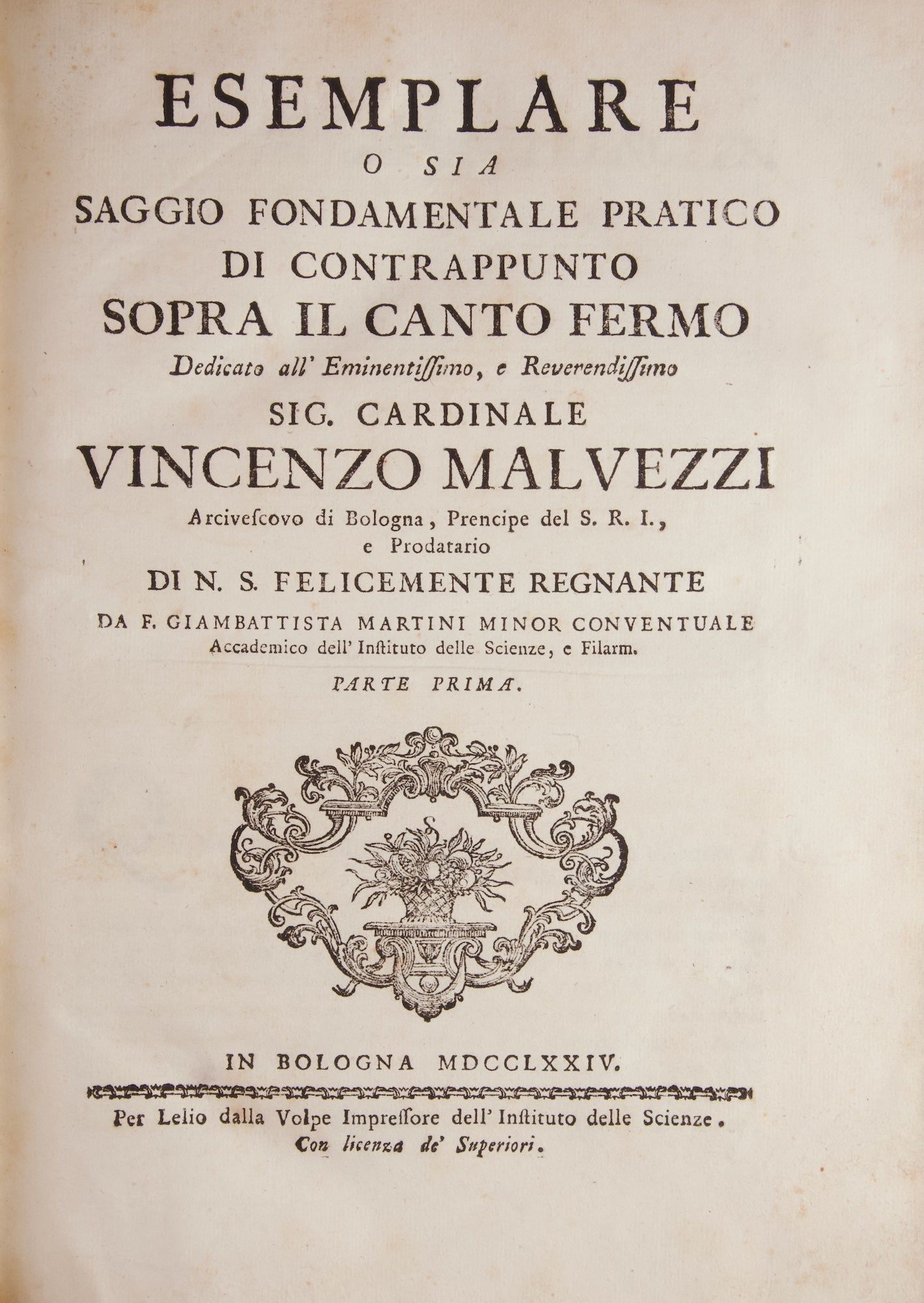
Esemplare o sia Saggio Fondamentale Pratico di Contrappunto Sopra il Canto Fermo Dedicato all' ... Sig. Cardinale Vincenzo Malvezzi ... Parte Prima. Together with Esemplare ... di Contrappunto Fugato dedicato all' ... Gennaro Adelelmo Pignatelli ... Parte Seconda
- Bologna: Per Lelio dalla Volpe Impressore dell' Instituto delle Scienze. Con licenza de' Superiori, 1775
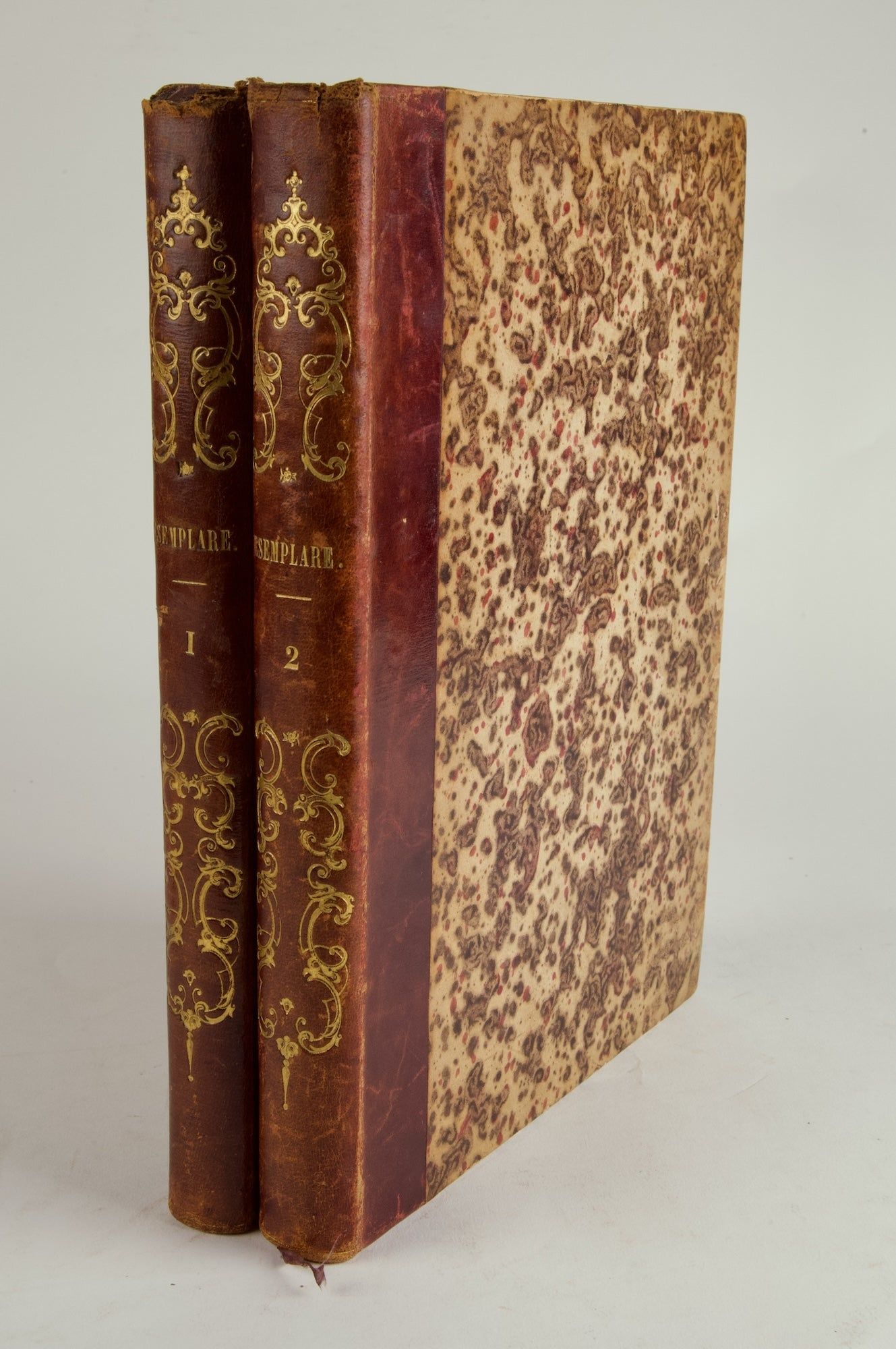
Bologna: Per Lelio dalla Volpe Impressore dell' Instituto delle Scienze. Con licenza de' Superiori, 1775. 2 volumes. Quarto. Quarter dark tan calf with marbled boards, titling gilt to spine with decorative tooling gilt, marbled endpapers.
Vol. I: Parte Prima
1f. (recto title with decorative woodcut device incorporating floral motifs, verso blank), iii-iv (dedication), v-xxxii (Prefazione, Breve Compendio, Regole di Contrappunto), [1] (part title), 2-258, 259-260 (errata) pp. + 1 folding plate "Tavola per la Modulazione").
Vol. 2: Parte Seconda
1f. (recto title with decorative woodcut device incorporating a portrait bust, verso blank), iii-v (dedication), v-xxxvi (Prefazione, Regole per Comporre la Fuga, license), 1f. (recto part title, verso blank), 3-326, 327-328 (errata) pp.
Profusely illustrated with typeset musical examples in diamond-head notation.
Inscribed to French composer and music theorist François Antoine Camille Durutte (1803-1881), with "á Camille Durutte acheté chez Mlle. Lavinée ..." in ink to preliminary leaf of Vol. 1 with a similar note in pencil to preliminary leaf of Vol. 2, with a pencilled date of 1879.
Binding slightly worn, rubbed, and bumped. Very minor internal wear; some margins slightly foxed.
A very good, crisp, clean, wide-margined copy overall. First Edition. Cortot p. 125. Wolffheim I, 811. Hirsch I, 366. RISM Écrits p. 551.
"In addition to his activities as a teacher and composer, Martini was a prolific historian and theorist. His two great works are the Esemplare ossia saggio fondamentale pratico di contrappunto and the Storia della musica. The Esemplare provides an illustration of Martini's pedagogical method - the presentation of many examples of Renaissance and Baroque music as models and as starting-points for theoretical and historical discussion." TNG Vol. 11, p. 724.
"Martini’s didactic approach is best represented in the two volumes of his Esemplare, o sia Saggio fondamentale pratico di contrappunto (1774–6). This is a compendium of extracts from musical works intended for advanced students and is based ‘on the example rather than on the rule, on judgment rather than precept’ (Reich); Knud Jeppesen, however, argued that it is rather ‘a collection of intelligently commented examples of vocal polyphony than a real counterpoint handbook’ (quoted in E. Darbellay: ‘L’Esemplare du Padre Martini: une exégèse musicologique du “stile asservato”’; see Padre Martini: Bologna 1984, 137–71). Despite the apparent modernity of the approach through examples, the organization is traditional and perhaps conceptually indebted in its analytical purpose to the broader but incomplete Guida armonica of G.O. Pitoni (of which Martini was certainly aware). The whole work, but especially the first volume, represents a passionate defence of the aesthetic specificities of church styles." Howard Brofsky, revised by Sergio Durante in Grove Music Online.
Vol. I: Parte Prima
1f. (recto title with decorative woodcut device incorporating floral motifs, verso blank), iii-iv (dedication), v-xxxii (Prefazione, Breve Compendio, Regole di Contrappunto), [1] (part title), 2-258, 259-260 (errata) pp. + 1 folding plate "Tavola per la Modulazione").
Vol. 2: Parte Seconda
1f. (recto title with decorative woodcut device incorporating a portrait bust, verso blank), iii-v (dedication), v-xxxvi (Prefazione, Regole per Comporre la Fuga, license), 1f. (recto part title, verso blank), 3-326, 327-328 (errata) pp.
Profusely illustrated with typeset musical examples in diamond-head notation.
Inscribed to French composer and music theorist François Antoine Camille Durutte (1803-1881), with "á Camille Durutte acheté chez Mlle. Lavinée ..." in ink to preliminary leaf of Vol. 1 with a similar note in pencil to preliminary leaf of Vol. 2, with a pencilled date of 1879.
Binding slightly worn, rubbed, and bumped. Very minor internal wear; some margins slightly foxed.
A very good, crisp, clean, wide-margined copy overall. First Edition. Cortot p. 125. Wolffheim I, 811. Hirsch I, 366. RISM Écrits p. 551.
"In addition to his activities as a teacher and composer, Martini was a prolific historian and theorist. His two great works are the Esemplare ossia saggio fondamentale pratico di contrappunto and the Storia della musica. The Esemplare provides an illustration of Martini's pedagogical method - the presentation of many examples of Renaissance and Baroque music as models and as starting-points for theoretical and historical discussion." TNG Vol. 11, p. 724.
"Martini’s didactic approach is best represented in the two volumes of his Esemplare, o sia Saggio fondamentale pratico di contrappunto (1774–6). This is a compendium of extracts from musical works intended for advanced students and is based ‘on the example rather than on the rule, on judgment rather than precept’ (Reich); Knud Jeppesen, however, argued that it is rather ‘a collection of intelligently commented examples of vocal polyphony than a real counterpoint handbook’ (quoted in E. Darbellay: ‘L’Esemplare du Padre Martini: une exégèse musicologique du “stile asservato”’; see Padre Martini: Bologna 1984, 137–71). Despite the apparent modernity of the approach through examples, the organization is traditional and perhaps conceptually indebted in its analytical purpose to the broader but incomplete Guida armonica of G.O. Pitoni (of which Martini was certainly aware). The whole work, but especially the first volume, represents a passionate defence of the aesthetic specificities of church styles." Howard Brofsky, revised by Sergio Durante in Grove Music Online.