

Letter from Union Army Soldier Concerning Sherman’s “Forty Acres” Order and His Carolinas Campaign
- Single letter measuring 7.5 x 10 inches folded, one double-sided sheet, with stampless envelope
- South Carolina , 1865
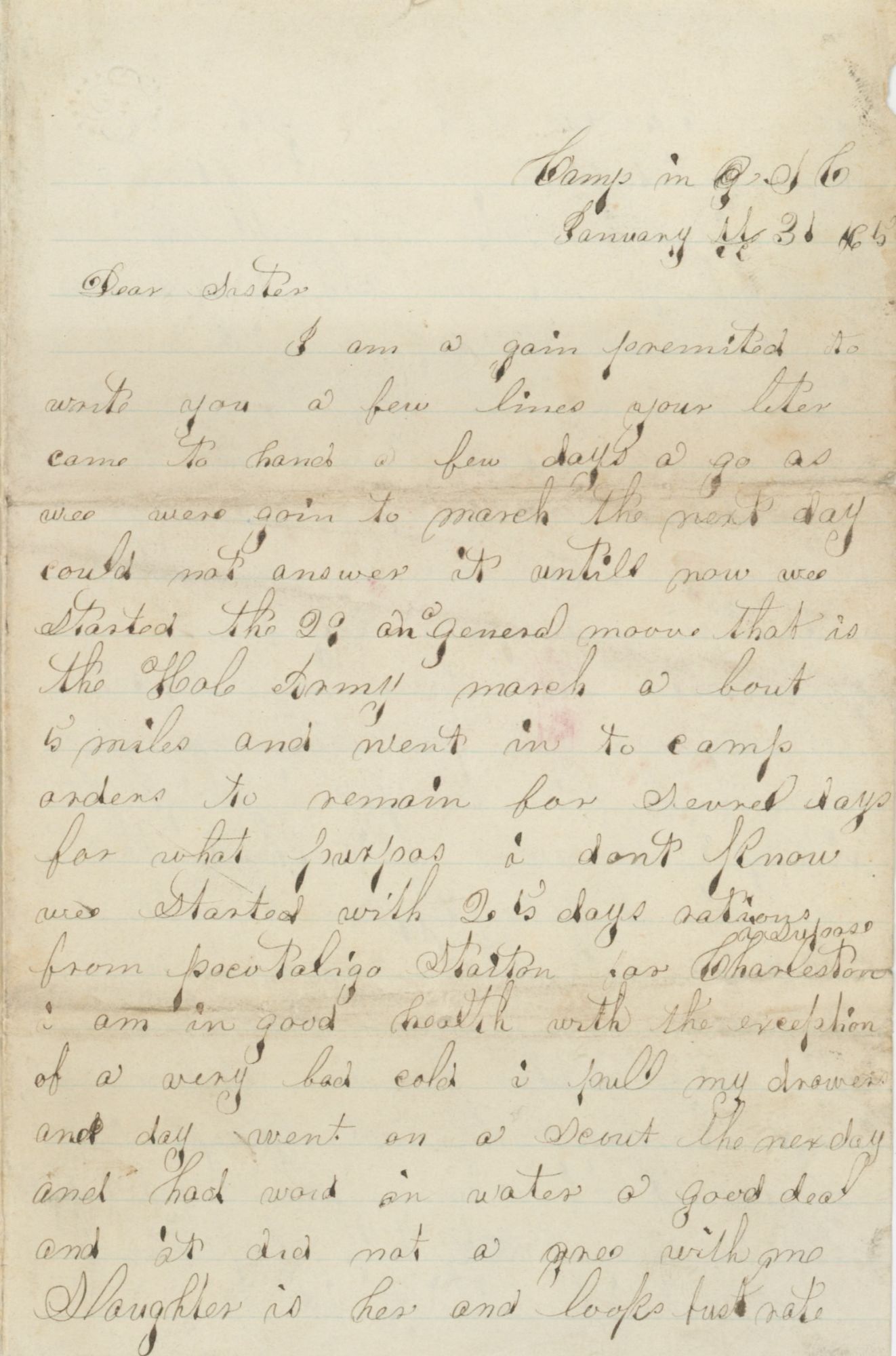
South Carolina, 1865. Single letter measuring 7.5 x 10 inches folded, one double-sided sheet, with stampless envelope. Near fine with light normal wear. George Harpole Vannada (1844–1928) was a private, promoted to corporal, in Company I of the 25th Indiana Infantry Regiment during the Civil War. The 25th Infantry was a volunteer regiment, mustered in August 1861 and mustered out in July 1865. At the time of Vannada’s writing, the Regiment was involved in the Campaign of the Carolinas – led by General Sherman, this campaign would culminate in the Army of the South’s unconditional surrender and effectively end the war.
Vannada writes that his regiment had “started with 25 days rations from pocotaligo staton for i supose Charleston.” On the way, they had encountered:
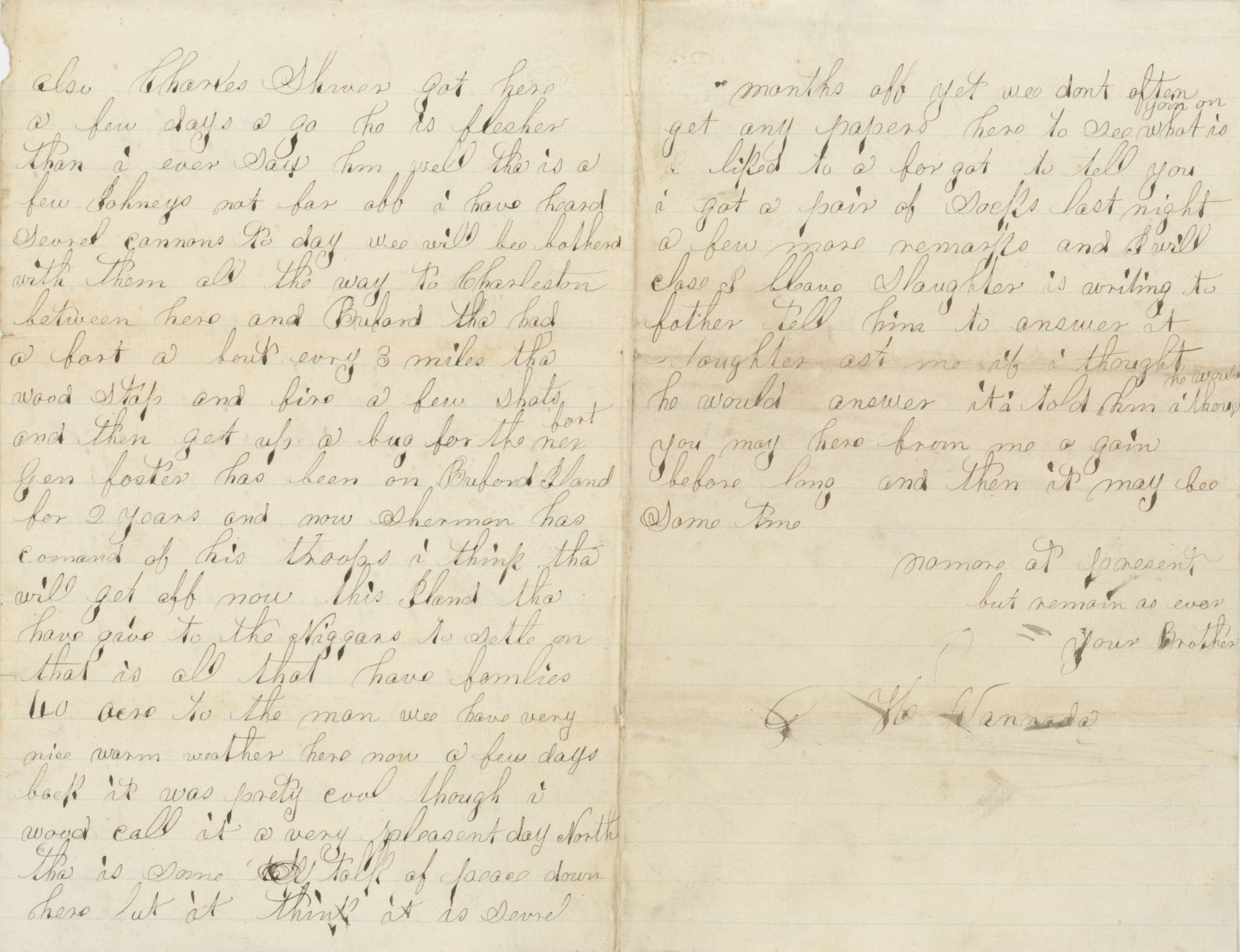
“a few Johneys [i.e., Confederates] not far off i have heard sevrel cannons to day we will be botherd with them all the way to Charleston between here and Buford th[ey] had a fort a bout evry 3 miles th[ey] wood stop and fire a few shots and then get up a bug for the nex[t] fort”.
By “Buford,” Vannada probably means Beaufort, South Carolina, which had been occupied by Union forces since November 1861. At this point the Savannah area had been essentially a refugee camp for freed people for several years, and Sherman’s Special Field Orders, No. 15, which settled them in the nearby South Carolina Sea Islands—the “forty acres and a mule” order—came in response to their request for stewardship over the land. Vannada remarks on Sherman’s order:
“Gen Foster has been on Buford Iland for 2 years and now Sherman has comand of his troops i think th[ey] will get off now this Iland th[ey] have to give to the Niggars to setle on that is all that have famlies 40 acre to the man”.
Vannada also accurately forecasts, despite the fact that “we don’t often get any papers here to see what is goin on”, that there “is some talk of peace down here but i think it is sevrel months off yet”.
Vannada writes that his regiment had “started with 25 days rations from pocotaligo staton for i supose Charleston.” On the way, they had encountered:
“a few Johneys [i.e., Confederates] not far off i have heard sevrel cannons to day we will be botherd with them all the way to Charleston between here and Buford th[ey] had a fort a bout evry 3 miles th[ey] wood stop and fire a few shots and then get up a bug for the nex[t] fort”.
By “Buford,” Vannada probably means Beaufort, South Carolina, which had been occupied by Union forces since November 1861. At this point the Savannah area had been essentially a refugee camp for freed people for several years, and Sherman’s Special Field Orders, No. 15, which settled them in the nearby South Carolina Sea Islands—the “forty acres and a mule” order—came in response to their request for stewardship over the land. Vannada remarks on Sherman’s order:
“Gen Foster has been on Buford Iland for 2 years and now Sherman has comand of his troops i think th[ey] will get off now this Iland th[ey] have to give to the Niggars to setle on that is all that have famlies 40 acre to the man”.
Vannada also accurately forecasts, despite the fact that “we don’t often get any papers here to see what is goin on”, that there “is some talk of peace down here but i think it is sevrel months off yet”.