

The Personal History of David Copperfield
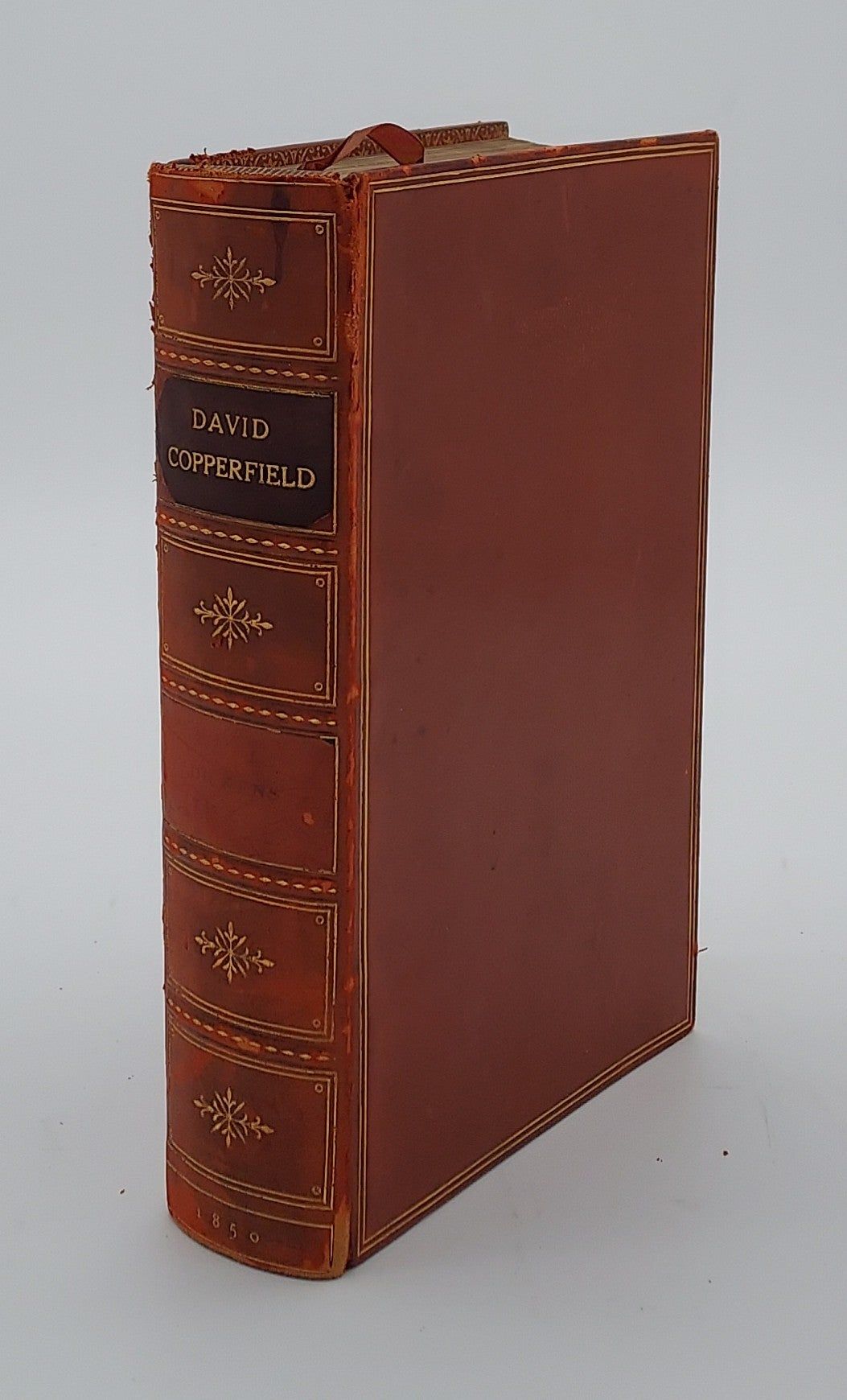
- Leather Bound
- London: Bradbury & Evans, 1850
London: Bradbury & Evans, 1850. First edition in book form, first issue. Leather Bound. Very Good. H. K. Browne. 624pp. Octavo [21.5 cm] Bound in a contemporary Bayntun binding of full brown leather, with gilt stamped ornamental designs on the spine, the publication date at the foot of the spine, and double gilt-ruled borders on the covers. All edges gilt. Turn-ins gilt. Half title vignette. Two brown silk ribbon page-markers. The spine label with the author's name is detached, but tucked in. Light rubbing to the extremities. Minor numerical notation to front free endpaper. Small dark patches on p. 275 and the recto of the plate opposite (from the spine label having been tucked in). The plate titled "Mr. Peggotty's Dream Comes True" is facing p. 496 rather than p. 512. 1850 date on both title pages. Errata with six lines. All plates present. With "recal" on first line of p. 16. Period after "and" on p. 30. Comma slightly apart from "mother" on p. 34. All other flaws called out in Smith are present. Eckel, pp. 77-78. Smith Part I: 9. With illustrations by H. K. Browne.
David Copperfield originally appeared serially in twenty numbers, bound in nineteen monthly parts. A largely biographic novel which was not hugely popular in the beginning, but grew to be one of Dickens' most popular works. Dickens also thought of this work as one of his favorite works. In "David Copperfield," Dickens relates a number of significant early personal experiences, including his work in a factory, his schooling and reading, and his development into a successful novel writer.
David Copperfield originally appeared serially in twenty numbers, bound in nineteen monthly parts. A largely biographic novel which was not hugely popular in the beginning, but grew to be one of Dickens' most popular works. Dickens also thought of this work as one of his favorite works. In "David Copperfield," Dickens relates a number of significant early personal experiences, including his work in a factory, his schooling and reading, and his development into a successful novel writer.