

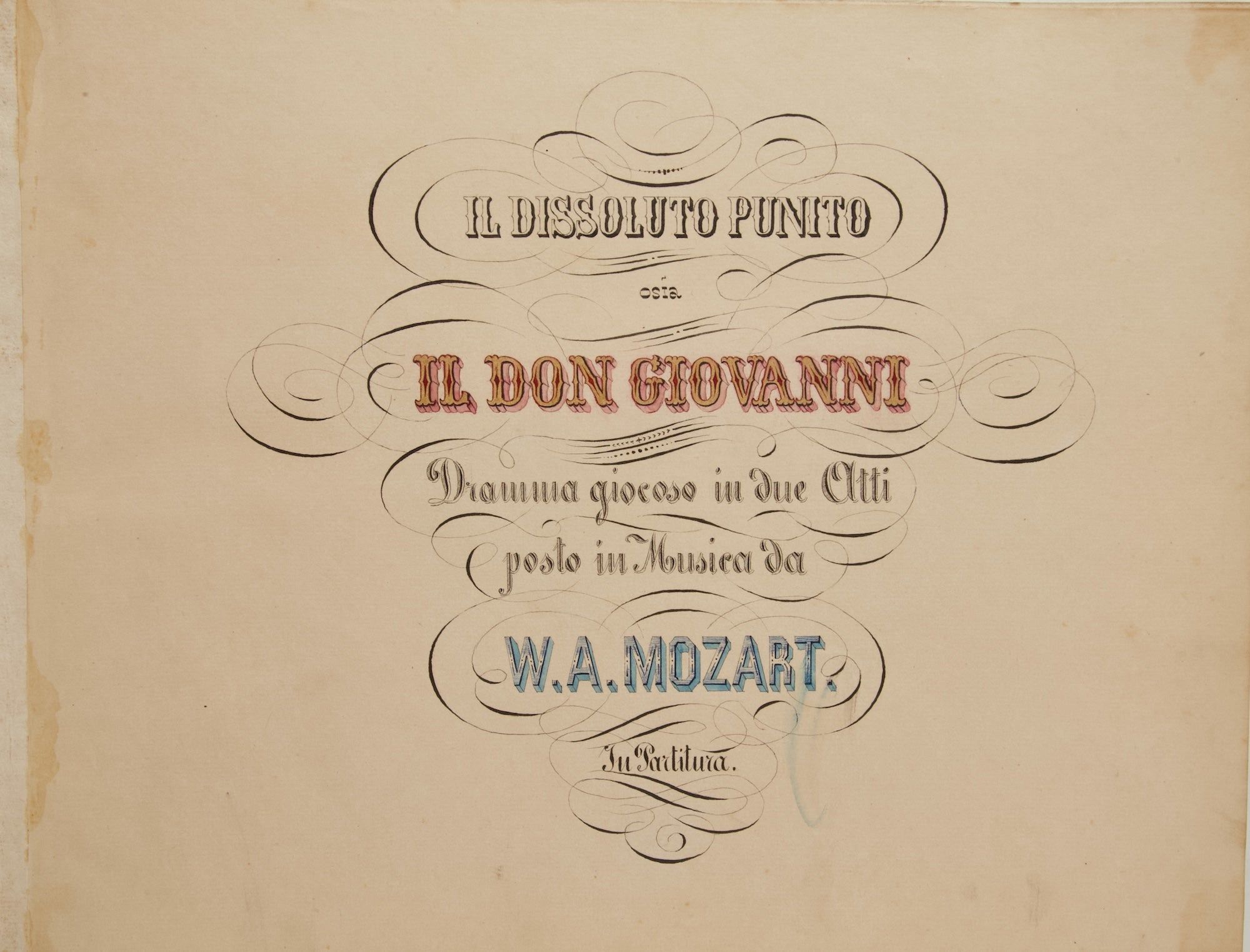
Il Dissoluto Punito osĩa Il Don Giovanni Dramma giocoso in due Atti posto in Musica da W.A. Mozart. In Partitura. [KV 527]. [Full score]. [Copyist manuscript]
- 1860
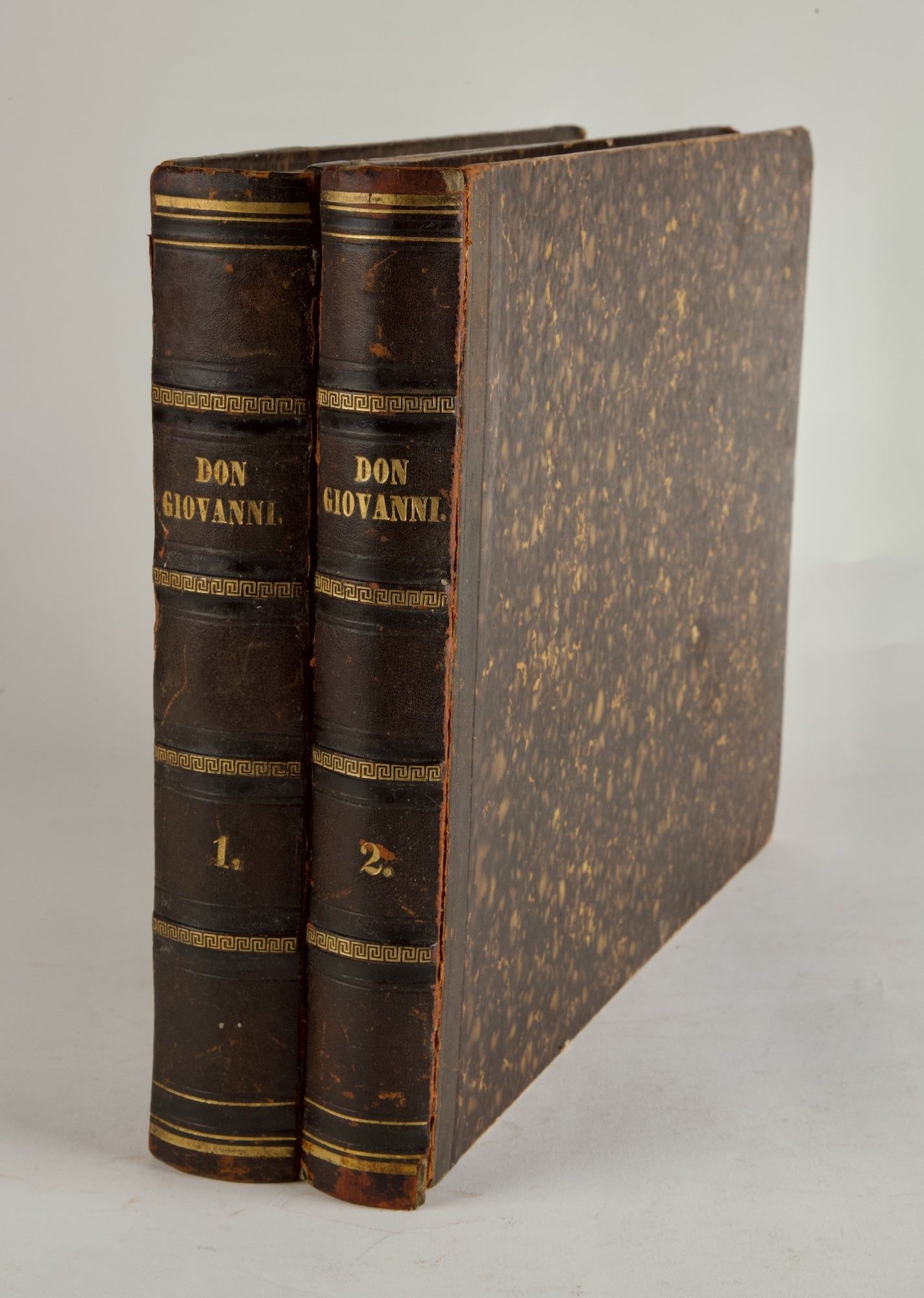
1860. 2 volumes. Oblong folio (241 x 312 mm). 19th century quarter black leather with marbled boards, raised bands on spine in compartments gilt with titling gilt.
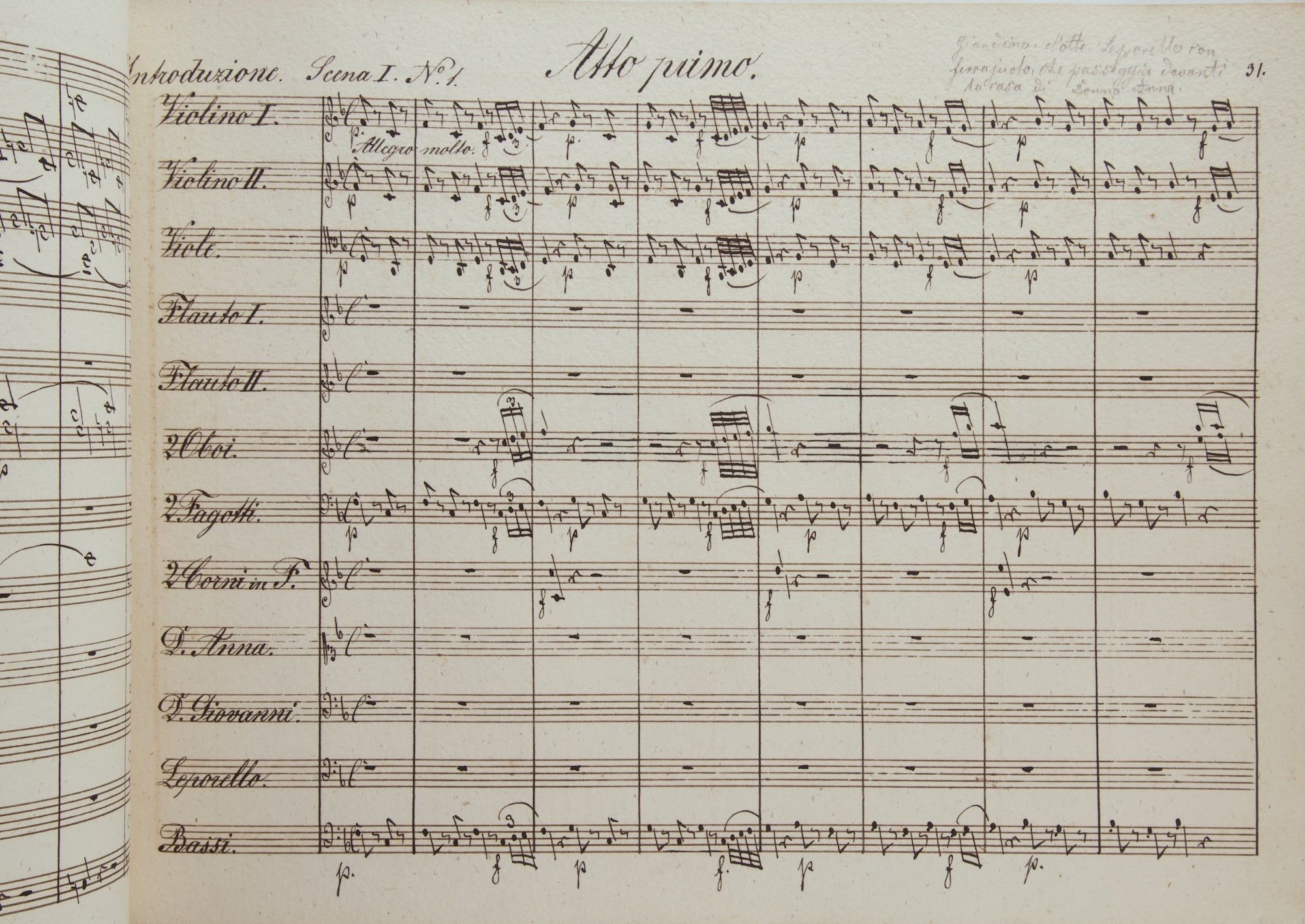
Notated in black on thick 12-stave rastrum-ruled paper, rendered in a precise, accomplished hand.
Vol. I
1f. (recto calligraphic title in blue, black, and gold, verso blank), 1f. (recto calligraphic "Atto Primo" in black and red ink, verso blank), 282 pp.
Vol. II
1f. (recto calligraphic "Atto Secondo" in black and red, verso blank), 283-520 pp.
Occasional annotations in Italian in pencil with stage directions from Da Ponte's libretto, occasionally attributed to the author as "(Da Ponte)" or "(D.P.)." Additional notes include "Segue Recitativo secco Vol. II p. 550" in Vol. I and "Segue Scena IX Vol. I p. 126 e Duettino p. 128," indicating that this was, in all probability, a conductor or director's score.
Binding worn, rubbed, and bumped. Slightly worn; title of Vol. I reinforced with narrow strip of white paper tape to inner margin. First performed on 29 October 1797 in Prague, "[Don Giovanni] was the second operatic collaboration of Mozart and his librettist Lorenzo da Ponte, who, some fifteen months earlier, had had a great success with their Le nozze di Figaro. Their third and last opera together was to be Così fan tutte. This triumvirate of masterworks has earned them their current reputation as one of the world's greatest opera-writing teams." Zaslaw and Cowdery, p. 61
"Don Giovanni is governed by a single idea, Giovanni’s flouting of society in pursuit of sexual pleasure, which binds together a disparate set of ambivalent or comic incidents. The libretto has been unfairly criticized; its episodic nature is a condition of the subject, in which respect it differs from Figaro and Così. Divine retribution appears like an act of God, or a different kind of life-force personified in the statue; what in previous treatments had been comic, perfunctory or merely gruesome, is raised to sublimity by Mozart’s music." Julian Rushton in Grove Music Online
The present manuscript appears to be a copy of the first edition of the full score published in Leipzig by Breitkopf & Härtel in 1801. The decorative calligraphic quality and care exhibited throughout would suggest that it may have been prepared on commission for an Italian conductor.
Notated in black on thick 12-stave rastrum-ruled paper, rendered in a precise, accomplished hand.
Vol. I
1f. (recto calligraphic title in blue, black, and gold, verso blank), 1f. (recto calligraphic "Atto Primo" in black and red ink, verso blank), 282 pp.
Vol. II
1f. (recto calligraphic "Atto Secondo" in black and red, verso blank), 283-520 pp.
Occasional annotations in Italian in pencil with stage directions from Da Ponte's libretto, occasionally attributed to the author as "(Da Ponte)" or "(D.P.)." Additional notes include "Segue Recitativo secco Vol. II p. 550" in Vol. I and "Segue Scena IX Vol. I p. 126 e Duettino p. 128," indicating that this was, in all probability, a conductor or director's score.
Binding worn, rubbed, and bumped. Slightly worn; title of Vol. I reinforced with narrow strip of white paper tape to inner margin. First performed on 29 October 1797 in Prague, "[Don Giovanni] was the second operatic collaboration of Mozart and his librettist Lorenzo da Ponte, who, some fifteen months earlier, had had a great success with their Le nozze di Figaro. Their third and last opera together was to be Così fan tutte. This triumvirate of masterworks has earned them their current reputation as one of the world's greatest opera-writing teams." Zaslaw and Cowdery, p. 61
"Don Giovanni is governed by a single idea, Giovanni’s flouting of society in pursuit of sexual pleasure, which binds together a disparate set of ambivalent or comic incidents. The libretto has been unfairly criticized; its episodic nature is a condition of the subject, in which respect it differs from Figaro and Così. Divine retribution appears like an act of God, or a different kind of life-force personified in the statue; what in previous treatments had been comic, perfunctory or merely gruesome, is raised to sublimity by Mozart’s music." Julian Rushton in Grove Music Online
The present manuscript appears to be a copy of the first edition of the full score published in Leipzig by Breitkopf & Härtel in 1801. The decorative calligraphic quality and care exhibited throughout would suggest that it may have been prepared on commission for an Italian conductor.