

The Epistle of Gildas, The most Ancient British Author: Who flourished in the yeere of our Lord, 546. And who by his great Erudition, Sanctitie, and Wisedome, acquired the name of Sapiens. Faithfully Translated out of the Originall Latine
- Leather Bound
- London: Printed by T. Cotes, for William Cooke, 1638
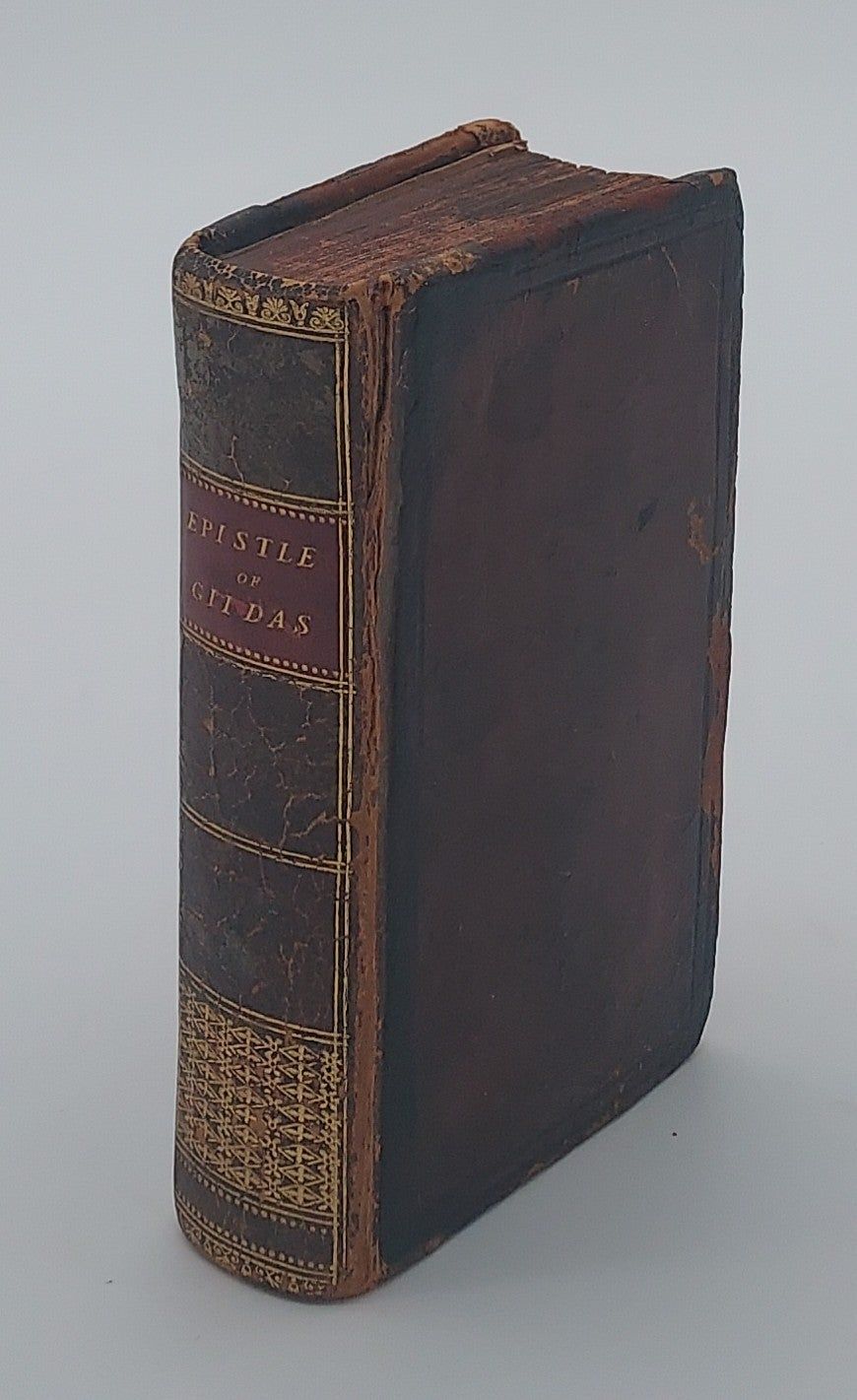
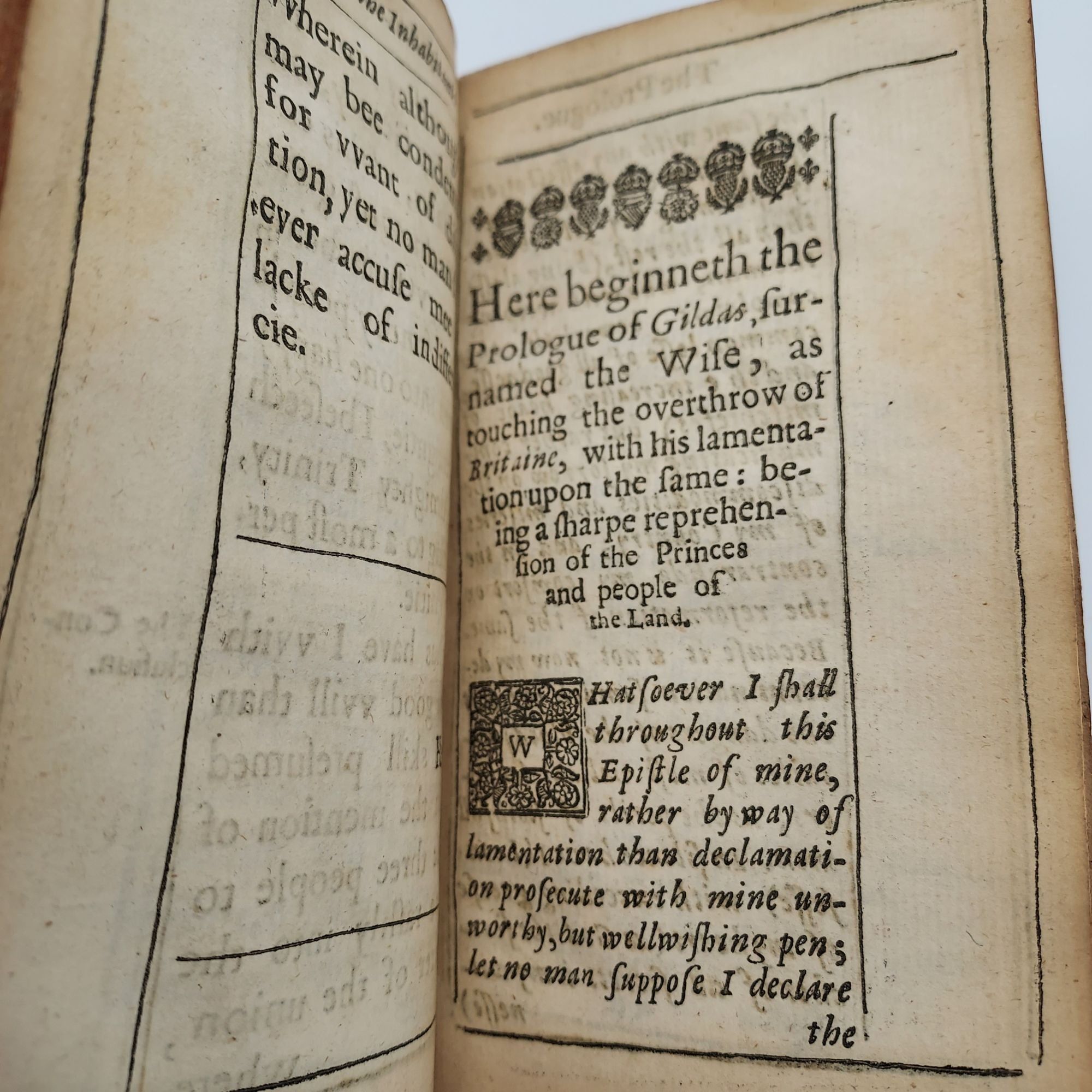
London: Printed by T. Cotes, for William Cooke, 1638. First edition in English. Leather Bound. Good. 327 numbered pages. Twentyfourmo [14.5 cm] Full brown leather, with a red leather spine label, decorative gilt tooling to the spine, and double blind-ruled borders on the boards. Later endpapers (circa 18th-19th century?). Lacking the frontispiece portrait. Extremities rubbed. Cracks to the head of the spine along the joints (the longer crack, along the front joint measures 1 inch). Leather boards darkened at the edges. Ownership inscription "C Humphreys 1746" on front flyleaf. Two contemporary notations on the title page. A single manuscript notation within the text. One gathering hanging by a thread. Text block cracked at p. 317, and pp. 317-322 are partially detached. Small stains in the top margins of pp. 40-162 of "The Epistle." P. 286 is numbered as p. 287 and vice versa.
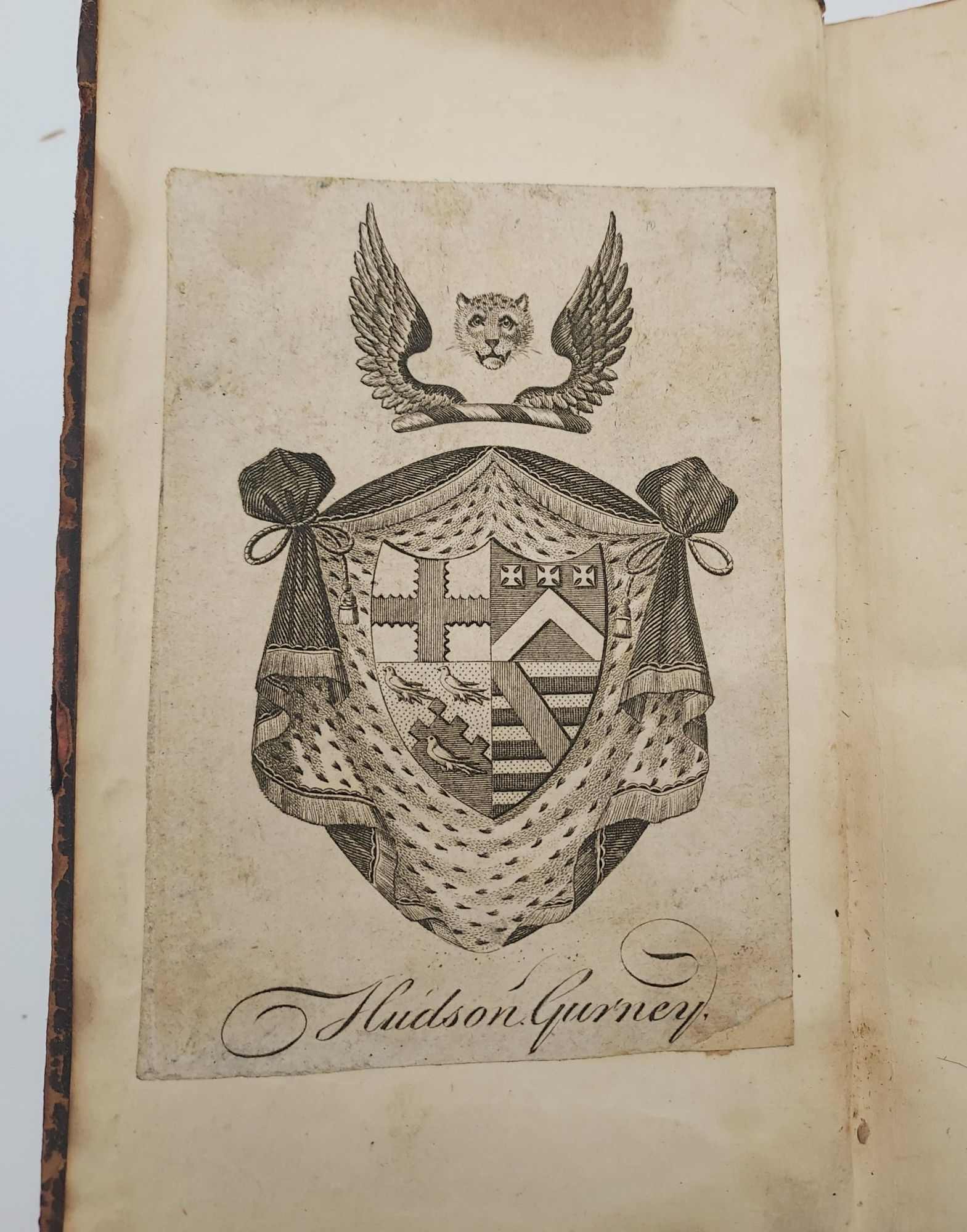
Ex-libris English antiquary, verse-writer, and politician Hudson Gurney of Norwich (1775-1864), with his armorial bookplate on the front pastedown. Hudson, a highly acclaimed intellectual and bibliophile, avowed to have read all 15,000 volumes in his library, and was a fellow of the Royal Society and the vice president of the Society of Antiquaries. His own verse works include the free translations of "Cupid and Psyche" (1798) and "The Orlando Furiosa" (1808), and his chronicle of major events in ancient history, "Heads of Ancient History" (1814). His "Observations on the Bayeux Tapestry" (1817) presented an argument for the authenticity of its subject. He made numerous contributions in Parliament, where he was viewed as an independent, who tended to see both sides of every question. The book opens with a note on the translation, which is followed by an unpaginated section titled "To the Inhabitants of the Island of great Britaine, Unitie and Felicity."
Gildas was a 6th century British monk and historian, who lived for many years as an ascetic hermit on Flatholm Island in the Bristol Channel, and was known for his piety and good education. He founded a monastery in Brittany known as St. Gildas de Rhuys. His "De excidio et conquestu Britanniae" ("The Overthrow and Conquest of Britain") is one of a handful of sources for the country's post-Roman history. This work, "The Epistle of Gildas," is a longer work, which is a series of sermons on the moral failures of rulers and of the clergy.
A work by one of the most influential figures of the early English Church.
Ex-libris English antiquary, verse-writer, and politician Hudson Gurney of Norwich (1775-1864), with his armorial bookplate on the front pastedown. Hudson, a highly acclaimed intellectual and bibliophile, avowed to have read all 15,000 volumes in his library, and was a fellow of the Royal Society and the vice president of the Society of Antiquaries. His own verse works include the free translations of "Cupid and Psyche" (1798) and "The Orlando Furiosa" (1808), and his chronicle of major events in ancient history, "Heads of Ancient History" (1814). His "Observations on the Bayeux Tapestry" (1817) presented an argument for the authenticity of its subject. He made numerous contributions in Parliament, where he was viewed as an independent, who tended to see both sides of every question. The book opens with a note on the translation, which is followed by an unpaginated section titled "To the Inhabitants of the Island of great Britaine, Unitie and Felicity."
Gildas was a 6th century British monk and historian, who lived for many years as an ascetic hermit on Flatholm Island in the Bristol Channel, and was known for his piety and good education. He founded a monastery in Brittany known as St. Gildas de Rhuys. His "De excidio et conquestu Britanniae" ("The Overthrow and Conquest of Britain") is one of a handful of sources for the country's post-Roman history. This work, "The Epistle of Gildas," is a longer work, which is a series of sermons on the moral failures of rulers and of the clergy.
A work by one of the most influential figures of the early English Church.