

Glorious Phantom
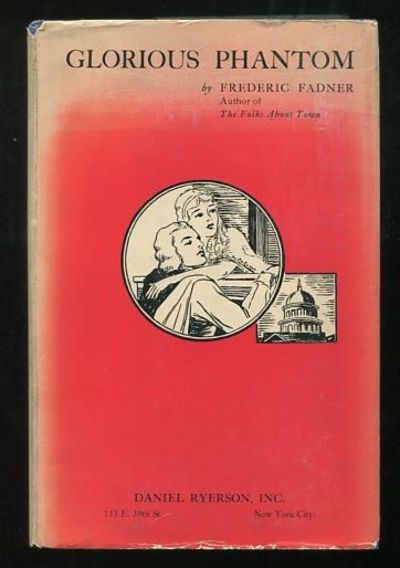
- Hardcover
- New York: Daniel Ryerson, Inc., (c.1937)
New York: Daniel Ryerson, Inc.. Very Good+ in Good dj. (c.1937). First Edition. Hardcover. [minor wear to extremities, very slight fraying of cloth at top of spine, faint bookseller's stamped name at bottom corner of front pastedown (Bertrand Smith Acres of Books, Long Beach, California); the jacket is edgeworn, with uneven fading to the front panel, a quarter-size chip at the top of the spine and some shallow paper loss at the base of the spine]. A novel of "love and politics," having to do with a romance between the "beautiful and brilliant daughter of [the] president of the Consolidated Edison Company" and the son of a small printer who little dreamed "that on that eventful day when Senator Walsh of Montana introduced a famous bill in Congress, calling for an investigation of public utilities, that he would eventually be drawn into the campaign of 1928." Notwithstanding the rather weird jacket illustration, which makes these modern-day lovers look like something out of a 17th-century costume drama, there's some real historical background here: according to a contemporary newspaper account, the author found his inspiration "entombed in the basement of a university library," in the form of the transcripts and documents related to the Federal Trade Commission's "sweeping investigation of the power industry," out of which he concocted "a fictional narrative as the vehicle for converting them into a form suitable for popular consumption." (This was, in fact, kicked off by Senator Thomas J. Walsh of Montana, who in late 1927 introduced the resolution that ultimately led to that investigation. Chapter 12 includes a factual account of the U.S. Senate's deliberation and passage of said resolution, along a party-line vote in February 1928.) The jacket blurb refers to the book's plot as "a struggle of two rival houses, symbolizing two opposed political theories," which I guess means those young canoodlers on the jacket are meant to evoke Mr. Montague and Miss Capulet. The rear jacket flap presents a little exchange of dialogue between the author and the publisher, in which the latter quotes a "professional critic" as saying the book's "analysis of democracy is both shrewd and clever," and that it's his own opinion that it "should be read by every voter in America, as well as by every man running for office" -- to which the author responds that "if it were read by everyone already in office, maybe some of them would resign." .