

Q. And Babies? / A. And Babies
- New York: Art Workers Coalition, [1970]
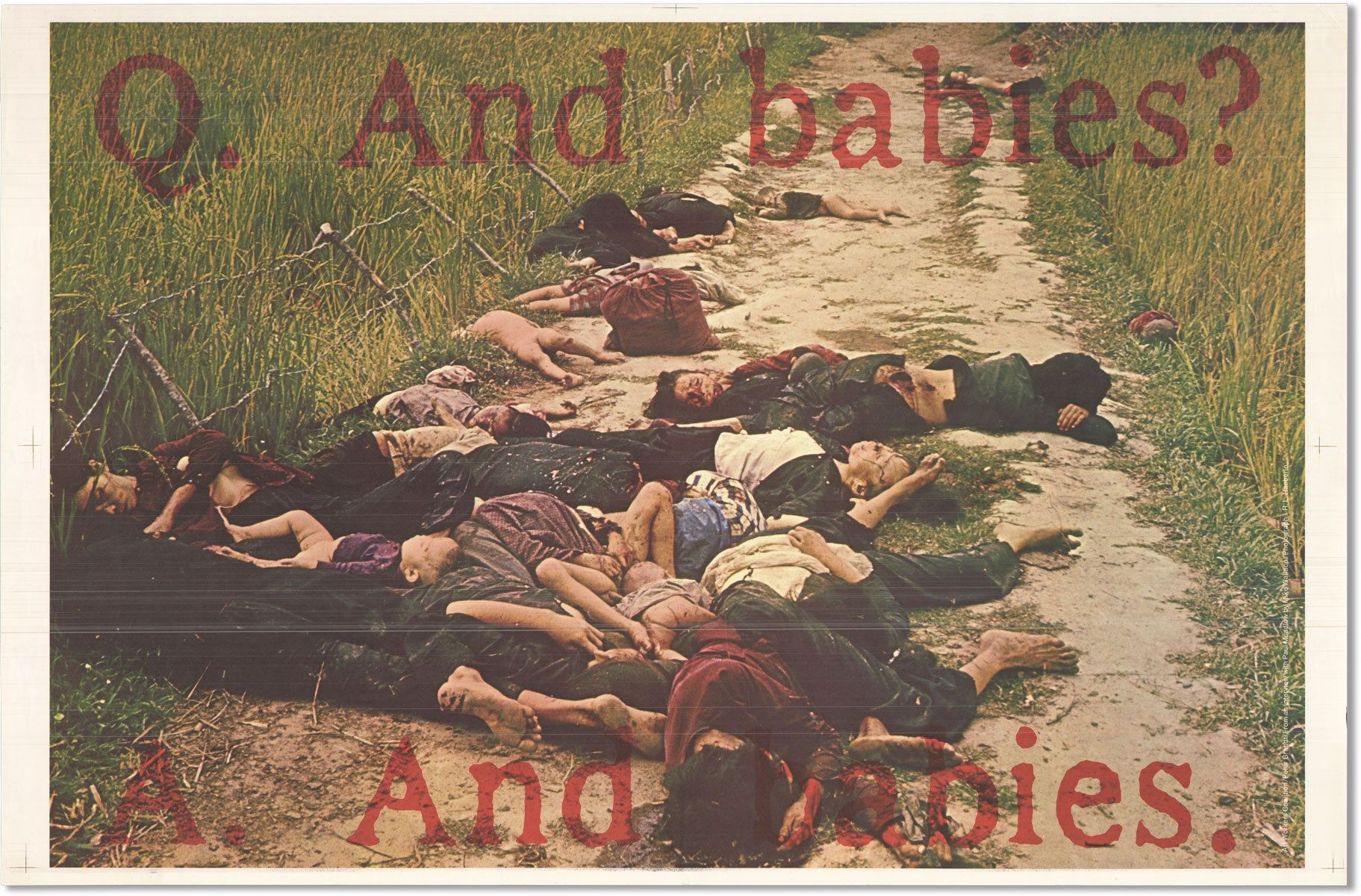
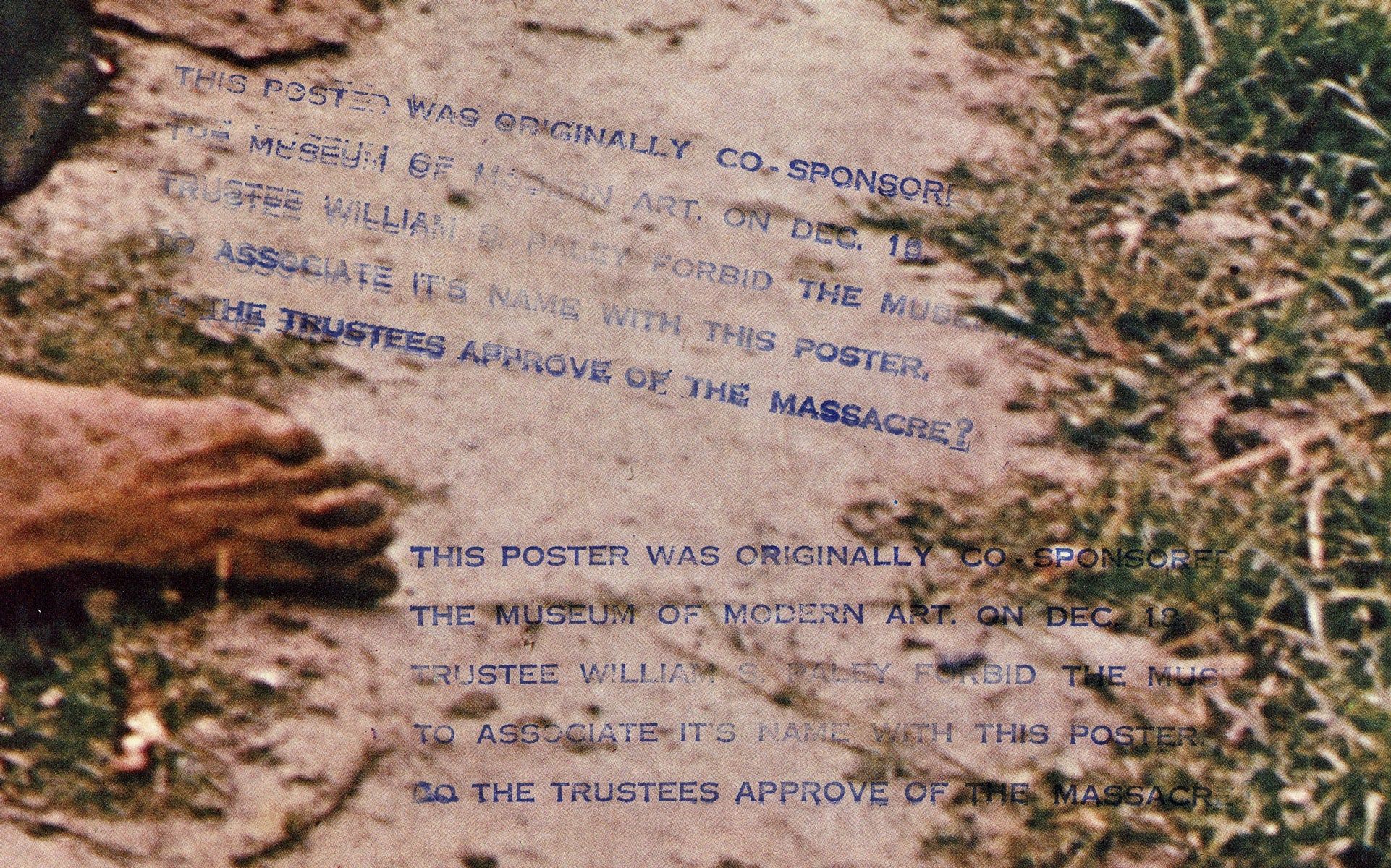
New York: Art Workers Coalition, [1970]. Offset lithograph in colors; 64cm x 97cm (25" x 38"). Mild creasing to extremities, else a fine, clean copy; unbacked. This one of a presumably small number of copies bearing a rubber-stamped message which reads: "This poster was originally co-sponsored by the Museum of Modern Art. On Dec. 19, trustee William S. Paley forbid the Museum to associate its name with this poster. Do the Trustees approve of the massacre?" (stamped twice in the image, lower right).
One of the true icons of Twentieth Century American protest art, this poster, created by the Art Workers Coalition under the guidance of Fraze Dougherty, Jon Hendricks and Irving Petlin, was issued to bring attention to the horrendous My Lai massacre of March, 1968. The photograph, by Ron Haeberle, originally appeared in Life Magazine. The Museum of Modern Art had originally promised to underwrite the poster's creation, and to donate paper and printing costs – but later abandoned the project under the objections of board President William S. Paley. The AWC still managed to print fifty thousand copies, which they distributed for free. As a response to MoMA's backing out of the project, an unknown number of the posters were rubber-stamped with the message quoted above, and a demonstration was held inside the museum, in front of Picasso's Guernica, where copies of the poster were unfurled and given away. These events are recorded in a 2015 interview with co-creator John Hendricks: "...We had a big meeting of Art Workers’ Coalition about how we should address their [MoMA’s] reneging of the agreement with us. It was decided to make a rubber stamp...saying, “This is the poster that the Museum of Modern Art agreed to do jointly with Art Workers’ Coalition and Bill Paley and Arthur Drexler refused to do,” or something like that. So we stamped as many posters as we could with that stamp. Then we had a number of demonstrations in front of the museum and inside in front of Guernica..." [interview with William Twersky, WT_History Blog, April, 2015]. We have traced no copies in commerce or institutional collections that make note of the rubber-stamped notice. In 1972, the design was repurposed to protest President Richard Nixon's campaign for a second term; for that version the motto was changed to "Four More Years? Four More Years?" 83515.
One of the true icons of Twentieth Century American protest art, this poster, created by the Art Workers Coalition under the guidance of Fraze Dougherty, Jon Hendricks and Irving Petlin, was issued to bring attention to the horrendous My Lai massacre of March, 1968. The photograph, by Ron Haeberle, originally appeared in Life Magazine. The Museum of Modern Art had originally promised to underwrite the poster's creation, and to donate paper and printing costs – but later abandoned the project under the objections of board President William S. Paley. The AWC still managed to print fifty thousand copies, which they distributed for free. As a response to MoMA's backing out of the project, an unknown number of the posters were rubber-stamped with the message quoted above, and a demonstration was held inside the museum, in front of Picasso's Guernica, where copies of the poster were unfurled and given away. These events are recorded in a 2015 interview with co-creator John Hendricks: "...We had a big meeting of Art Workers’ Coalition about how we should address their [MoMA’s] reneging of the agreement with us. It was decided to make a rubber stamp...saying, “This is the poster that the Museum of Modern Art agreed to do jointly with Art Workers’ Coalition and Bill Paley and Arthur Drexler refused to do,” or something like that. So we stamped as many posters as we could with that stamp. Then we had a number of demonstrations in front of the museum and inside in front of Guernica..." [interview with William Twersky, WT_History Blog, April, 2015]. We have traced no copies in commerce or institutional collections that make note of the rubber-stamped notice. In 1972, the design was repurposed to protest President Richard Nixon's campaign for a second term; for that version the motto was changed to "Four More Years? Four More Years?" 83515.