

Minutes of the Valdosta, Georgia Chapter of the Phillis Wheatley Club for July 28, 1916 to June 22, 1921
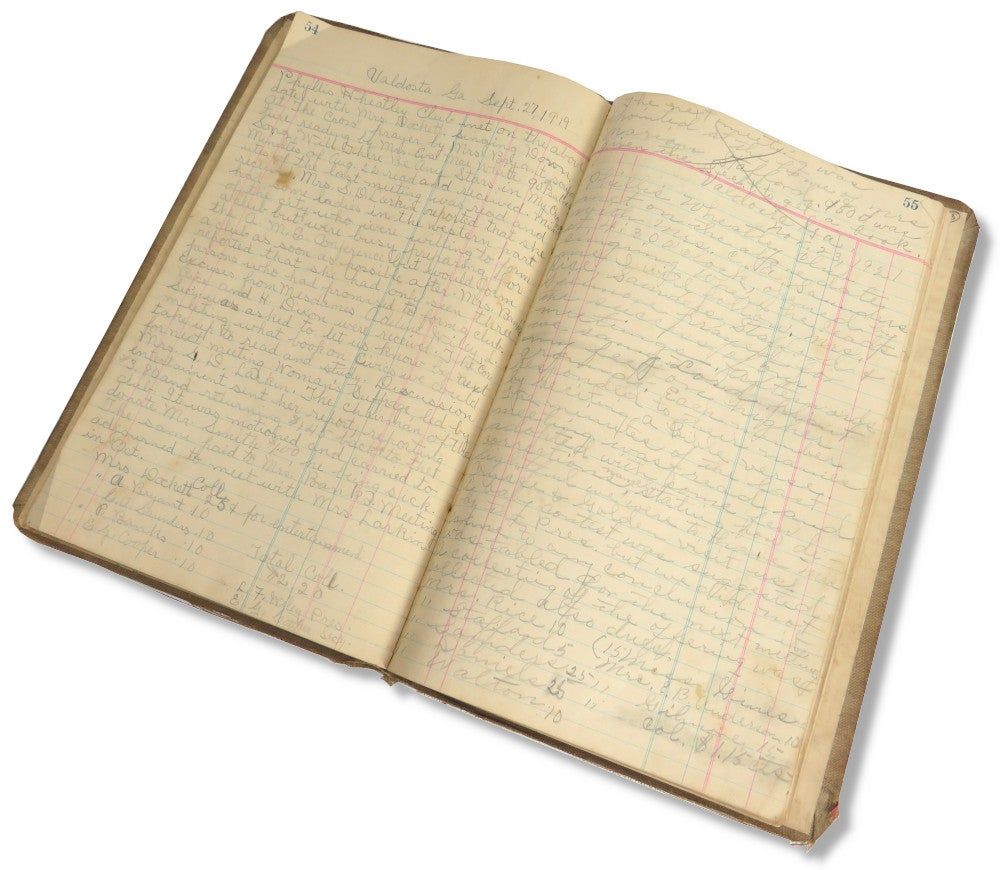
- Valdosta, GA , 1921
Valdosta, GA, 1921. Commercial ledger, 100pp, 82pp [5 blank] of which are minutes of meetings in holographic pencil, the remainder being the roll for January and June of 1920; Financial roll and Committees for 1918; Names of for 1917; financial roll for 1917 and 1917; members names and financial roll for 1920; member roll and financial report for 1916. Why the latter entries are out of order isn't clear, but it could be that the information was transcribed from elsewhere at a later date supporting our supposition that this journal starts very early in the club’s formation. There is no record of this particular branch of the Phillis Wheatley Club in Valdosta. However, a later Phillis Wheatley Club was formed in the area in the late 1930s, and even had its own building in the city. Some of these incarnations of the club were closely associated with the YWCA and benefited from the support these larger, more well-funded organizations could provide.
These minutes belong to a smaller, earlier club which started in the 1890s. These smaller Phillis Wheatley clubs tended to be local affairs organized by women who might know each other from church or other social activities. They were formed by African-American women who were usually excluded from other clubs because of their race. Formed to promote the advancement and wellbeing of the African-American community, they also engaged in numerous forms of community outreach. This Valdosta chapter worked with a local newspaper to find ways to keep young boys and girls off the streets.
The journal starts with an entry for July 28, 1916, and while it notes that there was earlier business, implying an earlier meeting, the feeling and content give the impression that this was a very early gathering of the club. Throughout the minutes, the most often discussed topics were future meetings, vetting of new members, and how the club interacted with other organizations in the city, including the Colored Women City Federation Club, Merry Matron Club, and others, including at least one men’s club.
As the years passed on, membership seemed to be dwindling. There was talk around the summer of 1919 of doing more outreach to form new clubs and engage in local uplift work, and talk of engaging a speaker on Women’s suffrage in the fall of that year.
While we can’t locate any specific information on this chapter, from our reading of the journal, it seems that it ended in 1919-20 on a strong note, doing charity work for children in Valdosta.
Overall a fascinating document rich in names, giving a glimpse into the lives of educated African-American Women in the south in the years before and after the first World War.
These minutes belong to a smaller, earlier club which started in the 1890s. These smaller Phillis Wheatley clubs tended to be local affairs organized by women who might know each other from church or other social activities. They were formed by African-American women who were usually excluded from other clubs because of their race. Formed to promote the advancement and wellbeing of the African-American community, they also engaged in numerous forms of community outreach. This Valdosta chapter worked with a local newspaper to find ways to keep young boys and girls off the streets.
The journal starts with an entry for July 28, 1916, and while it notes that there was earlier business, implying an earlier meeting, the feeling and content give the impression that this was a very early gathering of the club. Throughout the minutes, the most often discussed topics were future meetings, vetting of new members, and how the club interacted with other organizations in the city, including the Colored Women City Federation Club, Merry Matron Club, and others, including at least one men’s club.
As the years passed on, membership seemed to be dwindling. There was talk around the summer of 1919 of doing more outreach to form new clubs and engage in local uplift work, and talk of engaging a speaker on Women’s suffrage in the fall of that year.
While we can’t locate any specific information on this chapter, from our reading of the journal, it seems that it ended in 1919-20 on a strong note, doing charity work for children in Valdosta.
Overall a fascinating document rich in names, giving a glimpse into the lives of educated African-American Women in the south in the years before and after the first World War.