

Phillis Wheatley, Negro Servant to Mr. John Wheatley, of Boston
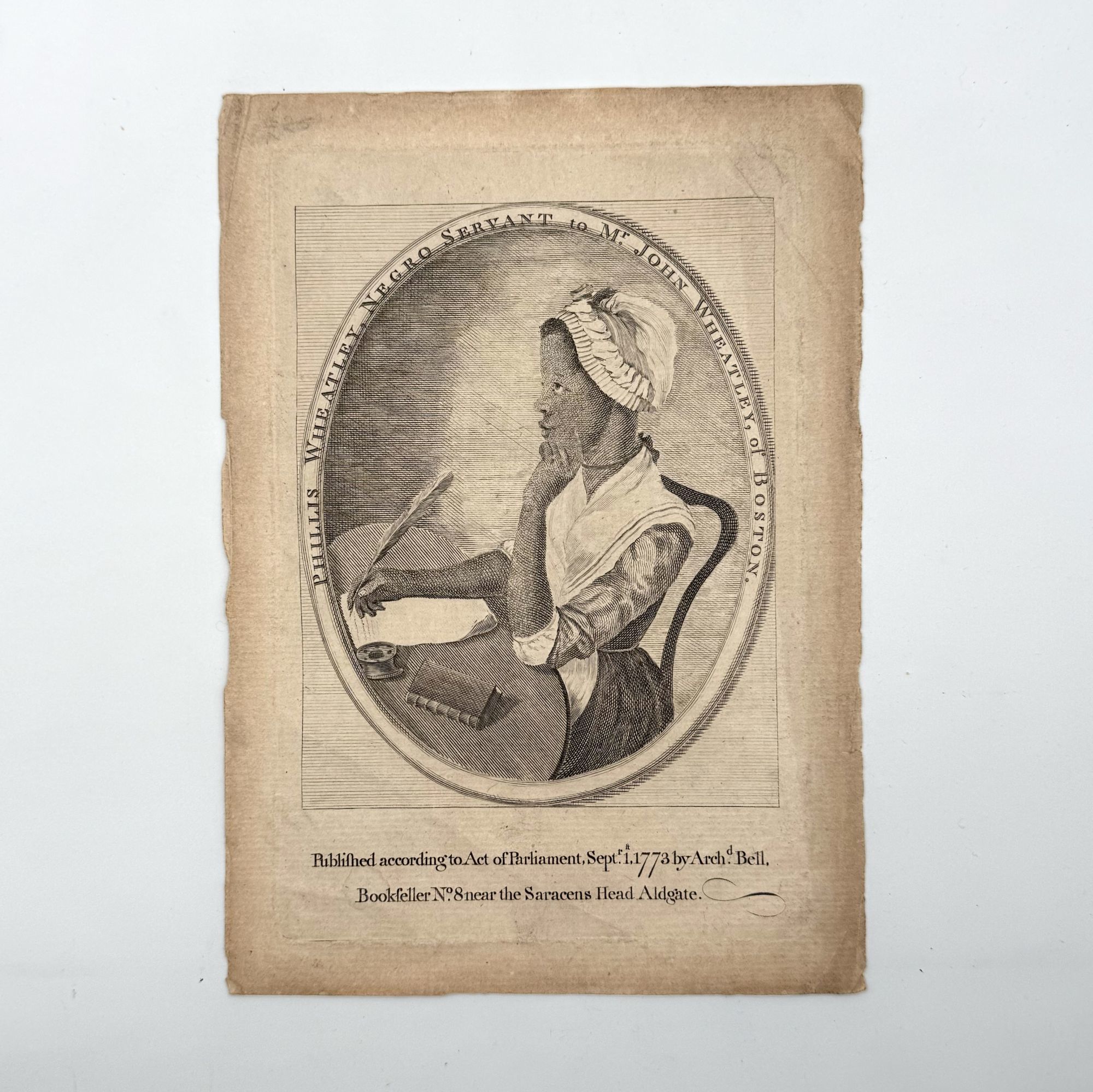
- Engraving, on laid paper. Sheet size: 183 x 134 mm. Plate mark: 165 x 110 mm
- London: Archibald Bell, 1773
London: Archibald Bell, 1773. State B.. Engraving, on laid paper. Sheet size: 183 x 134 mm. Plate mark: 165 x 110 mm. Lightly toned at margins, faint soiling. State B. Engraving, on laid paper. Sheet size: 183 x 134 mm. Plate mark: 165 x 110 mm. Phillis Wheatley was the “‘first colonial American woman of any race to have her portrait printed alongside her writings’” and the “first woman of sub-Saharan African descent to sit for an individualized portrait” (Carretta, and citing Gwendolyn DuBois Shaw). This unbound and wide-margined copy of Phillis Wheatley’s portrait may be the only extant physical evidence confirming that her likeness was sold as a print during the eighteenth century.
While details regarding the advertising and sale of Wheatley’s portrait are sparse, historical evidence unequivocally demonstrates that her portrait, printed from the same plate as was used to print the frontispiece to her poems, was independently circulated and sold as a print during this era.
In 1791, William Richardson, “Printseller of the Strand,” active between 1778–1815, issued a 127-page catalogue of prints for sale at his late father’s “Print Warehouse.” On page 35, within a section entitled, “Engraved Portraits,” customers could purchase a print of Phillis Wheatley from Richardson for one shilling. Nine years later, beginning on Monday, February 3, 1800, Richardson began a thirty-one day sale with a catalogue he issued entitled British portraits. A Catalogue of a Genuine and Extensive Collection of English Portraits Consisting of the Royal Families, Peers, Gentry, Clergy, Lawyers, Military, Literary, Artists, Actors, Writing-Masters, Musicians, Female Sex, Phenomena, Convicts, Monsters, &c. From Egbert the Great to the Present Time [...] Proofs, many Private Plates, and Unique Prints, not to be found in any other Collection… [London, 1800]. Richardson titled his 1800 catalog loosely based on Henry Bromley’s massive and hierarchically-arranged Catalogue of Engraved British Portraits, from Egbert the Great to the Present Time. Consisting of the Effigies of Persons in Every Walk of Human Life…, originally published in 1793. Bromley’s tome included Phillis Wheatley’s likeness, signifying its importance. His book organized subjects by historical period and social status, with the highest class being “Royals” (Class I) and the lowest being “Phaenomena, Convicts, and Persons otherwise remarkable” (Class X). Wheatley was categorized on this bottommost rung, described as “Phillis Wheatley, ‘Negress of Boston. N. England.’— prefixed to her ‘Poems,’1773, 8vo.” (p457). In his 1800 Catalogue, marking at least the second time he offered her portrait for sale, Richardson took it upon himself to elevate Wheatley’s social status by one tier, perhaps to increase its retail value. On day 30 of his sale, he advertised her portrait within his catalog’s Class IX section of “Gentlewomen,” lot 75: “Five—Phillis Wheatley, &c.”
Eighteenth-century booksellers also found commercial value in Wheatley’s likeness. In 1787/8, Thomas King’s catalogue advertised Wheatley’s book as a “Negro’s Poems on Divine and Moral Subjects,” emphasizing his copy as “with portrait,” in italics. This was item 4700 of
4708 titles, and one of just eighteen titles that drew attention to its portrait. (p133) King priced his print of Wheatley at one shilling, mirroring Richardson’s pricing strategy. Elsewhere, such as in Thomas Egerton’s 1798 catalogue, the commercial appeal of Wheatley’s portrait was also evident and specifically highlighted: “Phillis Wheatley’s Poems, head [italicized], 1s 6d 1773.” (Item 6314, p209).
Two 1773 editions of Wheatley’s Poems on Various Subjects, Religious and Moral were printed for Archibald Bell in London. After the first edition was issued, a second edition with reset text appeared. Overestimated demand for the second edition led to remaindered sheets, later used for a 1787 edition (Stoddard & Whitesell). Wheatley’s inserted portrait is known in two states, A. and B. It was likely printed by a plate printer and not by the letterpress printer. All evidence suggests that only one plate existed and that the portrait must have been printed one example at a time.
Compared to other examples of the portrait we have examined, its variations can be attributed to differences in inking and plate wear. We offer two interpretations: 1. The present item is an unbound copy from the surplus prints of the portrait produced for the second edition, later utilized in the 1787 edition. From this surplus, it was possibly marketed as a print. 2. It was separately printed as a standalone portrait print, distinct from the surplus sheets. It was then advertised for sale by printsellers, such as the aforementioned William Richardson.
Scholars, bibliographers, and booksellers are familiar with Wheatley’s portrait, as it was utilized as the inserted frontispiece within the 1773 editions of her book. Almost without exception, it was heavily trimmed by the original binder. Given that the present item is unbound and boasts a remarkable sheet size with ample margins, we suggest that these characteristics indicate it was likely sold as a print from the surplus plate engravings of 1773, if not specifically printed off as a print in 1773 or in the years following. Stoddard and Whitesell 233/7, pp243–247;312. Carretta, Vincent. Phillis Wheatley Peters. Biography of a Genius in Bondage. (Athens, 2023)
While details regarding the advertising and sale of Wheatley’s portrait are sparse, historical evidence unequivocally demonstrates that her portrait, printed from the same plate as was used to print the frontispiece to her poems, was independently circulated and sold as a print during this era.
In 1791, William Richardson, “Printseller of the Strand,” active between 1778–1815, issued a 127-page catalogue of prints for sale at his late father’s “Print Warehouse.” On page 35, within a section entitled, “Engraved Portraits,” customers could purchase a print of Phillis Wheatley from Richardson for one shilling. Nine years later, beginning on Monday, February 3, 1800, Richardson began a thirty-one day sale with a catalogue he issued entitled British portraits. A Catalogue of a Genuine and Extensive Collection of English Portraits Consisting of the Royal Families, Peers, Gentry, Clergy, Lawyers, Military, Literary, Artists, Actors, Writing-Masters, Musicians, Female Sex, Phenomena, Convicts, Monsters, &c. From Egbert the Great to the Present Time [...] Proofs, many Private Plates, and Unique Prints, not to be found in any other Collection… [London, 1800]. Richardson titled his 1800 catalog loosely based on Henry Bromley’s massive and hierarchically-arranged Catalogue of Engraved British Portraits, from Egbert the Great to the Present Time. Consisting of the Effigies of Persons in Every Walk of Human Life…, originally published in 1793. Bromley’s tome included Phillis Wheatley’s likeness, signifying its importance. His book organized subjects by historical period and social status, with the highest class being “Royals” (Class I) and the lowest being “Phaenomena, Convicts, and Persons otherwise remarkable” (Class X). Wheatley was categorized on this bottommost rung, described as “Phillis Wheatley, ‘Negress of Boston. N. England.’— prefixed to her ‘Poems,’1773, 8vo.” (p457). In his 1800 Catalogue, marking at least the second time he offered her portrait for sale, Richardson took it upon himself to elevate Wheatley’s social status by one tier, perhaps to increase its retail value. On day 30 of his sale, he advertised her portrait within his catalog’s Class IX section of “Gentlewomen,” lot 75: “Five—Phillis Wheatley, &c.”
Eighteenth-century booksellers also found commercial value in Wheatley’s likeness. In 1787/8, Thomas King’s catalogue advertised Wheatley’s book as a “Negro’s Poems on Divine and Moral Subjects,” emphasizing his copy as “with portrait,” in italics. This was item 4700 of
4708 titles, and one of just eighteen titles that drew attention to its portrait. (p133) King priced his print of Wheatley at one shilling, mirroring Richardson’s pricing strategy. Elsewhere, such as in Thomas Egerton’s 1798 catalogue, the commercial appeal of Wheatley’s portrait was also evident and specifically highlighted: “Phillis Wheatley’s Poems, head [italicized], 1s 6d 1773.” (Item 6314, p209).
Two 1773 editions of Wheatley’s Poems on Various Subjects, Religious and Moral were printed for Archibald Bell in London. After the first edition was issued, a second edition with reset text appeared. Overestimated demand for the second edition led to remaindered sheets, later used for a 1787 edition (Stoddard & Whitesell). Wheatley’s inserted portrait is known in two states, A. and B. It was likely printed by a plate printer and not by the letterpress printer. All evidence suggests that only one plate existed and that the portrait must have been printed one example at a time.
Compared to other examples of the portrait we have examined, its variations can be attributed to differences in inking and plate wear. We offer two interpretations: 1. The present item is an unbound copy from the surplus prints of the portrait produced for the second edition, later utilized in the 1787 edition. From this surplus, it was possibly marketed as a print. 2. It was separately printed as a standalone portrait print, distinct from the surplus sheets. It was then advertised for sale by printsellers, such as the aforementioned William Richardson.
Scholars, bibliographers, and booksellers are familiar with Wheatley’s portrait, as it was utilized as the inserted frontispiece within the 1773 editions of her book. Almost without exception, it was heavily trimmed by the original binder. Given that the present item is unbound and boasts a remarkable sheet size with ample margins, we suggest that these characteristics indicate it was likely sold as a print from the surplus plate engravings of 1773, if not specifically printed off as a print in 1773 or in the years following. Stoddard and Whitesell 233/7, pp243–247;312. Carretta, Vincent. Phillis Wheatley Peters. Biography of a Genius in Bondage. (Athens, 2023)