

Dr. Partridge's Almanack for 1935; With an Account of his Resurrection from the Grave after lying dead in it for two centuries.
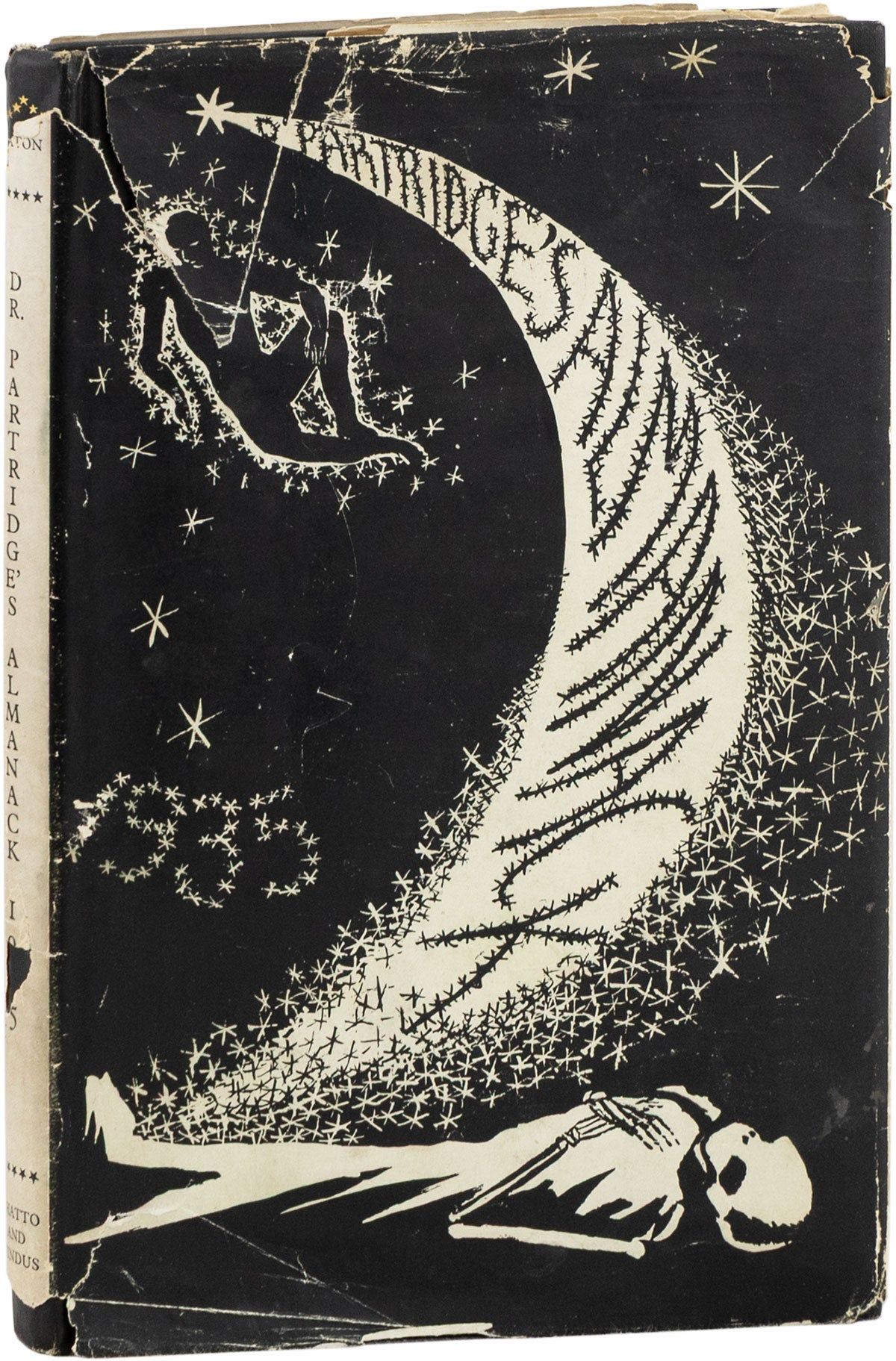
- London: Chatto and Windus, 1934
London: Chatto and Windus, 1934. First U.K. Edition. Octavo. 23cm. Publisher's black cloth boards titled in gilt to spine. Dustjacket. 65pp. Bumped to spine ends and corners, with a slight lean, and a small tear to the cloth at the head of the spine, bright and clean; internally clean, fore-edge untrimmed, handsome paper stock, inscribed by the author to the artist Augustus John on the front flyleaf; in a dustwrapper that has seen some wear with loss and creasing to the spine ends, a triangle of loss to the lower third of the spine panel, uniform fading, marginal chipping and some tape reinforcement to the verso. A very good copy by dint of solidity and association, in the scarce jacket, that has perhaps seen better days, but not recently and not in front of any reliable witnesses.
The inscription reads "Augustus John, from Gerald Brenan" with the later pencilled addition of his pseudonym below. In 1922 John stayed with Brenan in his remarkable self-imposed exile in Spain, in the tiny village of Yegen, found in the Granadan Alpujarra. The stay was commemorated by, among other things, a photograph album of John, his family, Brenan, and a number of other subjects taken by John Hope-Johnstone, which now resides in the National Portrait Gallery in London. Hope-Johnstone, Brenan's life-long companion, had originally set out with him to walk to China in the last years before WW1. The intrepid duo got as far as Bosnia before having to abandon their plan, and their future adventures were curtailed by the war. Both men immediately joined up, served, and returned to England where Hope-Johnstone introduced Brenan to his rather erratic group of friends, occasional lovers, and acquaintances, who would later become known as "The Bloomsbury Group".
Brenan, unable to handle the stultifying, pompous sterility of post war London, and chiefly to avoid any contact with his Kitchener-esque martinet of a father; fled to Spain where his tiny, solitary cottage became an informal vacation destination for Leonard and Virginia Woolf, Lytton Strachey (haemorrhoids and all), Dora Carrington (with whom Brenan had a vigorous affair), David Garnett, and just about every member of the Group who ever put pen to paper or brush to canvas. Augustus John and his boys were no exception, Duncan Grant stayed, Roger Fry visited, and Bertrand Russell made an extended holiday that, Withnail like, almost killed him when he ignored the advice of Brenan's housekeeper and wolfed down a can of rotten meat that had him delirious, hallucinating, and on the brink of death.
Brenan was more noted for his passionate works on Spain, earning him the admiration of Bruce Chatwin, who made a pilgrimage to see him in the early 1970's; but this piece of satirical weirdness, based on the 18th century Partridge Almanacks, with a series of arch twists, is one of his stranger contributions to literature. Aside from his poetic output, Brenan was also known for his crippling depression and loneliness, which rather than being amplified by his solitude, was in fact triggered into being by his attempts at normal social behavior. An interesting association, springing from mutual strangeness and admiration.
The inscription reads "Augustus John, from Gerald Brenan" with the later pencilled addition of his pseudonym below. In 1922 John stayed with Brenan in his remarkable self-imposed exile in Spain, in the tiny village of Yegen, found in the Granadan Alpujarra. The stay was commemorated by, among other things, a photograph album of John, his family, Brenan, and a number of other subjects taken by John Hope-Johnstone, which now resides in the National Portrait Gallery in London. Hope-Johnstone, Brenan's life-long companion, had originally set out with him to walk to China in the last years before WW1. The intrepid duo got as far as Bosnia before having to abandon their plan, and their future adventures were curtailed by the war. Both men immediately joined up, served, and returned to England where Hope-Johnstone introduced Brenan to his rather erratic group of friends, occasional lovers, and acquaintances, who would later become known as "The Bloomsbury Group".
Brenan, unable to handle the stultifying, pompous sterility of post war London, and chiefly to avoid any contact with his Kitchener-esque martinet of a father; fled to Spain where his tiny, solitary cottage became an informal vacation destination for Leonard and Virginia Woolf, Lytton Strachey (haemorrhoids and all), Dora Carrington (with whom Brenan had a vigorous affair), David Garnett, and just about every member of the Group who ever put pen to paper or brush to canvas. Augustus John and his boys were no exception, Duncan Grant stayed, Roger Fry visited, and Bertrand Russell made an extended holiday that, Withnail like, almost killed him when he ignored the advice of Brenan's housekeeper and wolfed down a can of rotten meat that had him delirious, hallucinating, and on the brink of death.
Brenan was more noted for his passionate works on Spain, earning him the admiration of Bruce Chatwin, who made a pilgrimage to see him in the early 1970's; but this piece of satirical weirdness, based on the 18th century Partridge Almanacks, with a series of arch twists, is one of his stranger contributions to literature. Aside from his poetic output, Brenan was also known for his crippling depression and loneliness, which rather than being amplified by his solitude, was in fact triggered into being by his attempts at normal social behavior. An interesting association, springing from mutual strangeness and admiration.